
Dynamic Night Sky Meteor Shower
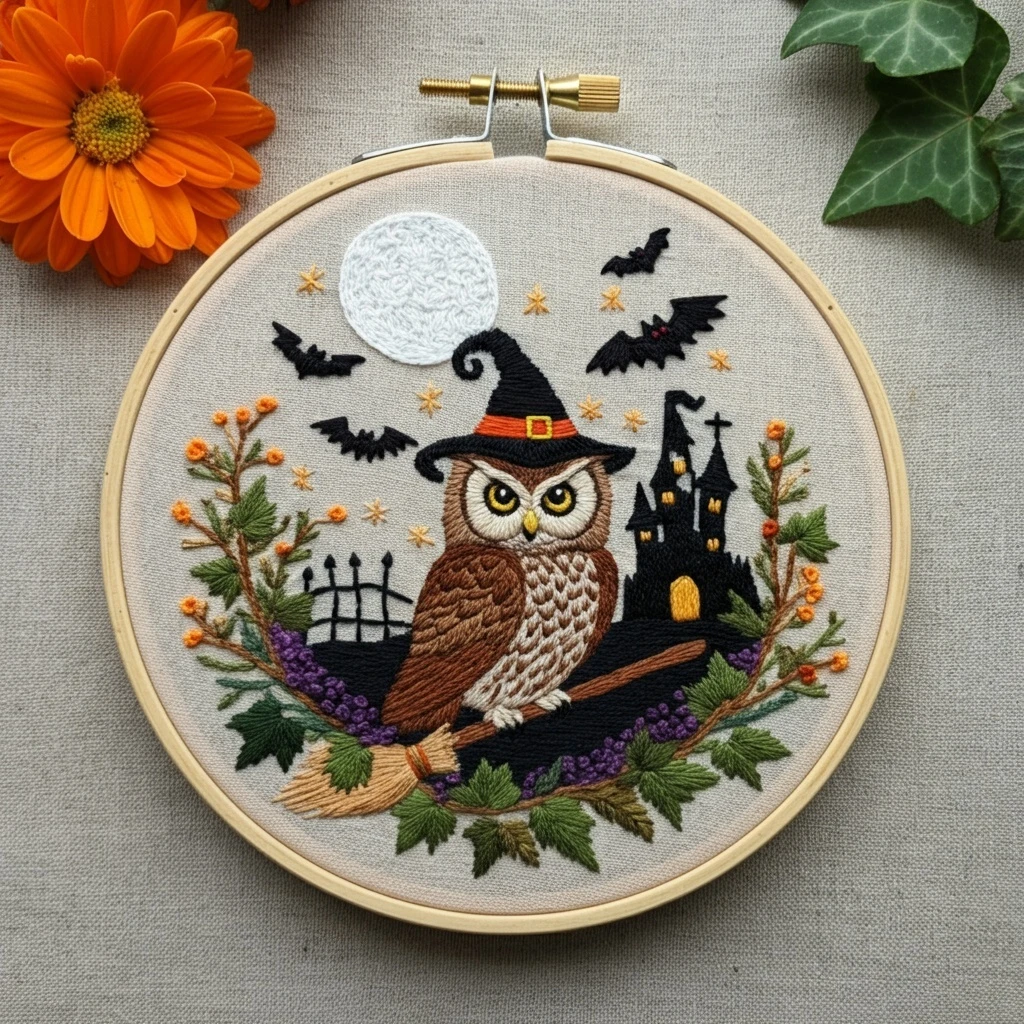
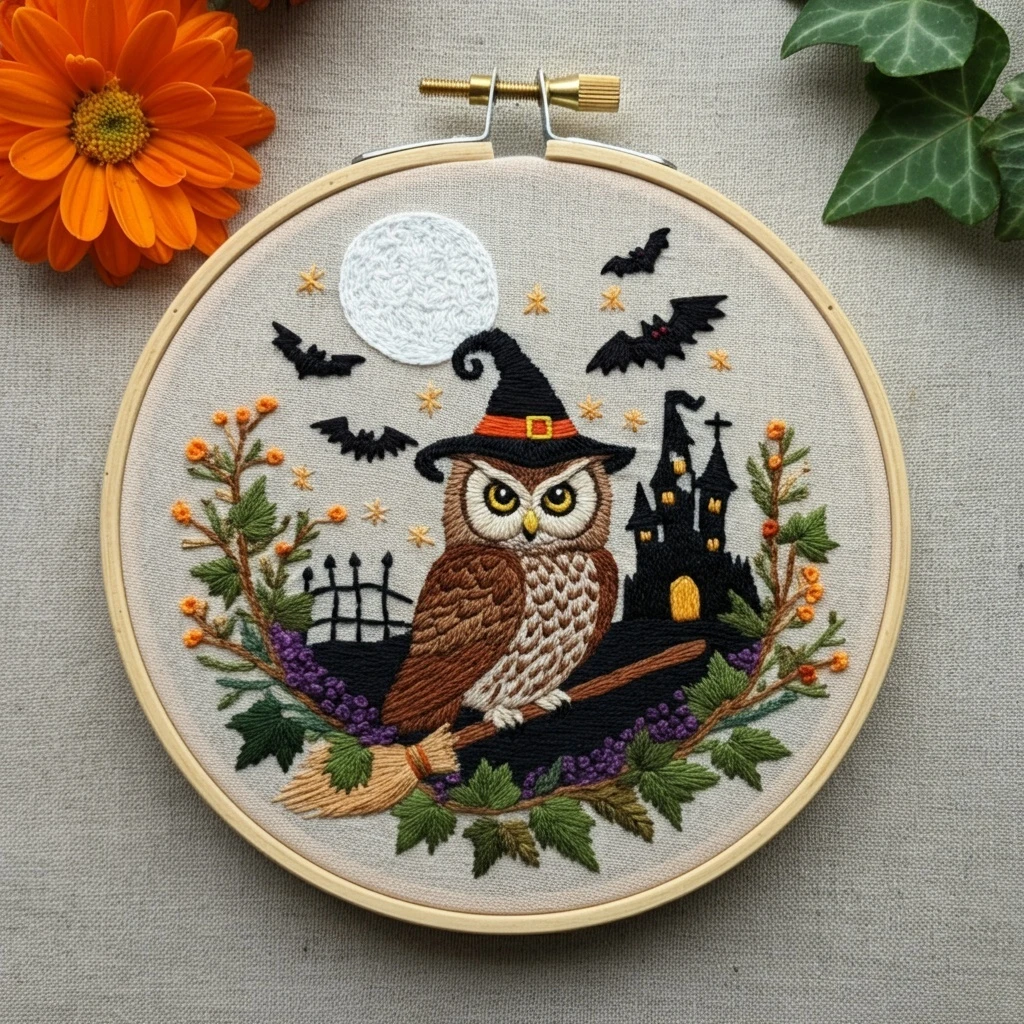
A dramatic night-hoop guide inspired by the reference image's moonlit sky, golden starbursts, dark flying silhouettes, warm woodland browns, evergreen sprigs, and bright orange accents. Use the palette below to keep the celestial details crisp while adding texture to the surrounding botanical and storybook elements.
Suggested DMC floss palette
The design reads as a high-contrast night scene: soft linen ground, white moon, black silhouettes, golden celestial sparks, rusty orange highlights, earthy browns, pine greens, and violet ground florals.
Primary silhouettes: bats, distant castle, fence lines, dark hill, and any sharp night-sky outlines.
Full moon, bright meteor cores, catchlights, and the cleanest high points on celestial details.
Moon shadowing and soft cloud-like stitches so the white areas do not look flat.
Starbursts, meteor glows, window lights, and the brightest golden sparkle centers.
Orange berries, warm comet tails, flower knots, and the vivid banding accents.
Tree stems, broom handle, warm bark shadows, and brown feather or ground details.
Deep owl or branch shading, underside shadows, and separation lines between warm brown sections.
Mid-tone feather texture, broom straw transitions, and lighter bark strokes.
Evergreen sprigs, ivy-like leaves, dark foliage bases, and grounded wreath shadows.
Leaf midtones and needle direction changes; blends well with dark pine for natural greenery.
Purple flower clusters, shadowed berry texture, and small cool accents against the warm oranges.
Subtle highlight alternative for moon, eyes, and tiny star points when pure white feels too stark.
Stitch types to use
- Long and short stitch: best for shaded feathers, the moon's soft surface, broom straw, and any gradient meteor tails.
- Satin stitch: fill bold silhouettes, the hat band, glowing windows, and smooth moon highlights.
- Stem stitch: use for curving branches, plant stems, broom handle, hill edges, and meteor direction lines.
- French knots or colonial knots: make stars, orange berries, purple flower clusters, and dotted sparkle trails.
- Backstitch: outline the castle, bats, fence, leaf veins, eyes, and tiny celestial shapes after filling.
- Fishbone stitch: use on leaves to create a clear center vein and raised botanical texture.
Thread-count guidance
- 1 strand: tiny stars, meteor tips, castle spires, fence bars, eye details, and delicate outlines.
- 2 strands: most backstitching, leaf veins, branch lines, feather strokes, moon texture, and small satin areas.
- 3 strands: black silhouette fills, large foliage patches, golden windows, orange berries, and bold purple clusters.
- 4 strands: use sparingly for raised knots, very dark ground areas, or thick foreground accents that need dimension.
Blending, shading & texture plan
Moon & sky
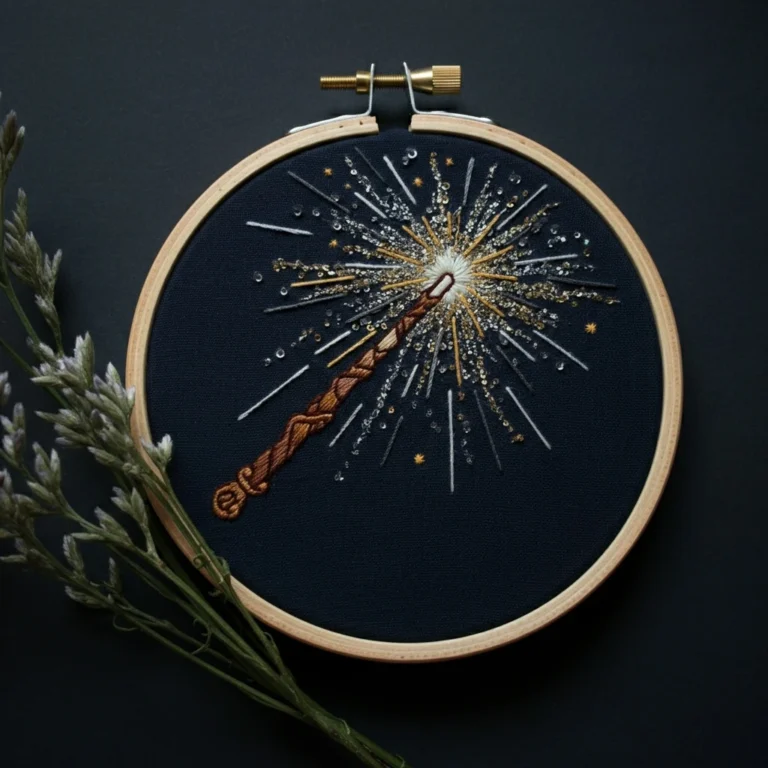
Fill the moon with Blanc and 3865, then add loose 762 long-and-short curls. Keep the edge clean with a 1-strand split stitch outline. For meteors, stitch a Blanc core and couch a fine 743 or 970 line beside it for glow.
Silhouettes
Work bats and castle shapes in 310 using tight satin or split stitch. Change stitch direction across wings so the edges look sharp but the bodies remain dimensional.
Botanical border
Layer 3362 under 730 for leaves and needles. Add 780/434 stems, then finish with orange and violet knots so the wreath feels lifted above the dark base.
Practical stitching sequence
Work from broad background shapes to delicate details so the small stars, meteors, and outlines stay crisp.
1. Anchor the composition
Start with the moon and the largest dark shapes. Use short split stitches around the moon edge, then fill with soft, circular long-and-short stitches. Complete large black silhouettes before adding gold stars so the sparkle placement stays balanced.
2. Add warm focal accents
Place 743 starbursts, 970 berries, and golden windows next. For starbursts, make a tiny cross first, then add diagonal straight stitches. Knot the center once only to avoid bulky stars.
3. Build foliage and lower texture
Stitch the branches in 780 with a 2-strand stem stitch. Add pine needles as small straight stitches in 3362 and 730. Vary stitch lengths so the border does not look mechanical.
4. Finish with outlines
Use 1 strand of 310 for fine castle points, bat wing notches, and fence bars. Add final Blanc/3865 highlights to the moon and meteor tips only after all darker stitching is complete.
Beginner-friendly tips
- Use a washable fine-tip transfer pen and mark only the main outlines; tiny stars can be placed by eye.
- Keep dark thread lengths short, about 12 inches, to prevent fuzzy black outlines.
- For neat stars, pierce the same center hole each time and avoid pulling too tightly.
- Stitch the smallest features with a sharp embroidery needle, not a large tapestry needle.
- Press from the back on a towel when finished so raised knots and satin shapes remain dimensional.
Optional upgrades
- Metallic sparkle: substitute DMC Light Effects E3852 for selected star centers or meteor tips.
- Soft glow: blend one strand Blanc with one strand 743 for pale golden light around windows and meteors.
- Extra dimension: pad the moon with a foundation layer of 3865 before the final white stitches.
- Sharper silhouettes: outline filled black shapes with one final 1-strand backstitch around the edges.