
-Embroidery-Hand-Embroidery-Pattern-PDF-sample.webp)
Vibrant Flame Tree Gulmohar
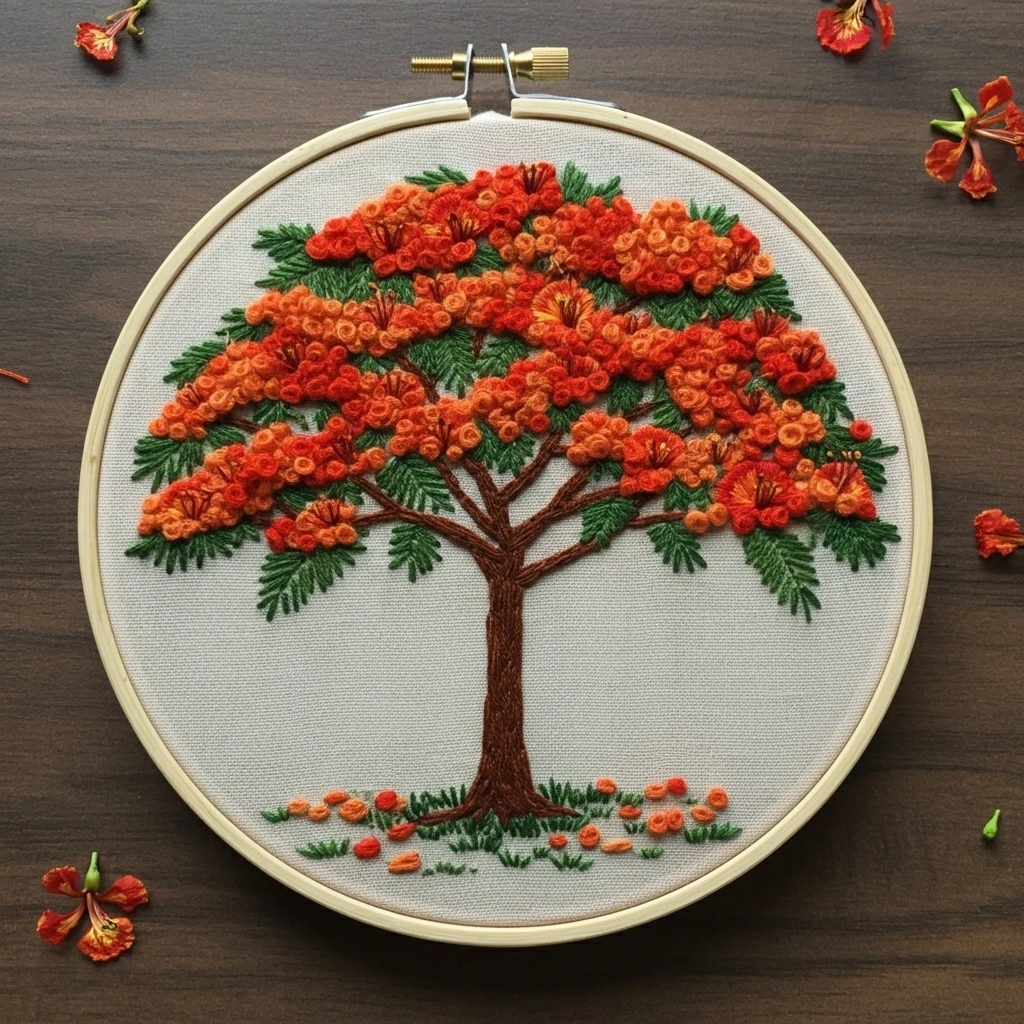
A polished DMC palette and stitching plan inspired by the reference hoop: a broad gulmohar canopy packed with fiery red-orange blossoms, fern-like green leaves, warm brown branching, and scattered flowers at the base.
Design Color Read
The composition is dominated by dense clusters of flame-red and orange gulmohar flowers across the top canopy. Deep evergreen leaflets peek through the blossoms, while a textured brown trunk and branching structure anchor the design. The pale linen background keeps the saturated flowers bright, so the embroidery benefits from strong contrast, raised knots, and directional trunk stitching.
Best Overall Approach
Likely DMC Color Palette
Coverage is a practical visual estimate from the preview, not an exact yardage calculation. Keep extra red, orange, and dark green on hand because the canopy is dense.
Stitching Suggestions
| Element | Stitch Type | Practical Notes |
|---|---|---|
| Tree trunk and roots | Long and short stitch, split stitch, stem stitch | Follow the vertical flow of the trunk with 2 strands. Blend DMC 801 with 975 for warm bark, then add single-strand 3371 grooves for depth. |
| Main branches | Stem stitch or whipped backstitch | Stitch branches before flowers so they tuck naturally under the canopy. Use 3371 sparingly on the underside of limbs. |
| Dense blossom canopy | French knots, colonial knots, detached chain, tiny satin stitches | Cluster knots in mixed reds and oranges. Vary wraps from 1 to 2 so the blossoms look rounded rather than flat. |
| Large open flowers | Lazy daisy, straight stitch, satin stitch | Use 666 or 946 for petals, add 918 near the center, and place a few 970 stitches for glowing stamens. |
| Fern-like leaf sprays | Fishbone stitch, straight stitch, fly stitch | Work individual leaflets outward from a central vein. Use 890 behind flower clusters and 702 only at the outer tips. |
| Ground grass and fallen blooms | Straight stitch, seed stitch, French knots | Keep the base light and scattered. Use green seed stitches for grass and small orange-red knots for fallen gulmohar petals. |
| Fine outlines and definition | One-strand backstitch | Outline only the most important edges: trunk silhouette, key branch forks, and a few flower throats. Too much outlining can flatten the airy canopy. |
Thread Count Guide
- 1 strand: bark grooves, leaf veins, fine branch tips, flower stamens.
- 2 strands: most petals, leafy sprays, trunk fill, and ground texture.
- 3 strands: occasional raised knots in the brightest canopy areas if the pattern is large enough.
- 6-strand full floss: avoid for small details; it may overwhelm the linen weave.
Blending Ideas
- Blend one strand DMC 666 with one strand DMC 946 for natural red-orange gulmohar transitions.
- Blend DMC 741 with 970 for bright sunlit flower knots.
- Blend DMC 801 with 975 for bark ridges; reserve 3371 for the deepest cuts.
- Alternate 890 and 699 in leaf clusters so foliage stays visible under the flowers.
Texture Tips
- Use slightly uneven knot spacing to mimic natural flower bunches.
- Let leaf stitches peek out from under orange clusters instead of filling every gap.
- Place a few detached-chain petals in front of knot clusters for variety.
- Keep roots flatter than the canopy so the top remains the focal point.
Suggested Stitching Order
Beginner-Friendly Practical Notes
- Do not try to make every flower identical; the gulmohar canopy looks better with irregular clusters.
- Use shorter thread lengths for the red and orange areas to reduce fuzzing from repeated knots.
- When French knots slip, hold the working thread firmly until the needle is almost through the fabric.
- Step back often: the design reads from color mass and contrast more than tiny individual details.
- Keep the underside tidy around dense knots so the fabric does not pucker.
Encouraging Finish
This flame tree will shine when the canopy feels abundant and textured: glowing red-orange knots, small golden highlights, dark green leaf shadows, and a sturdy brown trunk beneath. Work patiently in layers, keep the brightest oranges near the top and front, and let the scattered petals at the base echo the canopy without competing with it.