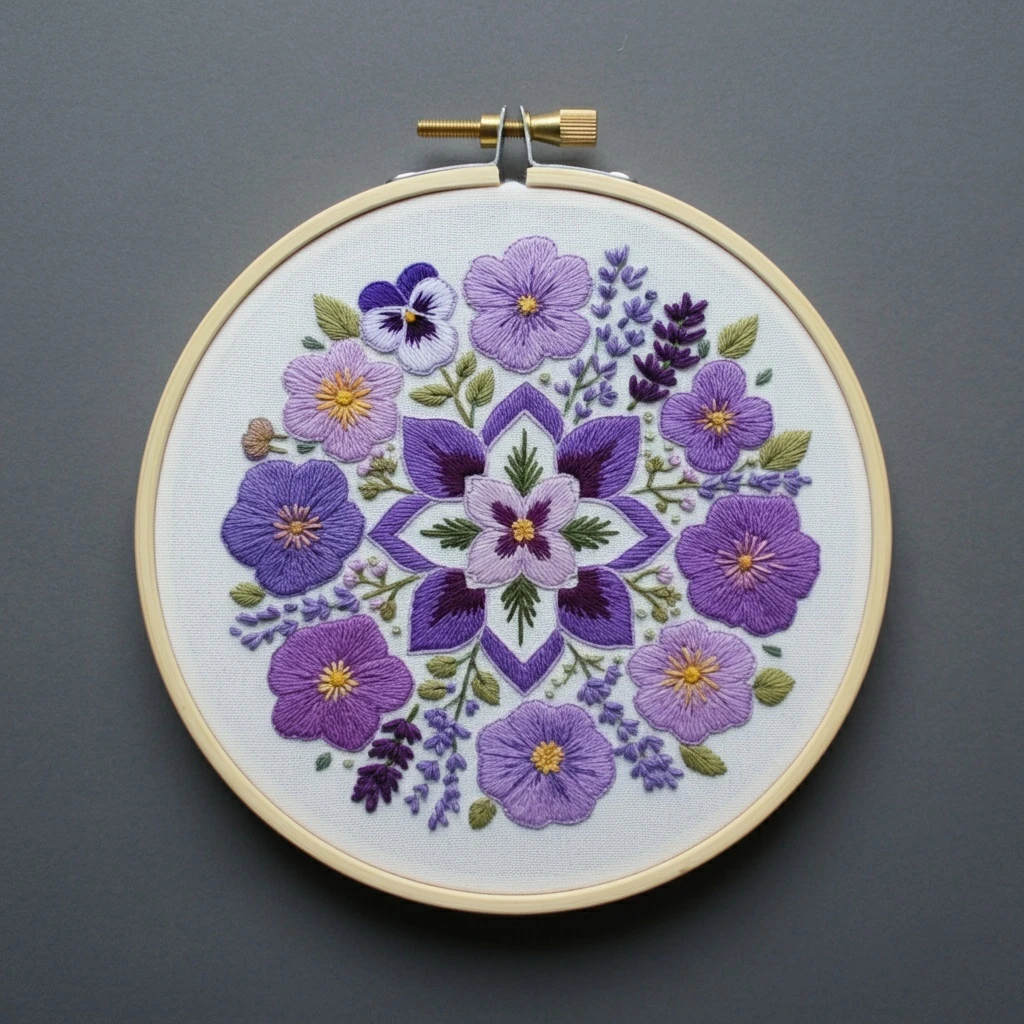

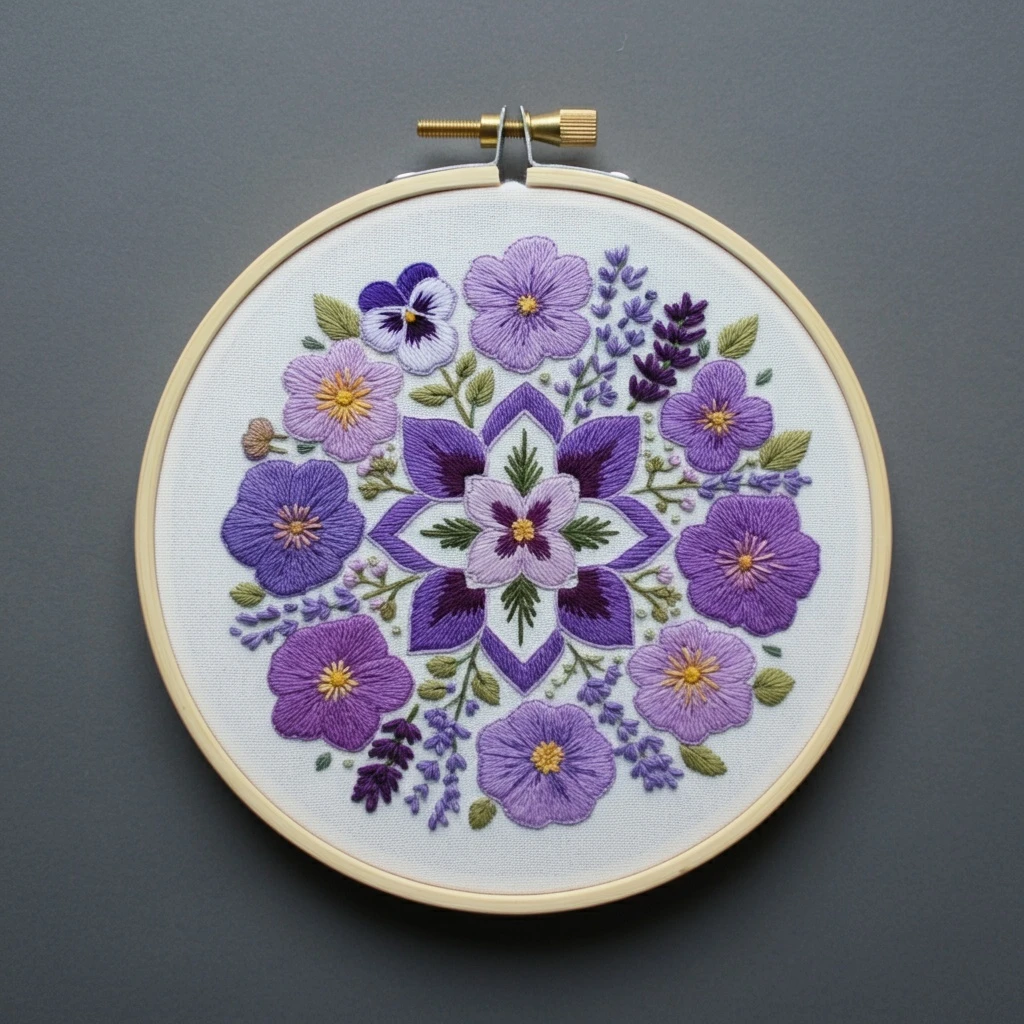
Purple Floral Mandala
A balanced floral mandala built from repeating purple petals, leafy motifs, soft mauve accents, and a decorative circular rhythm. The stitching should feel precise and soothing: clean symmetry, tonal purple shading, small center knots, and repeated stitch textures that make each ring look intentional.
Design color read
The mandala uses layered purples as its main structure, with deep plum for inner shadows, medium violet for petal bodies, lavender for highlights, mauve-pink for soft floral contrast, and muted greens for leaf shapes. Small golden or cream accents can brighten the center and keep the circular pattern from feeling too heavy.
Suggested DMC floss palette
This palette supports a polished purple mandala with enough tonal range for petals, outlines, centers, and botanical accents while keeping the overall look soft and cohesive.
Center shadows, deepest petal bases, and fine motif definition.
Main dark purple for petal outlines, inner arcs, and repeated ring details.
Primary petal fill and the strongest visible purple in the mandala.
Petal highlights, softer secondary motifs, and outer-ring lavender detail.
Lightest petal tips, small highlight stitches, and airy filler accents.
Warm mauve floral accents that soften the cooler violet bands.
Pale pink-mauve highlights, tiny buds, and delicate accent petals.
Pinpoint glints, negative-space outlines, and small bright center stitches.
Main leaf motifs and botanical separators between purple elements.
Leaf tips, pale greenery highlights, and softer outer wreath accents.
Leaf base shadows and darker botanical contrast where motifs overlap.
Golden French knots, center dots, and small warm accents in the mandala core.
Stitch map by design element
Central rosette
Use satin stitch or woven wheel stitches for small petals, with French knots in gold or cream at the exact center.
Large purple petals
Use long-and-short stitch or satin stitch from base to tip. Keep the direction identical on every repeated petal.
Mandala outlines
Use one-strand split stitch or backstitch in tonal violet. Smooth outlines help the circular design look crisp.
Leaf motifs
Use fishbone stitch, detached chain stitch, or lazy daisy stitches in muted green. Repeat the same leaf style around the circle.
Dot accents
Use French knots or colonial knots in lavender, gold, and cream. Keep knot wraps consistent for symmetry.
Outer ring texture
Use stem stitch arcs, seed stitch, or tiny straight stitches to make a delicate border without adding bulk.
Thread-count and blending guidance
| Area | Strands | Blending idea | Practical note |
|---|---|---|---|
| Main purple petals | 2 strands for smooth fill; 1 strand for highlight and vein lines | Use 550 or 333 at petal bases, 340 through the middle, and 341/211 near the tips. | Complete matching petals in pairs across the mandala to maintain balance. |
| Mauve accents | 1–2 strands | Pair 554 with 3689 for small floral details that feel warm but still purple-family. | Use mauve as an accent, not the dominant shade, so the design remains a purple mandala. |
| Leaves and separators | 1 strand for small leaves, 2 strands for larger motifs | Use 3362 at the base, 3012 for the body, and 3013 at the tip. | Keep green elements repeated and evenly spaced to support the circular rhythm. |
| Knots and dot details | 2 strands for standard knots; 1 strand for tiny dots | Use 3820 for warm center dots, 3865 for glints, and 211 for pale purple dots. | Count wraps consistently; mismatched knots can make a mandala look uneven. |
Recommended stitching order
- Transfer the mandala with clear center marks and light guidelines for each ring.
- Stitch the central rosette and main axis motifs first to lock in alignment.
- Work large purple petals in opposite pairs, then fill the remaining repeated petals.
- Add green leaves, mauve accents, and small separator motifs around the ring.
- Finish with knots, tiny highlights, and outer-ring texture after checking symmetry.
Beginner-friendly practical tips
- Use a ruler or printed transfer to keep the mandala truly round; freehand circles are difficult to correct later.
- Keep thread tension gentle so satin-filled petals do not pucker toward the center.
- Use shorter stitches near the center where petal shapes are narrower.
- Finish one full color family before switching if you want very consistent repetition.
- Press from the back on a towel to protect knots and raised center texture.
Texture, shading, and finishing notes
A floral mandala looks polished when it is both decorative and disciplined. Let the stitch texture repeat predictably, but use subtle color shading to prevent the design from feeling flat.
Petal dimension
Shade each petal from deep plum at the base to lavender at the tip. Add one narrow vein stitch down the center only if the motif is large enough; for smaller petals, a single satin highlight is cleaner.
Mandala balance
Use identical stitch counts where possible: the same number of chain links, knots, or seed stitches per repeated section. This small discipline makes the final hoop look intentionally designed and professionally finished.