Koala Forest

Koala Forest — DMC Palette & Stitching Guide
Koala Forest Embroidery Art
DMC palette & embroidery tips

Koala Forest

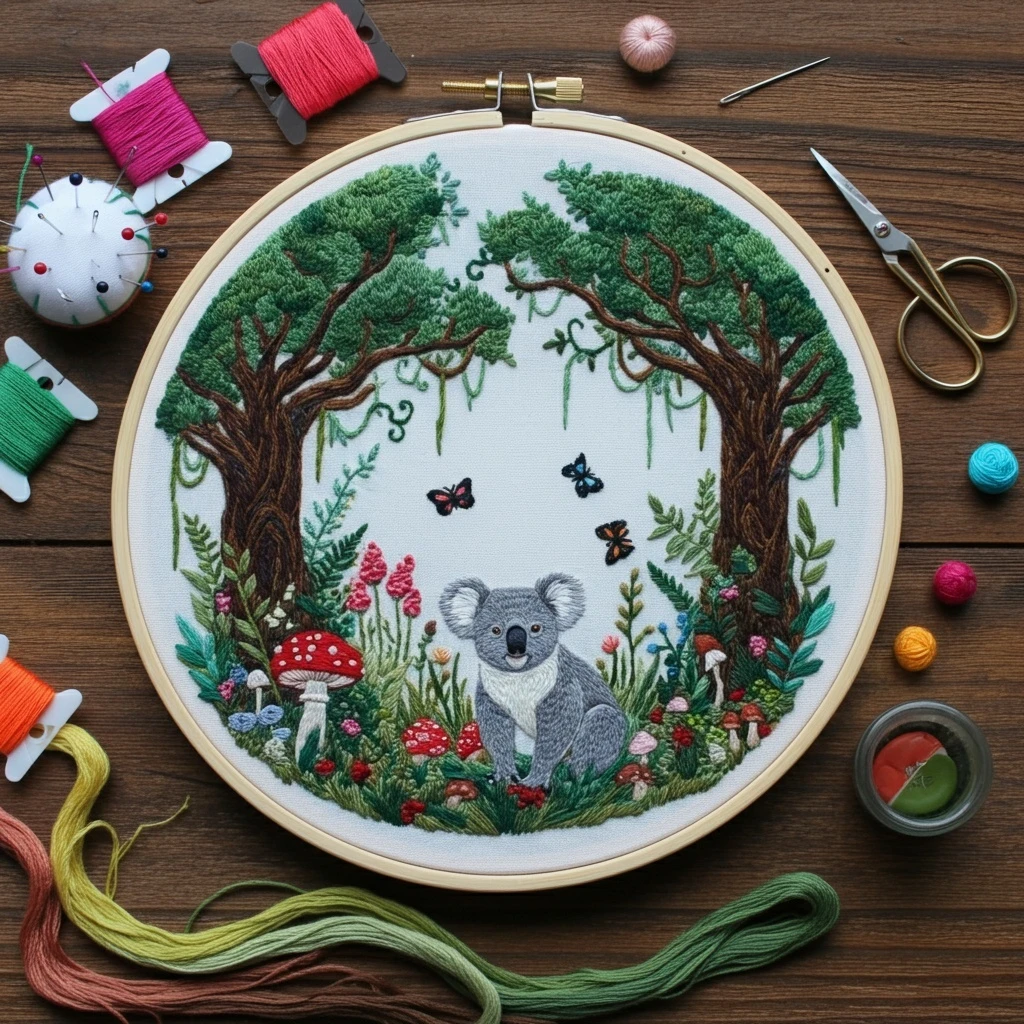
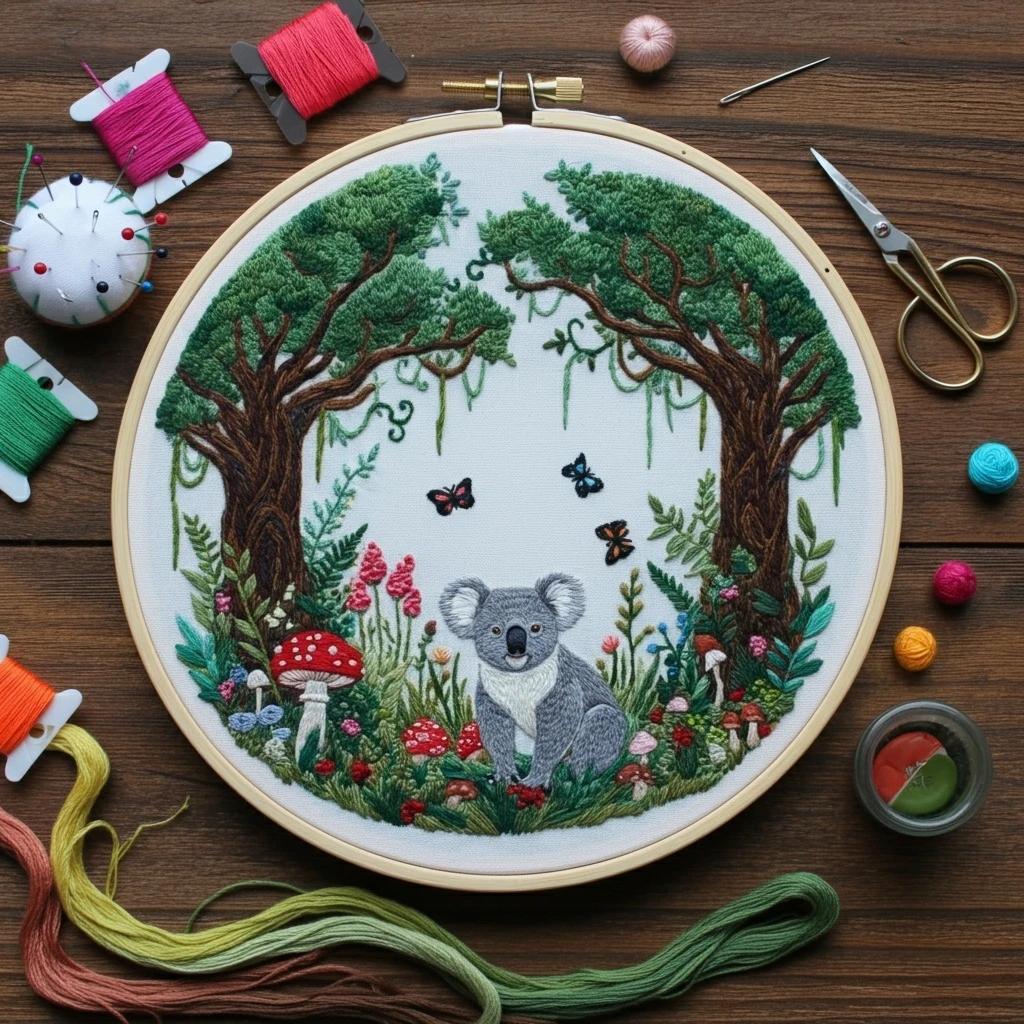
A woodland hoop with a soft gray koala framed by arching forest trees, mossy foliage, trailing vines, mushrooms, wildflowers, and tiny butterflies. The palette should feel lush and natural: layered eucalyptus greens, deep bark browns, gentle koala grays, red mushroom caps, berry pink flowers, and small cool blue accents.

Mood: woodland, gentle, storybook Best fabric: warm white cotton or natural linen Skill level: beginner to intermediate

Color read from the artwork

The design is driven by contrast between the soft koala and the richly textured forest frame. Keep the koala in cool blue-grays with a pale chest, then build the trees with several greens so the canopy does not become one flat mass. Browns should vary from golden bark highlights to dark creases, while the flowers, mushrooms, and butterflies bring small saturated dots of red, pink, blue, and orange.

DMC 318
Steel Gray Light
Main koala face and body fill; use as the soft middle gray for rounded forms.
DMC 414
Steel Gray Dark
Koala ear shadows, side contours, paws, and gentle body shaping.
DMC 317
Pewter Gray
Deep fur marks, nose base, eye rings, and darkest gray texture in ears.
DMC Blanc
White
Koala chest, ear fluff, eye sparkles, mushroom spots, and tiny flower highlights.
DMC 310
Black
Nose, pupils, butterfly bodies, and the smallest crisp facial accents.
DMC 895
Hunter Green Very Dark
Deep canopy pockets, fern shadows, lower grass clumps, and forest depth.
DMC 987
Forest Green Dark
Tree crowns, shrub masses, vine shadows, and leaf clusters behind flowers.
DMC 989
Forest Green
Main foliage, fern leaves, grassy mounds, and mid-tone eucalyptus sprigs.
DMC 3052
Green Gray Medium
Muted leaf highlights, koala-side foliage, and soft background greenery.
DMC 3013
Khaki Green Light
Fine grass tips, leaf highlights, hanging vine highlights, and airy texture.
DMC 801
Coffee Brown Dark
Tree trunk creases, branch outlines, root lines, and dark bark twist details.
DMC 433
Brown Medium
Main trunk fill, branch curves, bark ribbons, and mushroom stems in shadow.
DMC 435
Brown Very Light
Warm bark highlights, thin sunlit branch edges, and woody mushroom stems.
DMC 321
Red
Large mushroom caps, red berries, tiny flower centers, and foreground pops.
DMC 3685
Mauve Very Dark
Pink wildflowers, berry clusters, small blossoms, and butterfly wing touches.
DMC 827
Blue Very Light
Blue flowers, butterfly wings, cool highlights, and small airy accents.
DMC 3760
Wedgewood Medium
Darker blue petals, butterfly shading, and tiny contrast marks near the koala.
DMC 721
Orange Spice Medium
Orange butterfly wings, warm flower centers, and small autumn mushroom accents.
DMC 761
Salmon Light
Pale pink petals, tiny buds, cheek warmth if desired, and soft blossom highlights.
DMC 3865
Winter White
Mushroom stems, koala chest shading, pale flower petals, and subtle fabric-friendly highlights.
Palette balance: Use greens and browns as the dominant frame, keep koala grays calm and smooth, and save the reds, pinks, blues, and orange for tiny accents so the forest feels magical without overwhelming the central koala.

Stitch map by design element

Koala furUse long-and-short stitch or split stitch in 318 and 414, following the curve of the head, belly, and limbs. Add short 317 strokes only where the ears, paws, and body edges need depth.
Chest and ear fluffWork Blanc or 3865 with small irregular straight stitches. Let the stitches point outward from the center so the chest and ear tufts look soft and fuzzy instead of flat.
Face detailsUse one strand of 310 for the nose and pupils. Outline the smile and eye rings with one strand of 317 or 310, then add a tiny Blanc highlight to each eye if the scale allows.
Tree trunksUse stem stitch, split stitch, and whipped back stitch in 433, 435, and 801. Follow the twisting branch direction; alternate medium brown fills with dark creases to create bark ribbons.
Leafy canopyBuild the dense treetops with clusters of seed stitch, detached chain, and short straight stitches in 895, 987, 989, and 3052. Scatter lighter 3013 stitches on the outer edges for a lifted leafy texture.
Ferns and grassesUse fly stitch, fishbone stitch, and long straight stitches. Start with darker greens at the base, then add lighter tips in 3013 so the foreground plants stand forward.
VinesUse stem stitch or whipped back stitch for dangling vine lines. Add tiny detached chain leaves or single straight-stitch tendrils; keep these one strand so they do not compete with the tree trunks.
MushroomsFill red caps with satin stitch in 321, shade undersides with a touch of 801, and place Blanc French knots or tiny straight stitches for spots. Use 3865 and 435 for stems.
WildflowersUse French knots for berry-like pink clusters, lazy daisy for blue and pale pink petals, and small straight stitches for flower stems. Keep stems in 3052 or 989 so the blossoms stay delicate.
ButterfliesUse satin stitch for tiny wings in 827, 3760, or 721. Add a one-strand black body and antennae after the wings are complete for crisp definition.

Thread-count and blending guidance

Recommended strand counts

Use 2 strands for most koala fur, trunk fills, mushroom caps, and larger leaf clusters. Use 1 strand for facial details, vines, butterfly antennae, bark creases, and fine grass. Use 3 strands only for raised foreground knots or extra-plush canopy texture.

Koala gray blending

For a soft body fill, blend one strand 318 + one strand 414. For ear depth, blend one strand 414 + one strand 317. Keep Blanc and 3865 separated on the chest so the white fur remains visible against the gray.

Foliage depth

Layer the canopy from dark to light: 895 first in the deepest pockets, then 987 and 989 across the middle, finishing with scattered 3052 and 3013. Do not fill every gap; tiny spaces help the leaves breathe.

Outlining details

Use dark brown for tree contours and pewter gray for koala contours. Reserve black for the nose, eyes, and butterfly bodies only, so the forest keeps a natural stitched softness.

Suggested stitching order

Transfer the main structure first. Mark the hoop arch, tree trunks, koala outline, mushroom caps, main flower stems, and butterfly positions. Add tiny leaf clusters as you stitch rather than over-marking every small detail.
Stitch the koala base. Fill the body and head in pale and mid grays before adding face details. This keeps dark nose and eye threads from smudging into lighter fur areas.
Add white fur and gray shadows. Work the chest, ear fluff, and face highlights, then place short darker gray texture strokes around ears, paws, and the seated body edge.
Build the tree trunks. Stitch trunks and large branches next, following the curve of the bark. Add darker creases after the medium brown is in place to avoid a heavy outline-first look.
Layer foliage and vines. Work dark greens under the canopy, then add mid and light green stitches on top. Finish hanging vines after the canopy so they sit visibly in front.
Finish foreground details. Add ferns, grass, mushrooms, flowers, and butterflies. These small bright accents should be last so they remain clean and dimensional.
Complete facial expression last. Place eyes, nose shine, mouth, and tiny highlights after the surrounding stitching is complete. A crisp face makes the whole design feel polished.

Texture and beginner-friendly tips

Keep the canopy organic

Avoid perfect rows of leaves. Mix seed stitches, detached chains, and short straight stitches in uneven clusters, changing green shades every few stitches for a natural treetop effect.

Make bark look twisted

Stitch bark lines in the same direction as the branches curve. A few long sweeping stem stitches in 801 over 433 instantly create the knotted, old-tree feeling seen in the artwork.

Control small flowers

For tiny blossoms, use one-wrap French knots or three short straight stitches. Large knots can crowd the foreground, especially near the koala and mushrooms.
Practical hoop note: Dense greenery can pucker fabric if tension is too tight. Keep the hoop drum-tight, use shorter thread lengths, and release the hoop when you pause so the round forest frame stays smooth.

Leave a Reply

Your email address will not be published. Required fields are marked *