
DMC floss palette & hand embroidery notes
Willow Tree
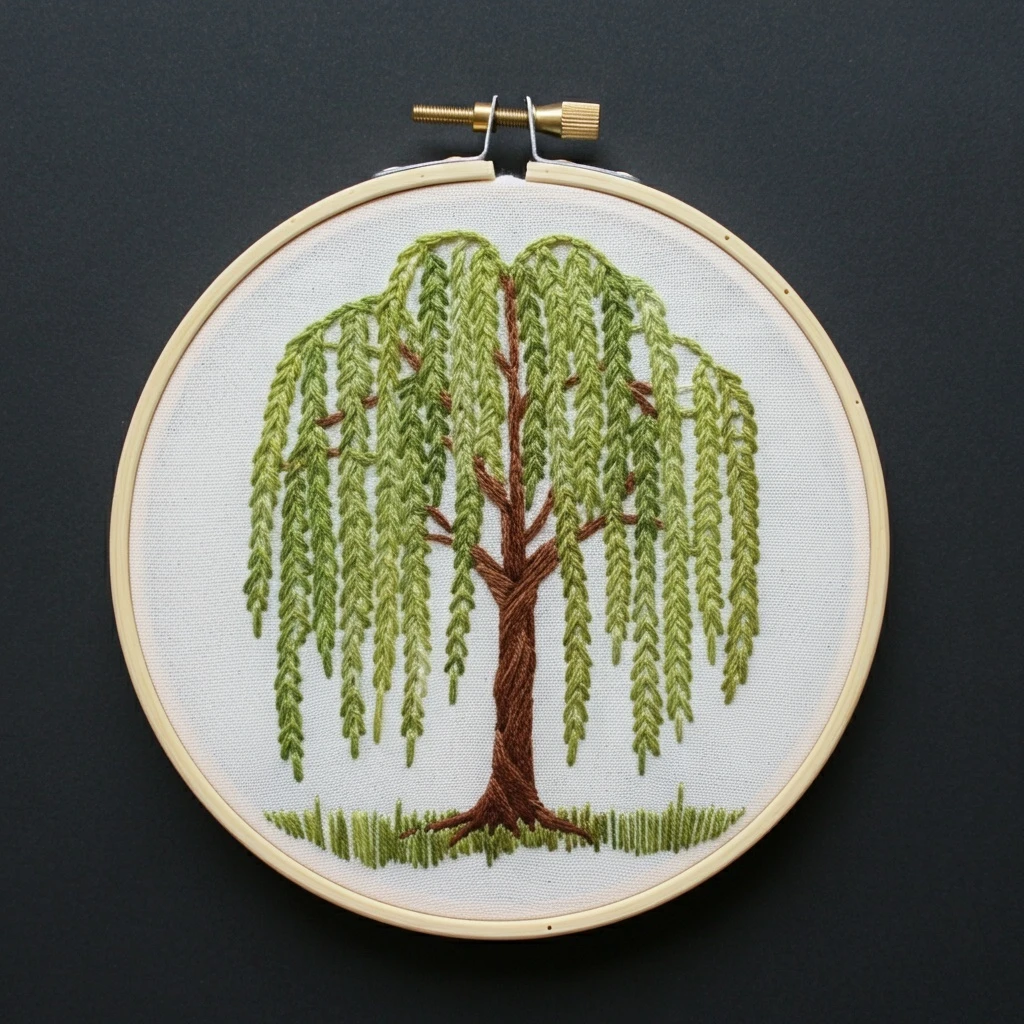
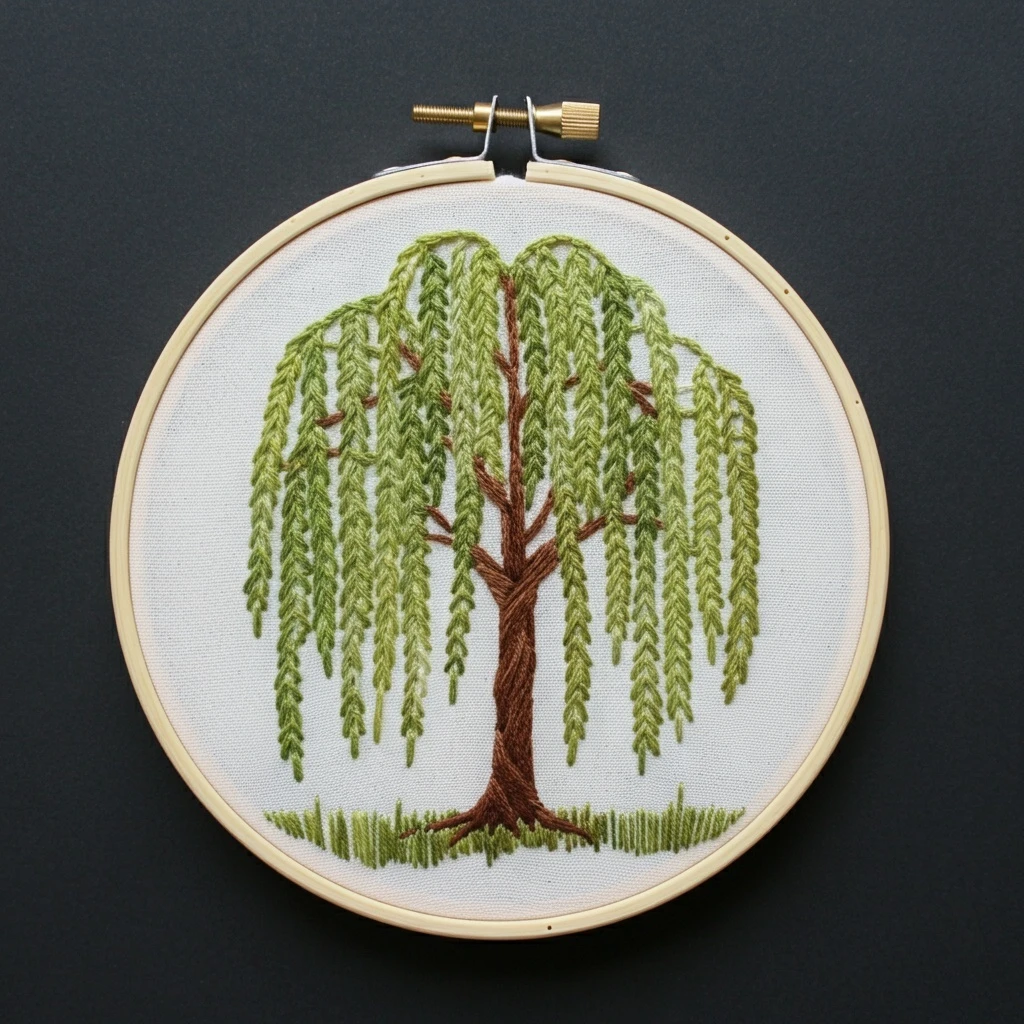
A graceful willow design calls for long, flowing green strands, soft bark shading, and a calm natural palette. The aim is movement: slender drooping branches, layered leaf clusters, and a trunk that feels grounded without becoming heavy.
Design Color Read
The design is built around a restrained woodland palette: pale sage highlights at the tips of the willow leaves, medium olive for most foliage, deeper moss in the inner branch shadows, and warm brown-grey tones for the trunk and branch structure. Keep the value changes gentle so the finished tree feels soft and wind-swept rather than graphic.
Leaves
Use short detached stitches and lazy daisies in mixed greens. Place the lightest green at the outer hanging tips and reserve darker greens for overlaps near the trunk.
Branches
Long split stitch or stem stitch lines should curve downward. Vary strand count so some hanging limbs almost disappear into the foliage.
Trunk
Layer warm browns with directional stitches. A few darker broken lines create bark texture without overpowering the delicate canopy.
Suggested DMC Palette
These colors are chosen to translate the willow’s pale, silvery greens and earthy trunk into embroidery floss. Use them as a practical palette rather than a strict rule: the most important part is keeping the foliage layered and light.
Stitch Plan
| Area | Best stitches | Thread guidance | Practical notes |
|---|---|---|---|
| Drooping fronds | Stem stitch, split stitch, couching for long lines | 1 strand for fine tips; 2 strands for main hanging limbs | Let each frond curve naturally. Avoid perfectly parallel lines so the willow looks organic. |
| Leaf clusters | Detached chain, lazy daisy, fly stitch, tiny straight stitch | 2 strands for visible leaves; 1 strand for distant delicate tips | Alternate DMC 165, 3013, and 3012 along the same branch for lively color variation. |
| Inner shadows | Short straight stitch, seed stitch, small fly stitch | 1 strand of 3052 or 3051 | Add shadows only where fronds overlap. Leave breathing room so the canopy stays airy. |
| Trunk | Long and short stitch, split stitch, stem stitch | 2 strands for fill; 1 strand for bark lines | Work stitches vertically and slightly curved. Blend 840 with 841, then add narrow 839 grooves. |
| Outlining | Back stitch, whipped back stitch, fine split stitch | 1 strand for refined edges; 2 strands only on the trunk base | Outline selectively. The foliage should be suggested by texture, not boxed in by heavy lines. |
Shading, Blending & Texture
Foliage blending
- For a soft willow-green blend, stitch one strand of DMC 3013 with one strand of DMC 3012 in the same needle.
- Use DMC 165 alone at the very outer tips to create the impression of light catching the hanging leaves.
- Place DMC 3051 and 730 in tiny touches only; too much dark green can make the willow look heavy.
Bark texture
- Fill the trunk with broken vertical long-and-short stitches in DMC 840 and 841.
- Add irregular 1-strand split-stitch grooves in DMC 839, especially near bends and the base.
- Work a few pale DMC 822 stitches on the lit edge for a dry, weathered bark effect.
Texture tip: stitch the trunk first, then lay the hanging branches over it. This creates natural depth, as if the fronds are falling in front of the wood.
Beginner-Friendly Workflow
Hoop, Fabric & Strand Suggestions
Fabric
Natural linen, cotton-linen, or tightly woven quilting cotton in ivory, oatmeal, or pale warm beige will flatter the muted willow palette.
Needle
Use a size 7-9 embroidery needle. Switch to a finer needle when working 1-strand frond tips to avoid visible holes.
Strands
Keep most foliage at 1-2 strands. Use 3 strands only for the base of the trunk or a bolder decorative interpretation.
Final Polishing Notes
- Leave small spaces between leaf stitches so the tree reads as delicate and wind-moved.
- Vary stitch length: shorter near twig tips, longer near the crown and trunk.
- Keep outlines fine; a willow’s beauty comes from soft cascading texture.
- Before tying off, rotate the hoop and view the tree from multiple angles to catch uneven branch density.