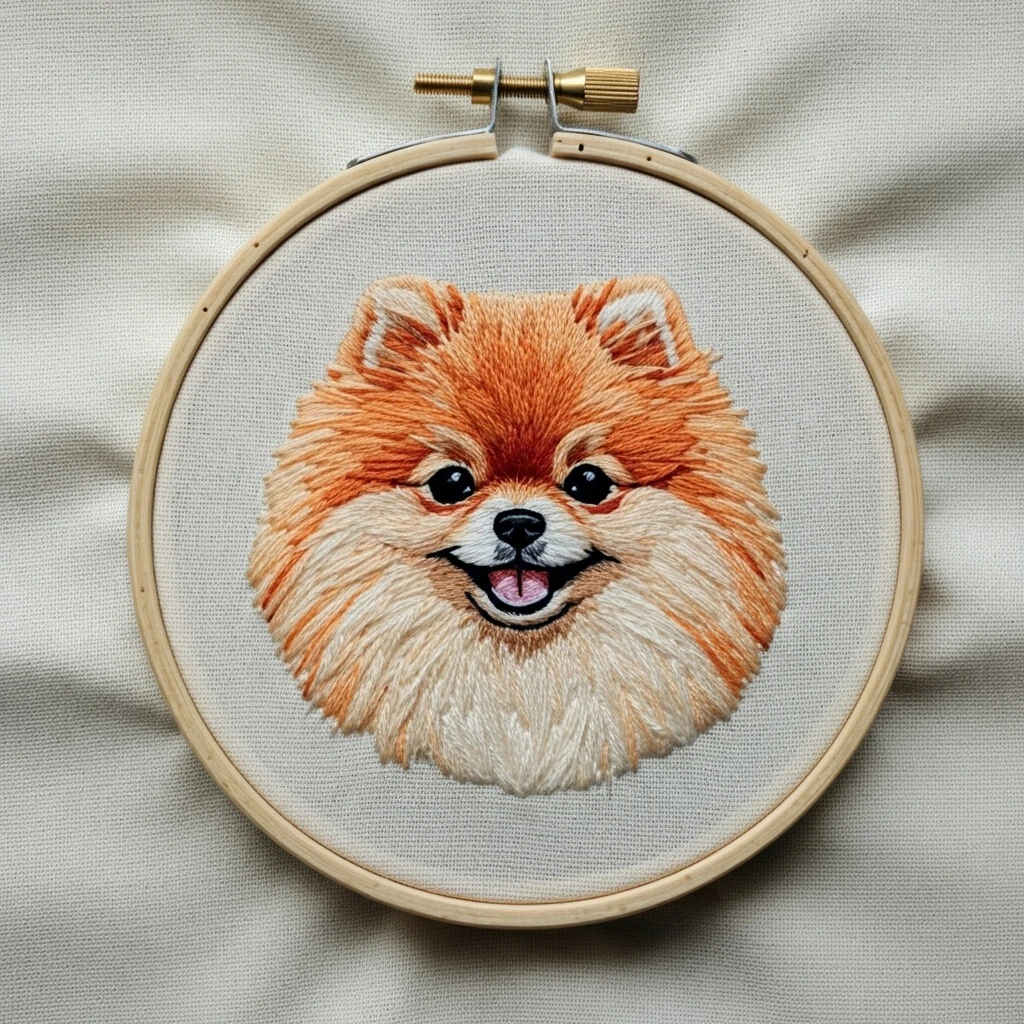

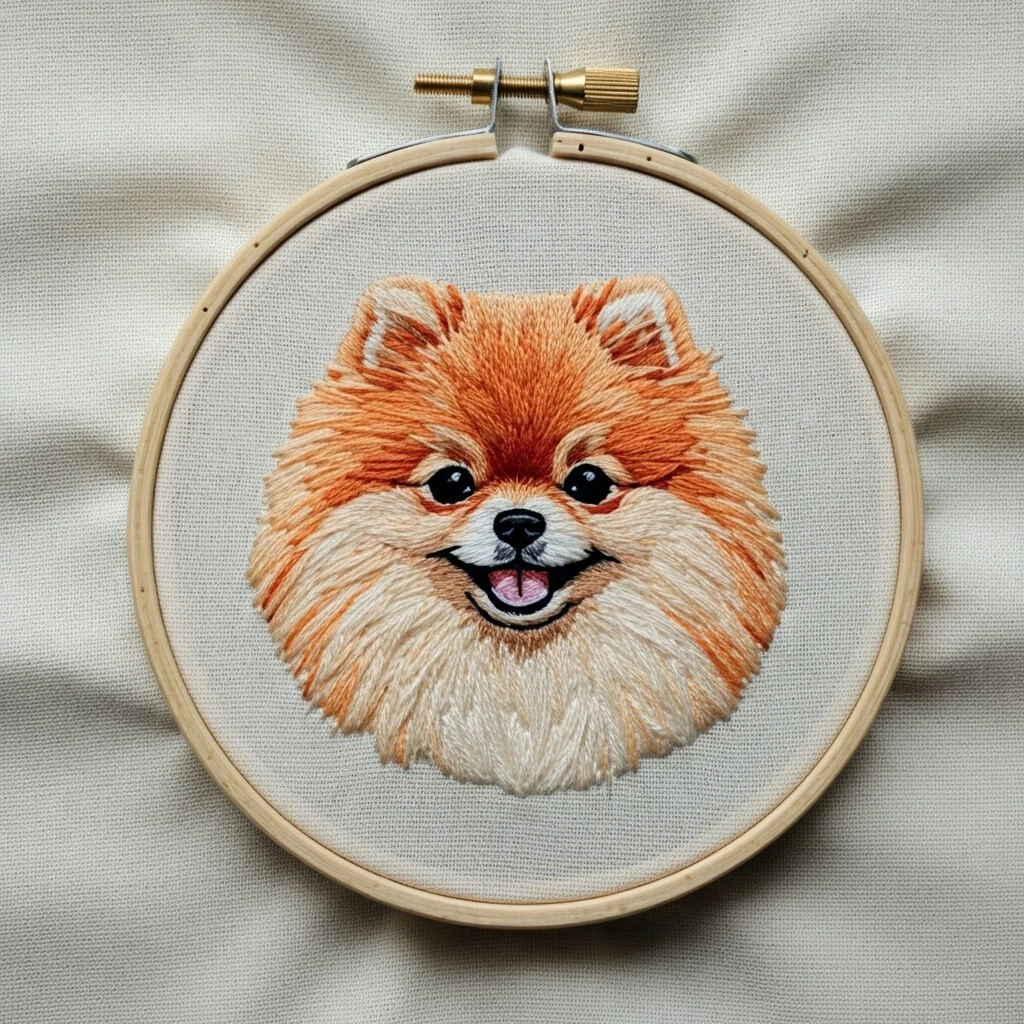
Fluffy Pomeranian Portrait
A warm, plush embroidery guide for a smiling Pomeranian face with layered apricot fur, darker ear shadows, bright muzzle highlights, glossy eyes, and tiny floral accents.
Design read
The artwork is all about volume: a round fox-like face, haloed ruff, soft ears, creamy muzzle, dark button features, and small botanical accents that frame the portrait without stealing attention.
Suggested DMC floss palette
These DMC matches are selected for a peachy orange Pomeranian with creamy highlights and warm brown shadows. Shift one value lighter on tan linen or one value darker on bright white fabric.
Use for the muzzle, cheek highlights, and the softest strands around the forehead and chest ruff.
A gentle base for the face and outer ruff; excellent for long-and-short stitching in 2 strands.
Layer through the cheeks, crown, and ruff to create the Pomeranian’s warm orange coat.
Use in the lower ruff, ear bases, and under the chin for rounded shadows.
Add short strokes inside ears and around the side tufts, especially where fur turns away from light.
Use sparingly in the deepest ruff cuts, ear folds, and tiny separations between fur clumps.
Best for glossy eyes, nose, and mouth line. Keep it minimal so the portrait stays soft.
Add tiny eye catchlights and a few final whisker-like stitches on the muzzle and chest.
Use for small floral accents, cheeks, or a subtle bow-like bloom near the portrait edge.
Shade the lower side of petals or blend with 3716 for fuller blossoms.
Work French knots or seed stitches in flower centers and occasional golden fur glints.
Use simple detached leaves around floral accents; keep greenery muted so the dog remains central.
Strand plan
- Fur fill: 2 strands for the first pass, then 1 strand for top texture.
- Eyes, nose, mouth, and whisker dots: 1 strand or tiny knots only.
- Flowers and leaves: 2 strands for satin fill; 1 strand for inner veins.
Shape the ruff
- Stitch outward from the face into the ruff like sun rays.
- Use curved strokes on cheeks and vertical strokes on the forehead tuft.
- Break the outer edge with uneven stitches instead of a hard outline.
Warm coat mixes
- Blend 754 + 738 for the muzzle and upper cheeks.
- Blend 738 + 3824 across the face and crown.
- Blend 3824 + 977, with tiny 433 accents, in the lower ruff and ears.
Stitch suggestions by design area
| Area | Best stitches | Practical notes |
|---|---|---|
| Outer ruff | Long-and-short stitch, split stitch guide, loose straight stitches | Begin with a split-stitch outline in a light fur color, then fill in outward strokes. Leave a jagged edge to mimic fluffy guard hairs. |
| Face and forehead | Long-and-short stitch, stem stitch curves | Follow the natural direction from the forehead down to the nose. Use lighter stitches on top of darker base layers for soft volume. |
| Muzzle | Satin stitch, short straight stitches, seed stitch | Keep the muzzle rounded with 754 and 746. Add a few tiny seed stitches, not heavy dots, to suggest whisker texture. |
| Ears | Fishbone stitch, long-and-short, back stitch accents | Use 922 and 433 near folds, then soften the outer rim with 3824 or 738 so the ears blend into the ruff. |
| Eyes | French knots, padded satin stitch, tiny straight highlight | Use 3371 for the eye body and a pinprick of 746 for catchlight. Symmetry matters more than size. |
| Nose and mouth | Padded satin stitch, back stitch, couching | Pad the nose lightly before satin stitching for a rounded shine. Use one strand for the mouth curve to avoid a cartoon-heavy line. |
| Flowers and leaves | Lazy daisy, satin stitch, French knots, fishbone leaves | Use flowers as quiet framing elements. Keep petals simple and let the fur remain the most detailed stitched area. |
Beginner-friendly stitching order
Lightly draw a few guide arrows inside the ruff, cheeks, and forehead so the stitches flow naturally.
Use 738 and 3824 to establish the face and ruff before placing dark shadows or cream highlights.
Stitch eyes and nose after the surrounding fur so you can position them cleanly on top.
Use 746, 754, 977, and 433 as final hair strokes to sharpen highlights and deepen fluffy pockets.
Make the portrait plush
- Use a 7–8 inch hoop for comfortable stitch direction changes around the face.
- A size 7 embroidery needle works well for two strands; switch to size 9 for one-strand details.
- Avoid a full black outline around the dog. Use fur-colored broken stitches for a softer edge.
- Trim floss lengths to about 14–16 inches to prevent fuzzy thread from wearing thin.
- Press from the back over a thick towel so the nose, eyes, and raised fur keep their dimension.
Optional embellishment ideas
For a sweet hoop-art finish, add a tiny floral cluster near one side of the ruff, a few muted green leaves, or a blush accent in 3716 worked with just one strand. Keep embellishments sparse and low contrast so the Pomeranian’s expressive face stays the focal point.
Recommended palette size: 10–12 floss colors · Suggested skill level: confident beginner to intermediate · Best fabric: natural linen, cotton, or cotton-linen blend