

DMC palette & hand embroidery notes
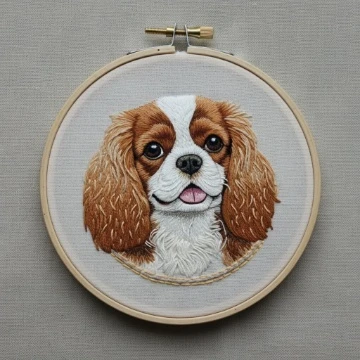
Realistic Cavalier King Charles Spaniel
A warm, portrait-style guide for stitching a sweet Cavalier face with glossy eyes, copper-brown ears, creamy white muzzle, soft feathered fur, and gentle dimensional shading inside a hoop-friendly composition.
Suggested DMC Color Palette
Use the browns in layered strands for the spaniel's chestnut ears and face patches, then reserve the palest neutrals for the white blaze, cheeks, and chest so the portrait keeps its soft realistic contrast.
DMC 3371 Black Brown
Deepest eye rims, nostril shadow, tiny mouth creases, and the darkest separations under folded ears. Use sparingly with one strand.
DMC 310 Black
Pupils, nose core, and the sharpest pin-point shadows. Add only after the surrounding browns are placed so it does not overpower the face.
DMC 938 Ultra Dark Coffee Brown
Dark chestnut folds at the ear bases, under the cheek curls, and the lower edge of the brown facial patches.
DMC 801 Dark Coffee Brown
Main deep brown for the ears and sides of the face. Work in broken directional stitches to suggest long silky spaniel hair.
DMC 780 Topaz Ultra Very Dark
Warm mid-tone in the ears, brow spots, and outer muzzle shading. Ideal for filling between dark coffee and copper highlights.
DMC 434 Light Brown
Copper highlight strokes on the ear tips, cheek edges, and raised fur around the forehead. Blend with 801 for realistic transitions.
DMC 435 Very Light Brown
Soft golden glints on individual ear strands and warm reflected light around the cheeks.
DMC 739 Ultra Very Light Tan
Creamy base for the muzzle, chest, and face blaze where the white is warm rather than stark.
DMC 842 Very Light Beige Brown
Subtle shadow in the white fur, especially under the muzzle, along cheek curves, and between chest tufts.
DMC 3864 Light Mocha Beige
Cooler beige-grey shadow for the neck, lower chin, and recessed fur grooves in the white areas.
DMC 3865 Winter White
Bright highlights on the blaze, muzzle bridge, eye sparkle touches, and the top edges of fluffy chest fur.
DMC 318 Light Steel Grey
Nose shine, cool eye reflections, and a few tiny grey accents where white fur turns away from the light.
DMC 407 Desert Sand Dark
Muted pink-brown for the tongue shadow and warm mouth details.
DMC 761 Salmon Light
Tongue highlight and the softest inside-mouth accent; blend with 407 for a natural rosy tone.
Stitching Strategy by Area
Build the portrait from broad soft masses to fine hair strokes. The most realistic effect comes from changing stitch length and direction often rather than filling every area with one uniform texture.
Chestnut ears
Use long-and-short stitch with 1 strand for the final layer. Follow the drooping ear shape downward, curving outward at the tips. Scatter 435 and 434 over 801/780 to create silky separated strands.
White blaze and muzzle
Use short directional split stitch or long-and-short stitch in 3865, 739, 842, and 3864. Keep stitches feathered and uneven so the white fur looks fluffy, not flat.
Eyes
Satin stitch or tiny padded satin works well for the glossy dark ovals. Outline with 3371, fill with 310/3371, then add pinpoint 3865 and 318 highlights last.
Nose
Pad lightly with split stitches, then cover with satin stitches radiating around the nostrils. Use 310 for depth, 3371 for softer black-brown edges, and 318 for the wet shine.
Tongue and mouth
Use 1 strand of 407 for the shadowed lower curve and 761 for the small raised center. A fine 3371 split-stitch line defines the mouth without making it cartoonish.
Chest fluff
Work loose overlapping fly stitches, feather stitch, or short straight stitches in 739 and 3865, adding 842/3864 only in recessed V-shaped grooves.
Thread Count, Blending & Shading
For this realistic dog portrait, fewer strands usually look more refined. Use strand painting for fur and reserve heavier thread only for small padded facial features.
| Area | Recommended strands | Blend or transition | Practical note |
|---|---|---|---|
| Ear base shadows | 1 strand | 938 + 801, then glaze with 780 | Place darkest stitches first in the deepest folds, leaving narrow gaps for mid-tones. |
| Golden ear highlights | 1 strand | 434 + 435 over 780 | Use uneven, tapered straight stitches; avoid parallel rows. |
| White muzzle | 1 strand, occasionally 2 for base | 3865 + 739, shaded with 842 | Let the fabric show faintly between strokes for a soft fur effect. |
| Chest texture | 1-2 strands | 739 + 3865, tiny 3864 shadows | Layer short V and Y shapes to suggest fluffy overlapping tufts. |
| Eyes and nose | 1 strand for outline, 2 strands for padded fill | 310 + 3371 with 318/3865 highlights | Keep highlights crisp; one misplaced bright stitch can change the expression. |
| Tongue | 1 strand | 407 shaded under 761 | Use a few tiny satin stitches rather than heavy filling. |
Texture & Outlining Details
Soft realism depends on edges that are defined in key places and deliberately broken in furry places.
Fur direction
Mark a few pencil arrows before stitching: ears fall down, cheek fur curves around the muzzle, forehead hair radiates from the center blaze, and chest fur points downward.
Broken outline
Use split stitch in 938 or 3371 only for the eye rims, nose, mouth, and deepest ear edge. For outer fur edges, use small floating straight stitches instead of a continuous line.
Dimensional muzzle
Keep the top of the muzzle brighter with 3865 and 739. Add 842 beneath the cheeks and 3864 under the chin to push those areas backward.
Beginner-Friendly Practical Tips
Work slowly in small zones and compare value, not just color. The portrait will read as realistic when the darkest darks and brightest highlights are placed confidently.
Finishing Notes
For a hoop presentation, use warm off-white linen or cotton and keep the background unstitched so the spaniel portrait remains the focal point.
Fabric choice
Medium-weight linen, cotton-linen, or tightly woven muslin supports detailed thread painting. Avoid very loose weave because one-strand fur strokes can sink unevenly.
Hoop handling
Keep the fabric drum-tight while stitching facial details. If the hoop marks the fabric, gently steam from the back after finishing.
Final check
Add the last 3865 highlights to the eyes, nose, and top muzzle only after all browns and creams are complete. These tiny touches create the polished 3D look.