
DMC palette & embroidery notes
Dachshund
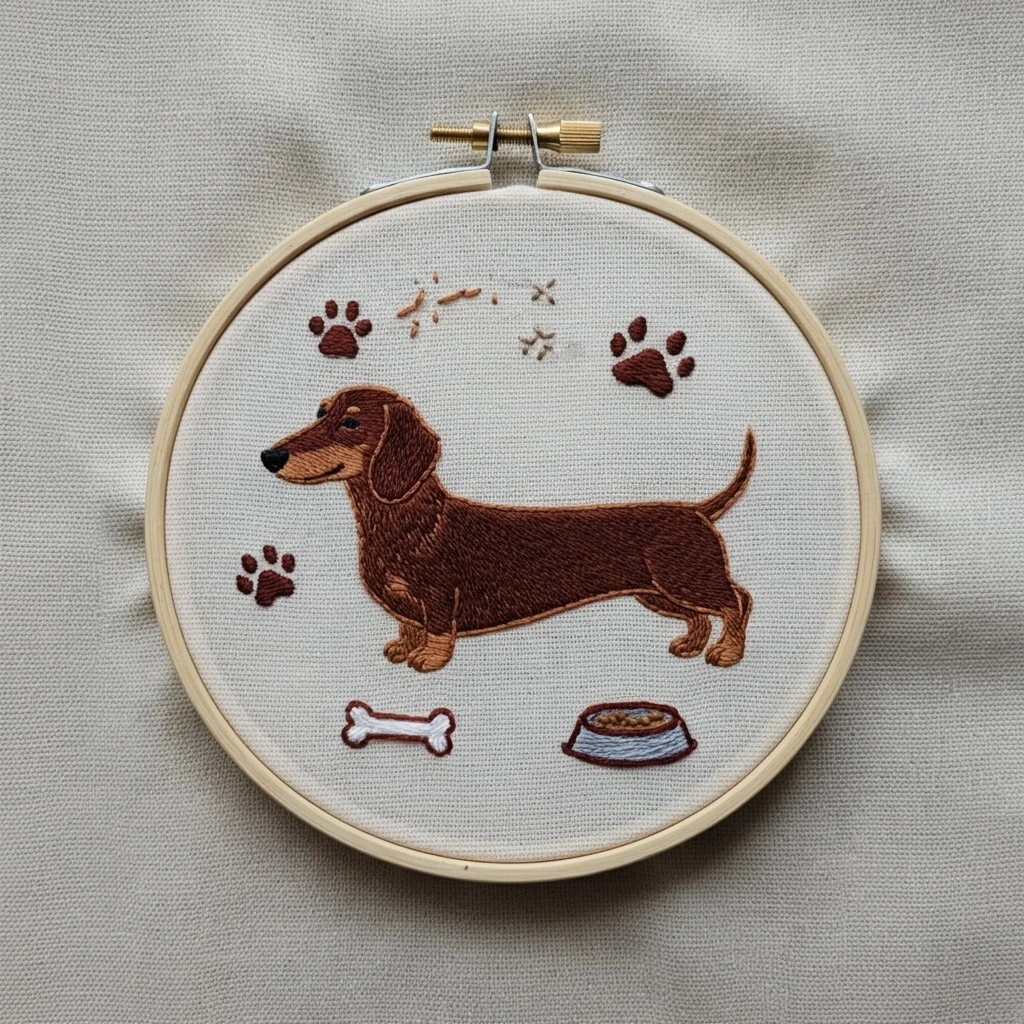
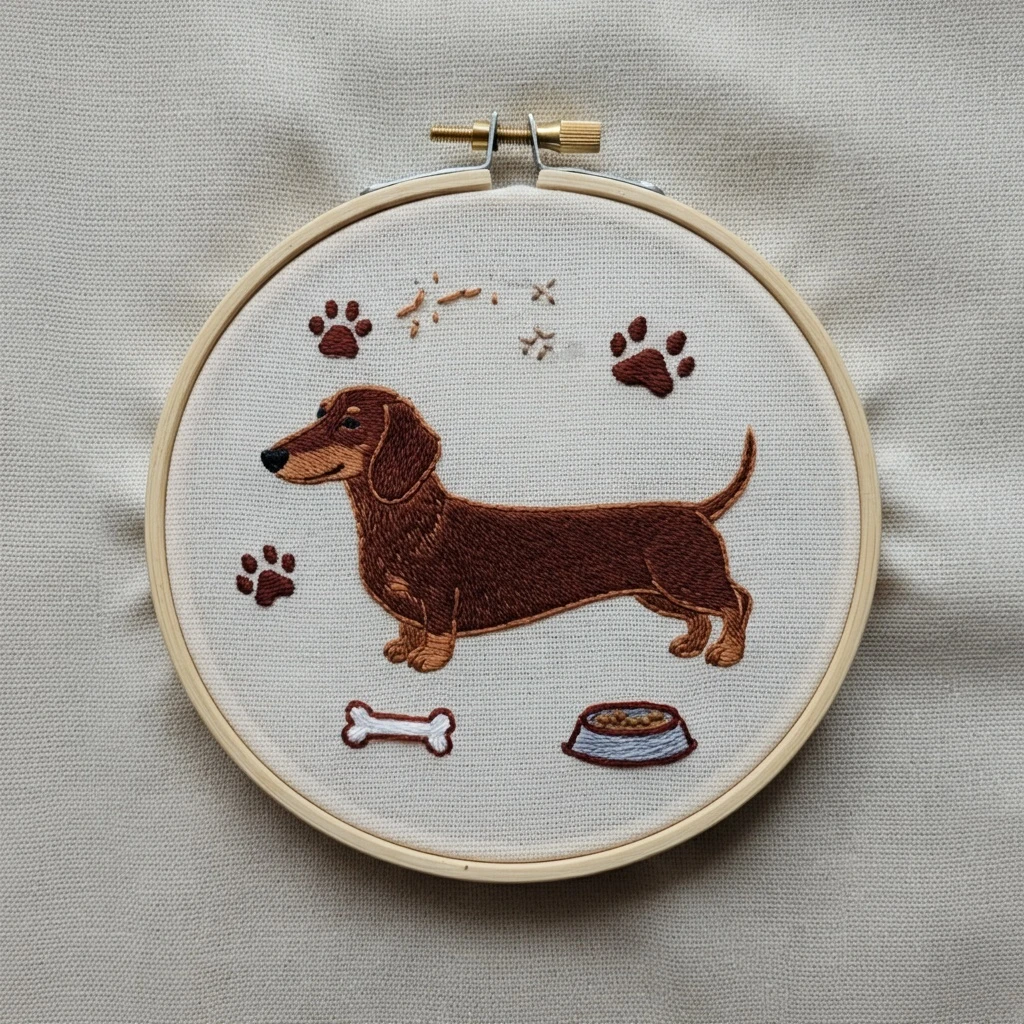
A warm hoop-art design with a chocolate dachshund, caramel muzzle and paws, burgundy paw prints, a tiny bone, food bowl, and playful sparkle details on natural linen. The palette below keeps the dog rich and dimensional while staying approachable for beginners.
Color read: deep chestnut body, tan muzzle and paws, burgundy paw accents, ivory bone, muted blue-gray bowl, and beige linen ground.
Suggested DMC Floss Palette
Use these colors as a practical hand-embroidery palette rather than a rigid chart. The dachshund looks best when the body is not a flat brown: mix dark, medium, and coppery strands to follow the long shape of the back, belly, ears, and tail.
Main shaded body, ear depth, underside, tail shadow, and dark areas where legs tuck under the body.
Strong outline around the dog, inner ear creases, nose bridge shadows, and crisp paw-print edges.
Middle body tone for long-and-short fill, soft transitions on the chest, legs, and head.
Warm highlights over the back, muzzle curve, paws, and small reflected stitches along the tail.
Caramel muzzle, front paw highlights, lifted brow line, and tiny fur strokes around the chest.
Brightest tan accents on toes, cheek, lower muzzle, and the little food pieces in the bowl.
Burgundy paw prints and decorative accents; stitch densely so the pads look rounded and plush.
Nose, eye pupil, mouth point, and tiny definition marks. Use sparingly for a cute expression.
Bone fill and eye sparkle. Leave a little fabric showing if stitching on cream linen.
Food bowl base, cool shine on the bone, and optional soft shadows beneath small objects.
Muted blue-gray bowl stripe and rim shadow, balancing the warm browns without looking too bright.
Optional background sparkles, tiny crumbs, hoop-like warmth, and gentle highlights on tan fur.
Stitch Plan by Design Element
| Area | Recommended stitches | Thread count & notes |
|---|---|---|
| Dachshund body | Long-and-short stitch, satin stitch for smaller leg sections, split stitch guide line | Use 1 strand for smooth fur shading, 2 strands for faster beginner fill. Work stitches horizontally along the long body, slightly curving around the chest and rump. |
| Ears | Long-and-short stitch with seed-stitch texture | Use 1 strand of 938/898 near the back of the ear and 433/434 along the outer edge. Add a few short irregular stitches to mimic floppy fur. |
| Muzzle and paws | Satin stitch, short straight stitches, split stitch outline | Use 1-2 strands of 435 and 436. Place the stitch direction around the rounded muzzle so it reads soft rather than striped. |
| Eye, nose, smile | French knot, satin stitch, back stitch | Use 1 strand of 310 for the smile and 2 strands for the nose. Add one tiny 3865 straight stitch or knot for the eye catchlight. |
| Paw prints | Satin stitch, padded satin stitch, tiny couching if needed | Use 2 strands of 814. First outline the pad with split stitch, then fill from edge to center for rounded, plush pads. |
| Bone | Back stitch outline, satin stitch fill, optional whipped back stitch | Use 1-2 strands of 3865 with 762 for a shadow at the lower edge. Keep the outline clean so the shape remains readable. |
| Food bowl | Back stitch, satin stitch, small French knots | Use 931 and 762 for the bowl, 436 and 433 for food pieces. French knots make the kibble look dimensional. |
| Sparkles and crumbs | Straight stitch, star stitch, detached seed stitches | Use 1 strand of 739, 436, or 433. Keep these loose and airy so the design does not become crowded. |
Shading, Texture & Outlining Guidance
Fur direction
Stitch the body from shoulder to tail with long, slightly uneven strokes. On the chest and rump, angle the stitches downward to follow the dog’s form. This makes the dachshund look long, smooth, and lively.
Clean cartoon outline
After filling, outline the dog with 1 strand of 898 using split stitch or stem stitch. Use 310 only for the nose and eye so the rest of the outline stays warm and softer.
Soft tan highlights
Blend 435 with 436 on the muzzle and paws. Add only a few highlight stitches on the brow, chest, and toes; too much light tan can flatten the chocolate body.
Linen-friendly finishing
Because the reference sits on natural woven fabric, avoid overfilling the background. Let the linen texture show around the dog, paw prints, and small accessories.
Beginner-Friendly Working Order
Practical Embroidery Tips
Thread-count guide
- 1 strand: fur shading, face, smile, delicate outline.
- 2 strands: paw pads, bowl, bone outline, faster body fill.
- 3 strands: only for bold paw pads on larger hoops.
Needle and fabric
A size 7 or 8 embroidery needle works well with 1-2 strands on linen or cotton. Keep the fabric drum-tight in the hoop so satin stitches do not pucker.
Thread lengths
Cut floss around 14-16 inches. Dark browns can fray when pulled repeatedly, so shorter lengths keep the body smooth and glossy.
Finishing polish
Steam from the back, never press directly on raised paw prints or French knots. Trim stray fibers around the dark body to keep the silhouette crisp.