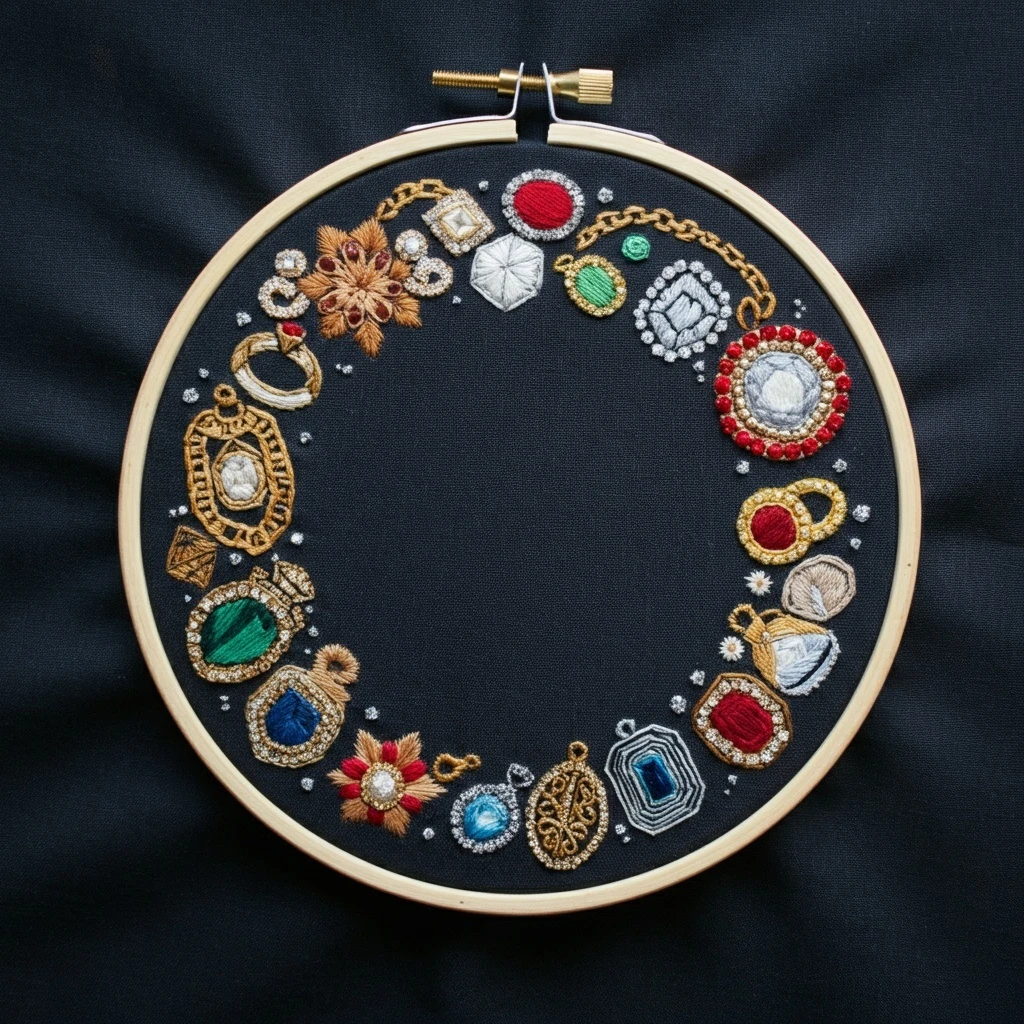

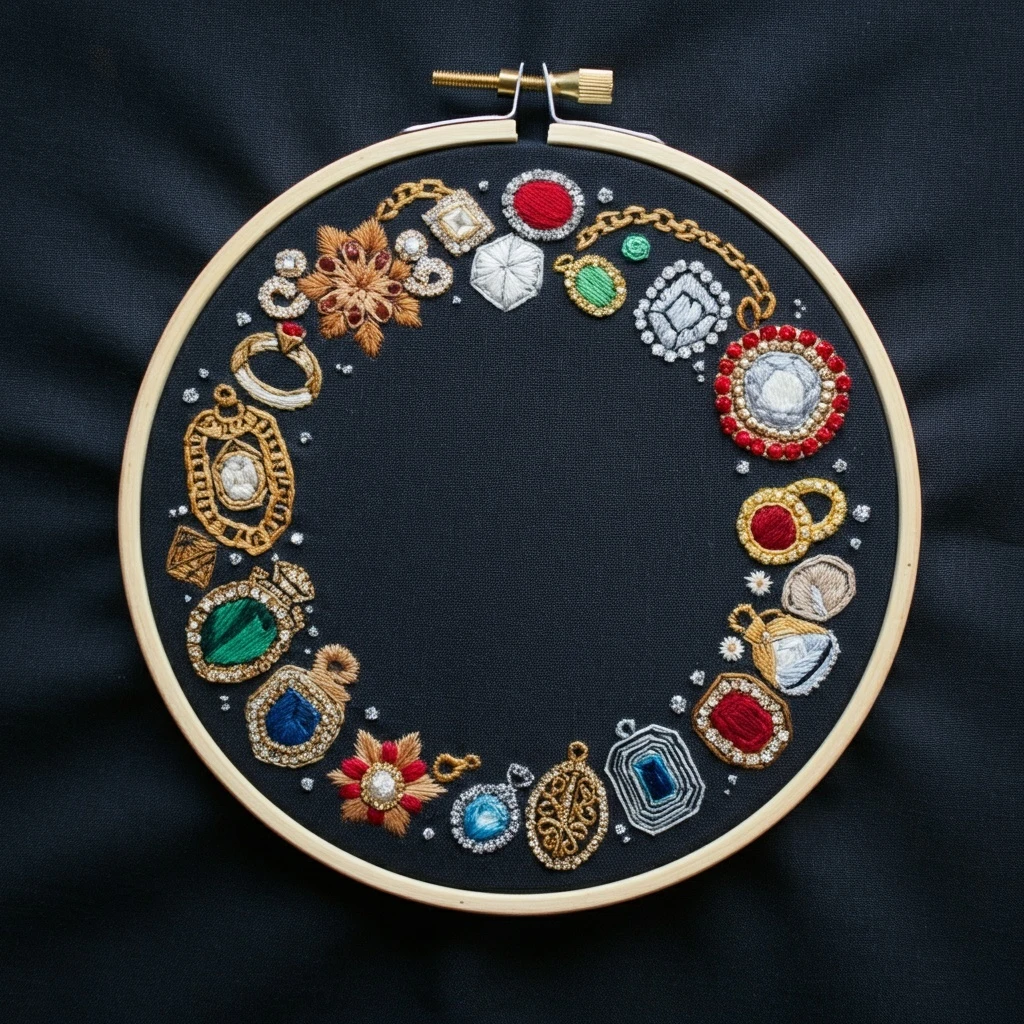
Embroidered Jewel Wreath on Black Fabric
A dramatic circular arrangement of embroidered jewels, pearls, gold chains, small floral sprays, rings, pendants and sparkling accents stitched over deep black fabric. The design depends on high contrast: warm metallic gold outlines, bright ruby and emerald stones, cool sapphire and aqua gems, and crisp pearl-white highlights that glow against the dark ground.
Color reading from the design
The reference image shows a wreath of vintage-style jewelry stitched on black fabric: golden chain links and filigree frames, pearl clusters, ruby cabochons, emerald medallions, blue sapphires, bright aqua stones, ivory diamond shapes, champagne flowers, and many tiny white sparkles. Use the black ground as a design element. Let small gaps of fabric separate the jewels so each pendant remains readable.
Stitch map by design area
Gold chains and settings
- Use couched 3-strand lengths or heavy chain stitch for the large necklace curve and bracelet-like links.
- Work frames with 2 strands of 729, then add 3821 on the upper-left edge and 680 on the lower-right edge.
- For filigree pendants, use single-strand stem stitch, tiny backstitches, and detached chain loops so details do not become bulky.
- Keep link openings visible by leaving black fabric between each gold loop.
Ruby cabochons and red beads
- Fill large red stones with satin stitch following the oval or round curve, not straight vertical rows.
- Place 815 in the lower third, 321 through the middle, and two or three tiny 666 strokes near the top-left highlight.
- For bead clusters, use French knots or padded satin dots; vary bead size slightly for a jeweled, handmade look.
- Outline only the shadow side with 815 or one strand of 310 so the ruby stays luminous.
Emerald stones
- Use long-and-short stitch or smooth satin for oval emerald fills.
- Blend 699 into the lower side, 906 across the center, and 907 on the top edge or diagonal facet.
- Add two narrow diagonal straight stitches in 907 to imitate cut-gem reflections.
- Ring the emerald with old gold knots or tiny chain stitch for a raised jewelry setting.
Sapphires and aqua gems
- Use 939 as the deepest shadow line, 798 as the main sapphire body, and 995 as the brightest blue facet.
- For aqua stones, pair 3846 with small 747 highlight stitches for a glassy center.
- Rectangular gems look best with straight satin rows and a final backstitched border that follows the gemstone shape.
- Leave one tiny black triangle or slit in dark gems to increase sparkle by contrast.
Thread-count and strand guidance
| Element | Suggested strands | Why it works |
|---|---|---|
| Large gemstone fills | 2 strands for satin or long-and-short | Gives a polished surface while keeping curved stones controllable. |
| Tiny beads, sparkle dots, pavé rims | 1–2 strands for knots | One strand keeps dots delicate; two strands creates raised pearl or bead texture. |
| Gold chains and heavy outlines | 2 strands for chain stitch; 3 strands for couched cords | Creates a metallic raised edge that stands out against black fabric. |
| Filigree curls and inner pendant details | 1 strand | Fine lines stay crisp and do not crowd the small jewelry shapes. |
| Diamonds, pearls and silver settings | 1 strand for facets, 2 strands for fill | Allows separate white, pearl-gray and steel-gray planes to remain visible. |
| Small flowers | 2 strands for petals, 1 strand for petal veins | Provides warmth and dimension without overpowering the jewelry. |
Blending, shading and outlining notes
Blended needle ideas
- Antique gold: one strand 729 + one strand 680 for shadowed links; 729 + 3821 for bright top ridges.
- Pearls: one strand 3865 + one strand 762 for the body; add B5200 only as a final dot.
- Rubies: one strand 321 + one strand 815 at the base; 321 + 666 at the lit edge.
- Emeralds: one strand 906 + one strand 699 for deep green; 906 + 907 for middle highlights.
- Aqua stones: one strand 3846 + one strand 747 for the brightest central flash.
Outlining on black fabric
- Outline most jewelry with gold or pearl gray rather than black, because the fabric already supplies the dark edge.
- Use 310 only where two bright shapes touch or where a gemstone needs a crisp shadow slit.
- Backstitch around rectangular gems, split stitch around oval cabochons, and couch around large medallions for a raised setting.
- For sparkle dots, use isolated seed stitches, single-wrap French knots, or tiny cross stitches in B5200 and 762.
Beginner-friendly rule: on black fabric, strong contrast makes every stitch visible. Work with shorter thread lengths, keep hands clean, and test white or gold stitches on a scrap first. A small light-colored towel in your lap can make the black weave easier to see while stitching.
Suggested stitching order
Texture tips for a polished hoop
Raised jewelry effect
- Pad a few central gems with a small underlayer of split stitch before satin stitching over the top.
- Couch a doubled strand of 729 around important stones to imitate a raised metal bezel.
- Use French knots for pearls and pavé rims so the wreath catches light from many directions.
Gemstone shine
- Place highlights consistently in the same direction, ideally top-left, so the jewelry looks lit by one source.
- Do not overblend every gem; sharp color changes often look more like facets.
- Leave occasional black slivers between highlight and shadow areas to intensify the jewel tone.
Pearls and diamonds
- Build pearls from 318 or 415 shadows into 762 and 3865, then add a tiny B5200 dot.
- For diamonds, divide the shape into triangular facets with single-strand straight stitches.
- Use 747 sparingly on cold white stones for a blue-white sparkle.
Working on black fabric
- Use a needle minder and avoid dragging pale threads across the surface where fuzz can show.
- Keep the back tidy around open black spaces so no carried threads shadow through gaps.
- Press face-down on a fluffy towel to protect knots, couching and padded satin.
Quick stitch glossary for this pattern
| Stitch | Best use in this design | Practical note |
|---|---|---|
| Satin stitch | Cabochons, oval stones, rectangular gems | Keep stitches parallel within each facet and anchor with a split-stitch outline first. |
| Long-and-short stitch | Large jewel shading and warm flower petals | Change colors gradually across the stone, but keep the highlight area crisp. |
| Chain stitch | Gold necklace links and decorative loops | Use even link length so the circular wreath feels balanced. |
| Couching | Raised gold bezels and thick chain sections | Lay 2–3 strands of gold floss and tack them down with one strand of matching gold. |
| French knots | Pearls, pavé dots, small sparkle beads | One wrap for tiny glints; two wraps for pearl-like beads. |
| Backstitch / split stitch | Fine outlines, ring bands, filigree details | Use one strand for small jewelry interiors and two strands for outer frames. |