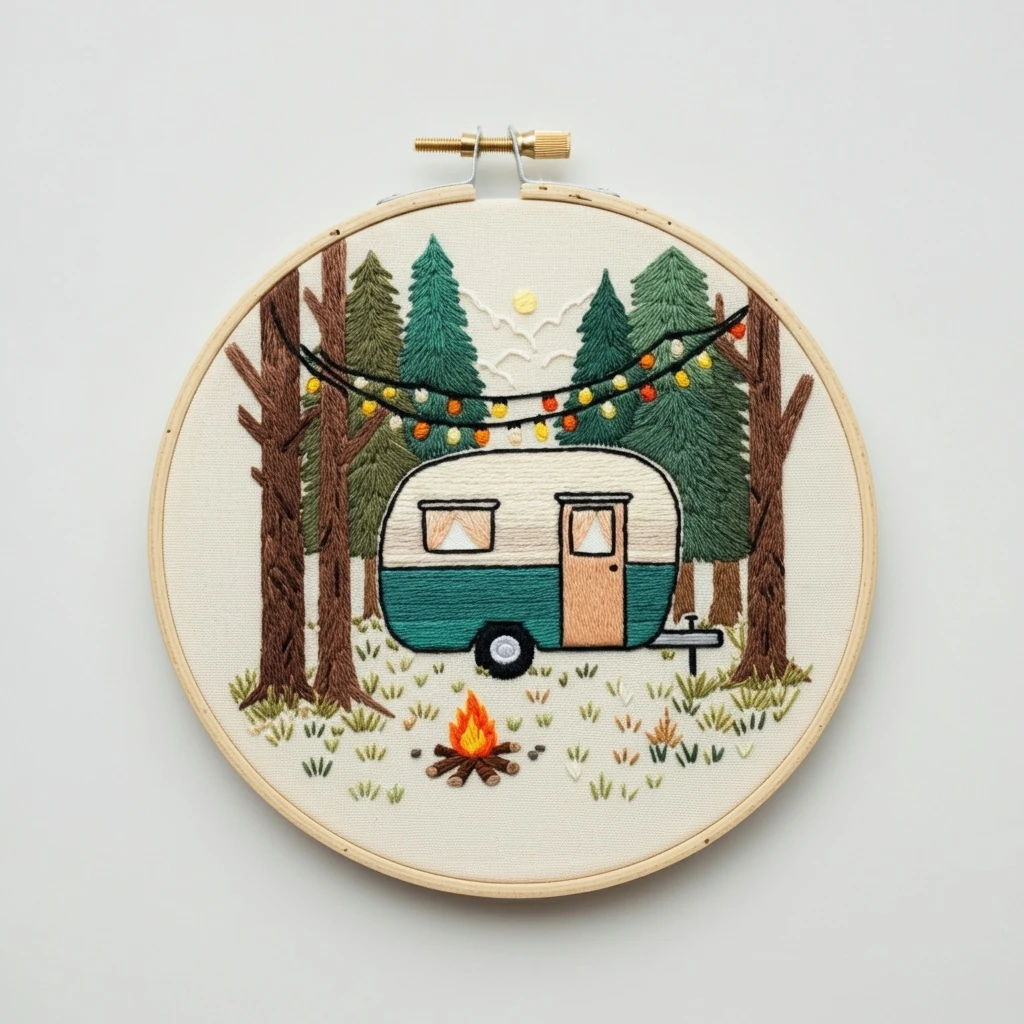


Cozy Camper Campfire
This cozy camping design combines a charming camper, warm campfire glow, woodland details, smoke curls, and small outdoor accents. The embroidery should feel friendly and atmospheric: a clean camper silhouette, soft cream and aqua panels, glowing orange-yellow flames, rustic log texture, muted pine greenery, and tiny smoke or star details that keep the scene relaxed and beginner-friendly.
Polished DMC Color Palette
This palette balances warm firelight with cool camper tones and woodland greens. Use cream and aqua for the camper, orange and yellow for the fire, dark browns for logs and outlines, and muted greens and blues for the outdoor setting.
Stitch Map by Design Element
Thread Count & Blending Guide
Fine details
Use 1 strand for window frames, camper trim, smoke curls, stars, wheel centers, door handles, tiny grass tips, and final outline corrections.
Main fills
Use 2 strands for camper panels, flame layers, logs, pines, ground stitches, and larger color blocks. Two strands gives clean coverage without losing small details.
Raised warmth
Use 2–3 strands only for a few ember knots, star knots, or foreground texture dots. Keep the camper body smooth and avoid bulky knots there.
Shading, Outlining & Texture Suggestions
Clean camper shape
- Stitch the camper outline and major panels before adding tiny trim details.
- Use cream tones for the main body and aqua only as a smooth accent panel.
- Keep dark outlines thin so the camper stays cheerful rather than heavy.
- Add window glints last so the glass looks crisp and polished.
Warm campfire glow
- Place yellow in the flame center, orange around it, and copper near the base.
- Use small orange stitches on nearby logs and ground to suggest reflected light.
- Keep flame stitches vertical or slightly curved upward for movement.
- Avoid outlining flames heavily; layered colors create a softer glow.
Woodland campsite texture
- Use dark pine greens behind the camper and lighter greens in front for depth.
- Keep ground stitches short and scattered, not filled solid.
- Add log grain with one-strand short strokes after the log fill.
- Use a few stars or smoke curls to frame the top without cluttering it.
Outlining approach
- Use brown for camper and log outlines, dark teal for aqua panel edges, and dark green for trees.
- Use back stitch for small camper details and split stitch for rounded body curves.
- Use stem stitch for smoke and tree trunks.
- Add final outlines before the last stars, ember dots, and bright window highlights.
Beginner-Friendly Stitching Order
- Transfer the main shapes: mark the camper body, door, windows, wheels, campfire, logs, smoke, trees, and ground line. Keep tiny stars and grass dots for later.
- Stitch background trees: add pines and any distant foliage first so the camper can sit clearly in front.
- Build the camper: stitch the cream body, aqua panel, windows, door, wheels, and trim in clean sections.
- Add the campfire: stitch logs first, then layer flames from darker base to bright center.
- Fill the ground: add short grass stitches, pebbles, and warm reflected glow around the fire.
- Finish small details: add smoke curls, stars, window glints, embers, log grain, and final outline corrections last.
Practical Tips for a Clean Finish
Fabric & hoop
Natural linen, warm cream, pale oatmeal, or soft blue-gray cotton-linen works well. A neutral fabric lets the camper, fire, and pines stand out without requiring a filled background.
Needle choice
Use a sharp embroidery needle size 7–9 for one- and two-strand stitching. A size 9 needle helps with window frames, smoke curls, and tiny wheel details.
Keeping it cozy
Let warm colors cluster around the fire and windows. This creates a natural glow that makes the camper feel inviting even if the surrounding trees stay simple.
Avoiding clutter
Do not overfill the ground with grass. A few short stitches and ember dots are enough to anchor the camper and fire while keeping the scene clean.