
DMC palette & stitching guide
Starry Celestial Cow
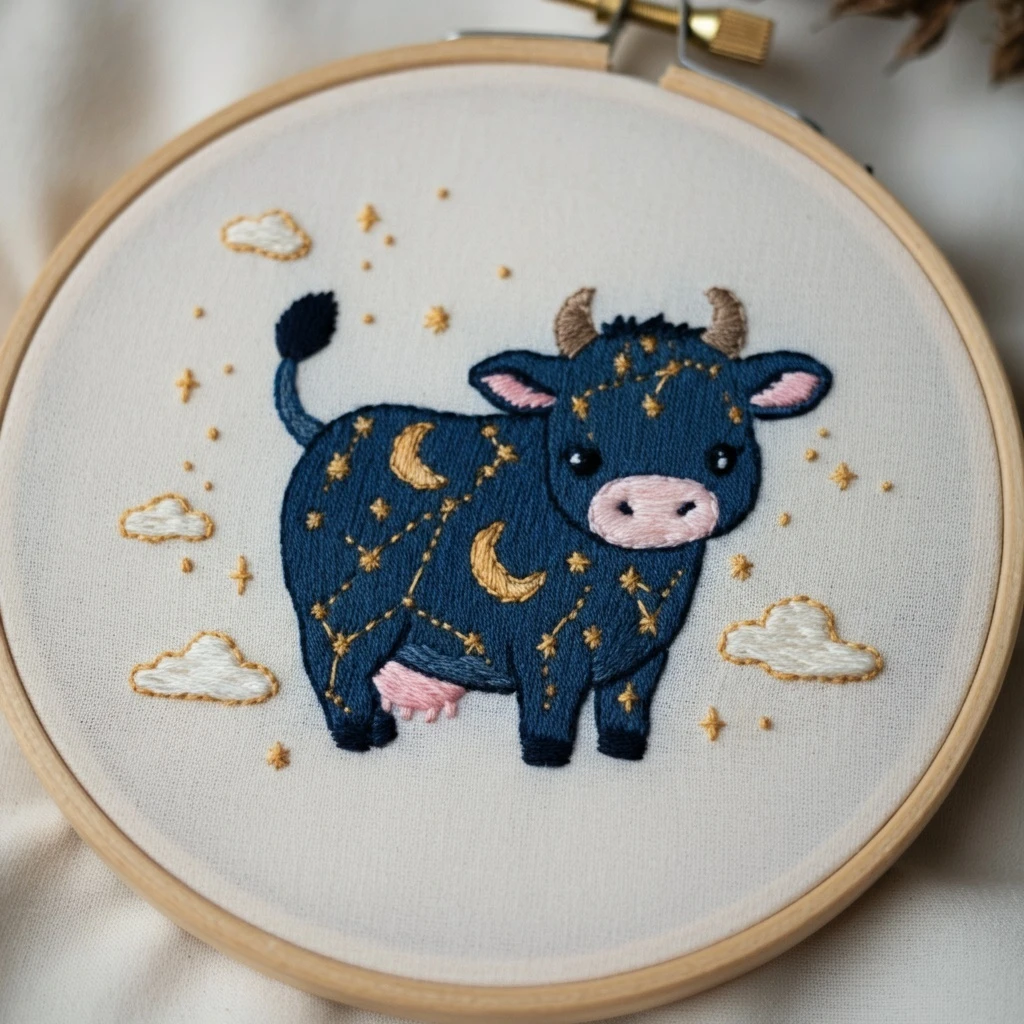
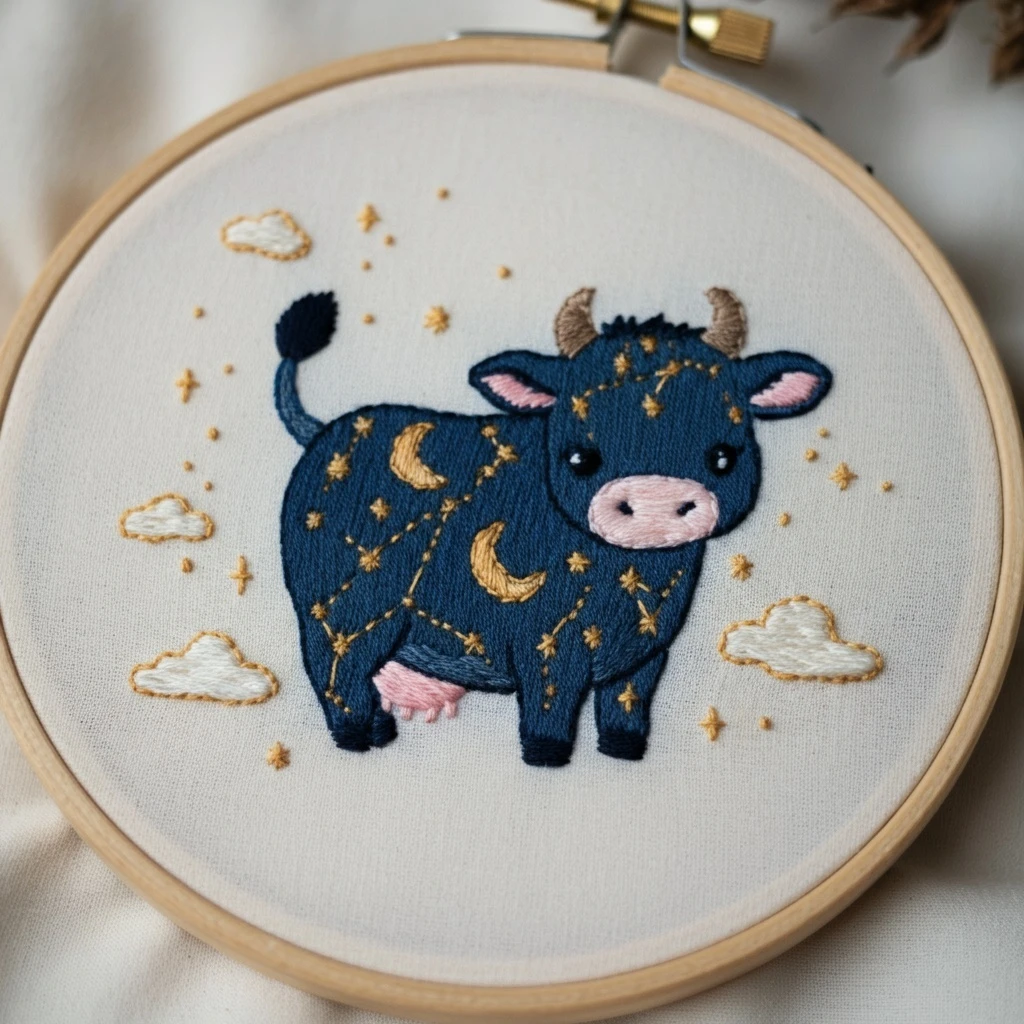
A charming hoop design with a deep midnight-blue cow, soft pink muzzle and ears, warm taupe horns, golden moon-and-constellation details, tiny surrounding stars, and airy cream clouds. The guide below keeps the animal bold and velvety while making the celestial accents sparkle without becoming bulky.
Suggested DMC Color Palette
The reference image relies on strong contrast: a plush blue-black cow against natural cloth, lifted by honey-gold stars and gentle pink details. Use darker blues for the cow base, then place small lighter strokes only where the body curves so the design stays rounded and dimensional.
Navy Blue Very Dark
Main outline for the cow, deepest body shadows, tail tuft, hooves, and dark facial edges.
Navy Blue Dark
Primary fill for the cow body and head; use directional stitches to show the rounded form.
Antique Blue Dark
Subtle highlights along the belly, cheek, leg fronts, and upper back where the light catches.
Black
Eyes, nostril dots, inner hoof base, and the smallest reinforcing stitches under dark outlines.
Snow White
Eye glints and the brightest cloud centers; use only a few stitches so the shine stays crisp.
Winter White
Soft cloud fill and creamy highlights that look warmer and less stark than pure white.
Topaz Medium
Crescent moons, larger starbursts, and the strongest gold constellation accents.
Old Gold Light
Small dot stars, cloud outlines, constellation lines, and delicate sparkle around the cow.
Salmon Light
Muzzle, inner ears, and udder highlights; keeps the pink soft and beginner-friendly.
Dusty Rose Medium
Pink shadows at the ear bases, muzzle edges, and lower udder folds for rounded form.
Mocha Beige Dark
Horn fill, warm cloud outline touches, and gentle brown-gold shading around small details.
Beige Brown Dark
Horn bases, lower horn shadows, and the tiny warm contour lines where more definition is needed.
Stitch Map by Design Area
For the prettiest finish, let stitch direction describe each shape. The cow should feel plush and rounded, while the stars and constellation lines should stay fine and airy.
Thread Count, Blending & Shading
Blending Ideas
- Blend one strand 823 with one strand 939 for smooth body shadows without a flat black look.
- Blend one strand 823 with one strand 930 for subtle blue highlights on the cheek, shoulder, and belly.
- Blend one strand 761 with one strand 3716 for the muzzle edge and udder folds.
- Blend one strand 783 with one strand 676 for moons that look warm but not too heavy.
Shading Guidance
- Keep 939 under the belly, inside the legs, and at the tail tuft; avoid spreading it over the entire cow.
- Place 930 highlights as short strokes rather than large blocks so the cow remains midnight blue.
- Use the brighter gold on star centers and the lighter gold for dotted constellation trails.
- Let the natural fabric remain open around the motifs; the negative space makes the celestial details feel light.
Outlining & Texture Suggestions
Outlining Details
Outline the cow with one or two strands of 939 using split stitch for a soft plush edge. Use one strand of 310 only for eyes, nostrils, and the deepest hoof accents. For clouds, choose 676 in stem stitch so the outline looks warm and handmade instead of harsh.
Texture Choices
The cow body can be filled with dense long-and-short stitch for a velvety surface, while the stars should remain raised and tiny. French knots, seed stitches, and small straight stitches create a playful night-sky texture without overwhelming the animal.
Practical Embroidery Tips
Fabric & Hoop
A natural linen, oatmeal cotton, or cream fabric works well because it becomes the soft sky. Keep the hoop drum-tight before filling the large cow body to prevent puckering from dense satin coverage.
Needle & Tension
Use a size 7 or 8 embroidery needle for two strands. Pull dark navy stitches smooth but not tight; over-tension can warp the round belly and make the legs look narrow.
Managing Dark Floss
Dark navy can shed tiny fibers onto light fabric. Wash hands first, trim thread lengths to about 16 inches, and stitch the clouds after the cow so light areas stay fresh.
Finishing Touches
After stitching, steam from the back over a towel. Avoid pressing the French knots flat; the raised gold dots are what give the constellation paths their sparkle.