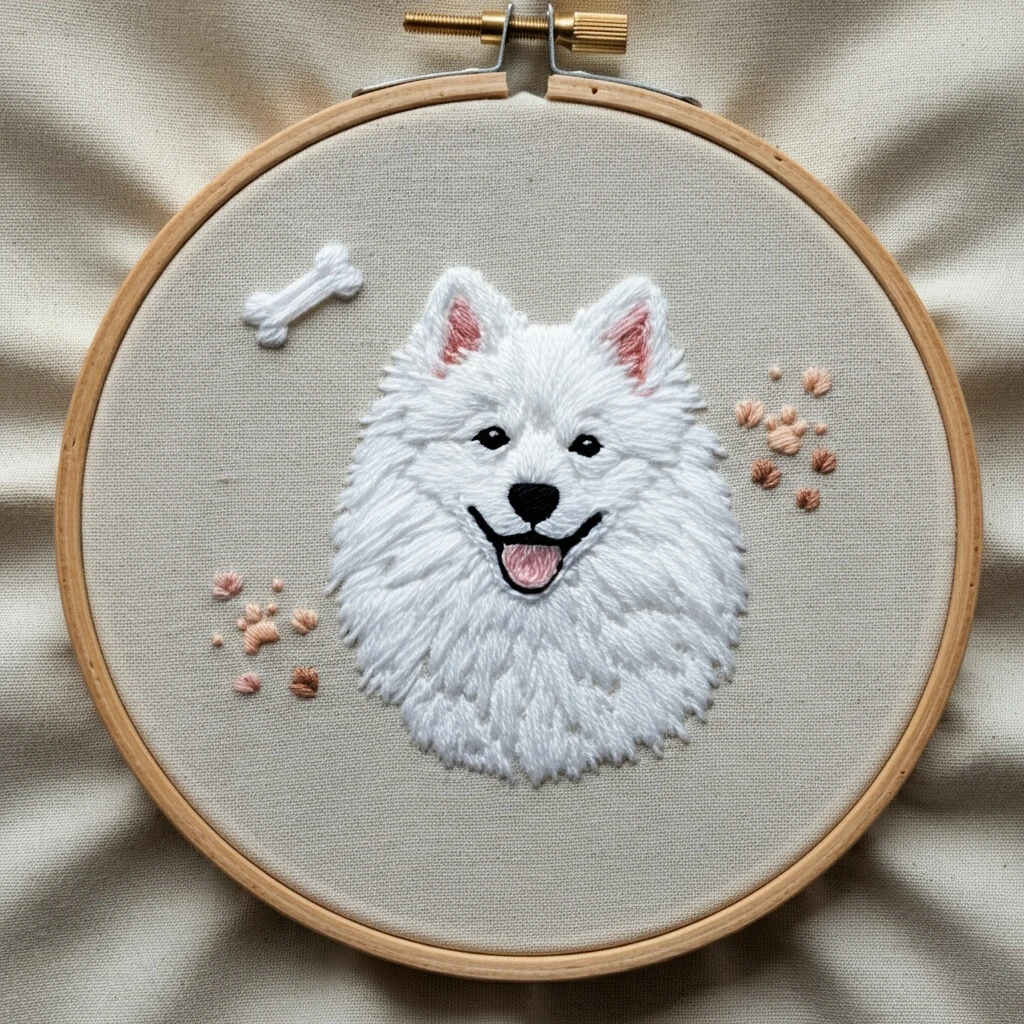

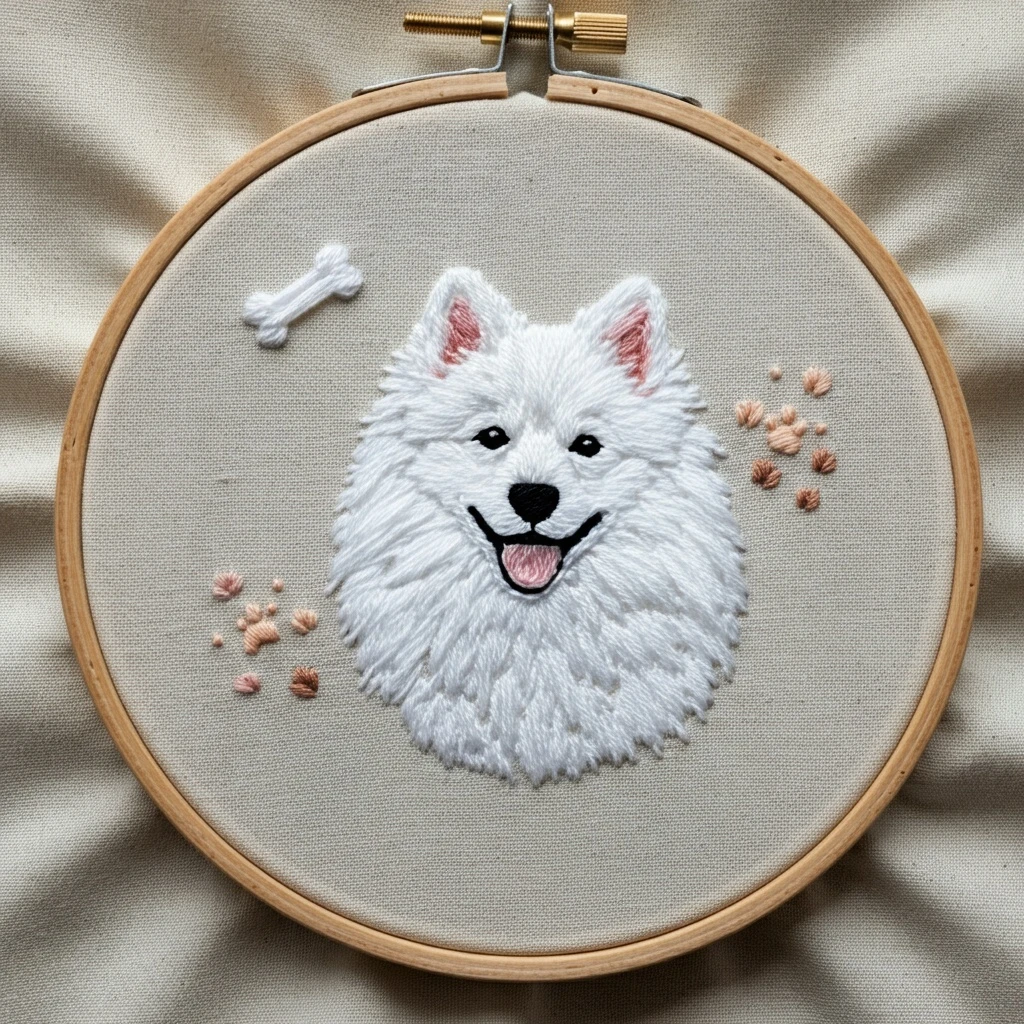
Fluffy Samoyed Dog
A soft, snowy Samoyed portrait stitched with feathery white fur, cool gray shadowing, rosy ears and tongue, shiny black facial details, a tiny white bone, and warm peach floral accents on natural linen.
Color story from the artwork
The reference design is dominated by clean white fur, but it is not flat white: the cheeks, neck, lower ruff, and ear bases need whisper-soft blue gray, pale shell gray, and creamy white transitions. The face relies on crisp black details, while the ears and tongue add gentle pink warmth. Small peach-brown flower clusters and a white bone keep the hoop playful without competing with the fluffy portrait.
DMC B5200
Snow WhiteMain highlights on forehead, muzzle, outer ears, cheek tips, bone shine, and the brightest fur strokes.
DMC 3865
Winter WhiteBase fill for most of the Samoyed coat; softer than pure white and ideal for broad fur coverage.
DMC 712
CreamWarm transition near the lower ruff, underside of the face, and areas where the linen casts warmth.
DMC 762
Very Light Pearl GrayFirst shadow layer between fur clumps, around cheeks, under ears, and beneath the muzzle.
DMC 415
Pearl GrayUse sparingly for deeper separations in the neck ruff, ear roots, and smile-side shadows.
DMC 310
BlackNose, eyes, mouth line, tiny pupils, and the strongest definition around the smile.
DMC 3713
Very Light SalmonBase color for tongue and inner ears; stitch lightly so the pink stays soft.
DMC 761 / 760
Salmon Pink BlendAdd short darker strokes at ear centers, tongue crease, and edges where pink recedes.
DMC 950
Light Desert SandSoft peach flower petals and warm dots around the dog.
DMC 407
Desert SandDeeper peach-brown petal shadows, flower centers, and accents for the small blossoms.
DMC 938
Ultra Dark Coffee BrownOptional single-strand depth for the darkest flower centers or very subtle hoop-shadow accents.
DMC 842
Very Light Beige BrownOptional linen-colored shadow touches under the bone or behind white fur on beige fabric.
Stitch plan
Samoyed fur and face
- Long-and-short stitch: work the coat in directional rows, radiating from the forehead, muzzle, cheeks, and chest. Keep the outer fur edge uneven and wispy.
- Split stitch guide lines: outline the head very lightly in 1 strand of 762 before filling; cover or soften this line with later white fur strokes.
- Turkey work or loose loop stitch: add a few trimmed tufts around the cheeks and lower ruff if you want extra fluff. Keep loops short so the portrait stays tidy.
- Satin stitch: use for the nose, then add a tiny B5200 straight-stitch glint. For eyes, use padded satin or small black satin ovals with a white highlight.
- Back stitch: outline mouth and tongue with 1 strand of 310; do not over-thicken the smile or it can look harsh.
Bone, flowers, and accents
- Bone: fill with satin stitch in B5200 or 3865, then add 762 at one lower edge for dimension.
- Peach flowers: stitch petals with lazy daisy or detached chain in 950; place 407 at the base of each petal for a soft cupped look.
- Accent dots: use French knots in 950, 407, and occasional 3713. Wrap once for tiny dots, twice for plumper buds.
- Inner ears: use long-and-short strokes in 3713 with 761/760 near the center, then feather in 3865 from the white ear edge.
- Tongue: satin stitch with 3713, shade the bottom with 761/760, and add a single split line for the center crease.
Thread-count and blending guidance
Strand counts
- 2 strands: main fur fill, white bone fill, and medium peach petals.
- 1 strand: facial outlines, mouth, tiny eye highlights, gray shadow strokes, ear feathering, and final flyaway hairs.
- 3 strands: optional plush strokes on the lower chest ruff only; avoid using 3 strands around the eyes and muzzle.
- 6 strands: only for trimmed turkey-work tufts, if adding dimensional fluff.
Useful blends
- B5200 + 3865: clean white fur that still covers well on beige fabric.
- 3865 + 762: soft gray-white shadow for cheek channels and the ruff underside.
- 712 + 762: warm neutral shadow where white fur meets natural linen.
- 3713 + 761/760: gentle pink shading for ears and tongue.
- 950 + 407: peach blossom petals with natural depth.
Suggested stitching order
Map the expression
Transfer the eyes, nose, mouth, tongue, inner ears, and head outline accurately. Stitch the black features early so the fur can be directed around them.
Build the soft shadows
Place 762 and tiny touches of 415 first in the cheek channels, below the muzzle, and under the ears. Keep these stitches thin and broken.
Layer the white coat
Fill with 3865, then add B5200 highlights over the top. Vary stitch length so the fur looks fluffy rather than striped.
Finish pink details
Work the ears and tongue after the surrounding fur, using satin and long-and-short stitches. Add only a fine black mouth line.
Add playful accents
Stitch the bone, flower clusters, and knots last. This prevents peach floss from catching under the white fur stitches.
Fluff and refine
Comb dimensional tufts gently with a clean needle tip, trim uneven turkey work, and add a few final single-strand white hairs along the outline.
Beginner-friendly practical tips
For a clean fluffy finish
- Use a sharp embroidery needle for precise face details and a larger crewel needle only for thicker fluffy stitches.
- Keep the fabric drum-tight; loose linen makes long white fur stitches buckle.
- Do not carry dark thread behind white areas. Black show-through is very visible on a pale dog.
- Use short thread lengths, especially with B5200, because white floss dulls and frays quickly.
Shading and texture reminders
- Think of the fur as clumps, not a solid fill: leave slight directional breaks between strokes.
- Reserve the darkest gray for only the deepest grooves. Too much gray will make the Samoyed look dirty instead of fluffy.
- Angle cheek stitches outward and chest stitches downward to match the natural fan of the coat.
- Add final highlights after all shading is complete; a few bright B5200 strokes can revive the whole face.