
DMC Palette & Hand Embroidery Guide
Wildflower Meadow Embroidery Art
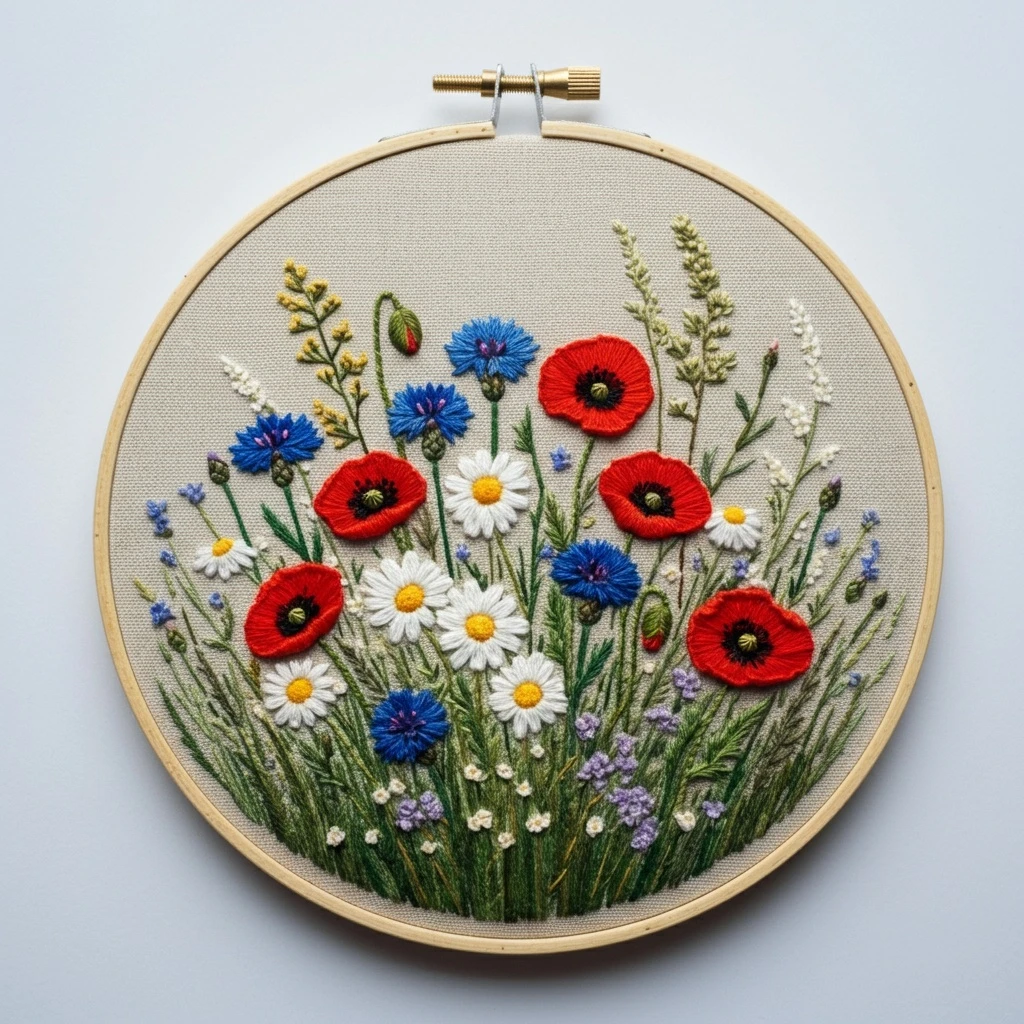
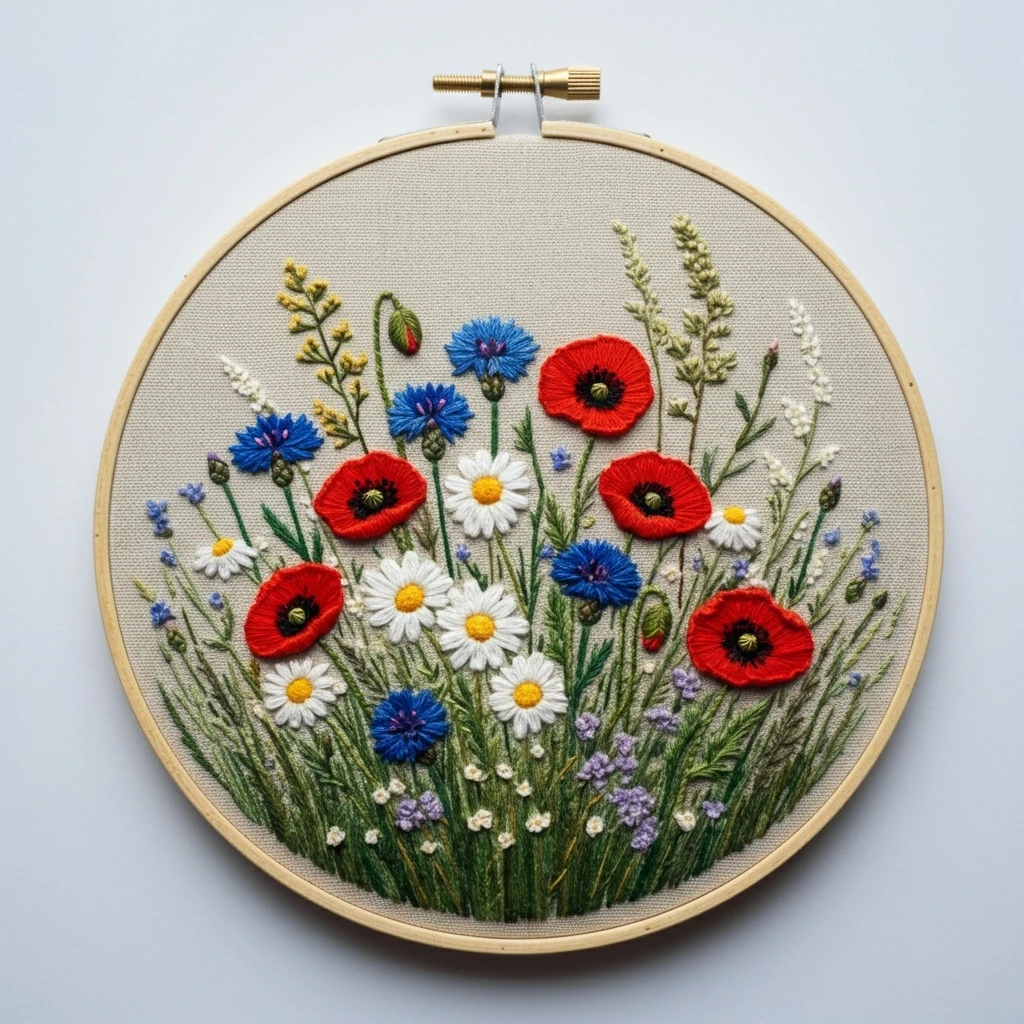
This wildflower meadow design works best when it feels airy, irregular, and naturally scattered. Use layered greens for stems and grasses, then build small blossoms in pink, lavender, yellow, white, and soft blue so the hoop reads like a breezy field rather than a formal bouquet.
Design Analysis
The wildflower meadow is defined by many small details rather than one dominant bloom. Thin stems, varied heights, seed heads, small petal clusters, and wispy grasses should overlap lightly to create depth. The strongest colors can sit near the main floral clusters, while paler stitches and single-strand grasses soften the outer edges.
Because meadow embroidery can become crowded, treat the design as layers: first the distant grass texture, then the main stems, then blossoms, then tiny knots and highlights. Keep spacing uneven and organic. A few taller stems should break the outline, while lower stitches can fill the base without making a heavy solid band.
DMC Floss Color Palette
| Area | Main DMC Colors | Close Matches / Alternatives | Use Notes |
|---|---|---|---|
| Meadow grasses & stems | 3052, 3051, 3011 | 3363 for deeper olive; 522 for muted sage; 3347 for brighter garden green | Use for main stems, tall grasses, and leaf outlines. Mix 1-strand and 2-strand stitches so the meadow has both fine and visible lines. |
| Soft leaf highlights | 3012, 524, 772 | 733 for yellow-green warmth; 369 for pale spring green | Add short lazy daisy leaves and small highlight stitches on the upper side of stems. Keep pale greens scattered, not continuous. |
| Pink wildflowers | 3688, 3687, 3803 | 3354 for dusty rose; 3608 for brighter pink; 605 for vivid accents | Use for tiny five-petal flowers, scattered buds, and small satin petals. Reserve the darkest pink for petal bases and occasional focal blossoms. |
| Lavender & purple blooms | 211, 209, 208 | 153 for smoky mauve; 340 for blue-violet; 3837 for deeper purple | Good for lavender sprigs, small star flowers, and shadowed petals. Combine with green stems to create vertical rhythm through the design. |
| Yellow centers & sunny blossoms | 726, 783, 782 | 725 for bright yellow; 3821 for soft straw; 977 for golden orange | Use for daisy centers, tiny buttercup petals, pollen dots, and warm accents near the lower meadow. |
| White daisies & pale petals | B5200, 3865, 746 | Blanc for softer white; 712 for cream; 822 for antique white | Use on small daisies and pale petal tips. Add only a few stitches per flower so the white remains clean and delicate. |
| Blue meadow flowers | 3752, 932, 931 | 157 for pale cornflower; 3761 for fresh blue; 312 for deep blue accents | Use sparingly for cornflower-style blossoms and cool contrast against pinks and yellows. |
| Seed heads & earthy accents | 420, 869, 3828 | 3862 for taupe brown; 612 for dry straw; 838 for dark brown | Use for tiny seed heads, dried grass tips, flower centers, and subtle grounding at the base of the meadow. |
| Fine outlines & shadow accents | 3362, 645, 3371 | 3021 for brown-grey; 844 for cool dark grey | Use very lightly for the darkest stem intersections, flower bases, or tiny shadow dots. Too much dark thread can make the meadow look heavy. |
Stitch Suggestions by Design Area
Tall Grasses
Use straight stitch, stem stitch, and long single-strand stitches in several greens. Vary the length and angle so the grass looks wind-touched rather than evenly combed.
Wildflower Stems
Use stem stitch for curved stems and back stitch for very fine upright stems. Work the tallest stems first so blossoms can sit cleanly on top.
Small Petal Flowers
Use lazy daisy, detached chain, tiny satin stitch, or fly stitch for petals. Keep many blossoms to three or five stitches so they stay light and meadow-like.
Daisy Centers & Buds
Use French knots or colonial knots in yellow, gold, or brown. Cluster two or three knots for larger centers and single knots for buds scattered through the grasses.
Lavender Sprigs
Use stacked detached chains, tiny straight stitches, or small knots along a slim green stem. Alternate 211 and 209 to create soft lavender variation.
Meadow Base
Use seed stitch, short straight stitches, and a few couching stitches for layered ground texture. Avoid filling the base solidly; small gaps keep the design breathable.
Thread Count & Strand Guidance
- Fine grasses: 1 strand for wispy outer blades and distant texture.
- Main stems: 2 strands for visible curved stems; 1 strand for tiny secondary stems.
- Leaves: 2 strands for lazy daisy leaves; 1 strand for narrow filler leaves.
- Small blossoms: 2 strands for petal stitches that need color impact; 1 strand for miniature flowers.
- French knots: 1 strand wrapped twice for tiny dots; 2 strands for larger flower centers.
- White petals: 1–2 strands depending on fabric color; use fewer strands on pale linen.
- Dark accents: 1 strand only for flower bases, seed shadows, and fine outlines.
- Layered meadow texture: Mix strand counts intentionally so no single texture dominates.
Placement & Stitching Order
- Map the tallest stems: Transfer the main flower stems and a few high grass lines first so the composition keeps its meadow shape.
- Stitch background greens: Add pale and mid-green grasses before any blossoms. Keep the outer edges sparse and feathery.
- Add main stems and leaves: Work stronger olive stems next, using stem stitch on curves and straight stitch on fine verticals.
- Place focal blossoms: Add the most visible pink, lavender, white, and blue flowers, spacing colors unevenly for a natural field effect.
- Fill with buds and seed heads: Use French knots and short stitches to bridge empty areas without overcrowding the design.
- Finish with highlights: Add bright yellow centers, pale green leaf tips, and a few white petal highlights last.
Texture & Shading Notes
Natural color scatter: Avoid placing all pinks, purples, or yellows in neat groups. Repeat each color at least three times in small amounts so the meadow feels balanced.
Depth through greens: Use deeper greens at the base and behind flowers, mid greens for main stems, and pale greens at the top edges where grasses catch light.
Flower scale: Keep most blossoms small. A wildflower meadow looks more convincing with many tiny marks than with a few oversized petals.
Airy negative space: Let fabric show between stems. The open spaces are what keep the composition light and breezy.
Directional movement: Angle a few stems slightly left and right, especially near the outer edges, to suggest a natural meadow rather than a rigid vertical pattern.
Finishing Tips
Fabric Choice
Choose cream cotton, natural linen, oatmeal linen, or pale warm grey. A soft neutral background makes the greens and flower colors look fresh without needing heavy fill stitches.
Hoop Tension
Keep the fabric taut while making French knots and detached chains so tiny flowers sit neatly on the surface and stems do not pucker.
Back Management
End threads between color clusters instead of carrying bright floss across open areas. This is especially important on light linen where traveling threads can show through.
For a polished final hoop, press the embroidery face-down on a thick towel, trim stray fibers, lace the back evenly, and consider a plain felt backing so the delicate meadow stitches remain protected.