
Lunar Howl
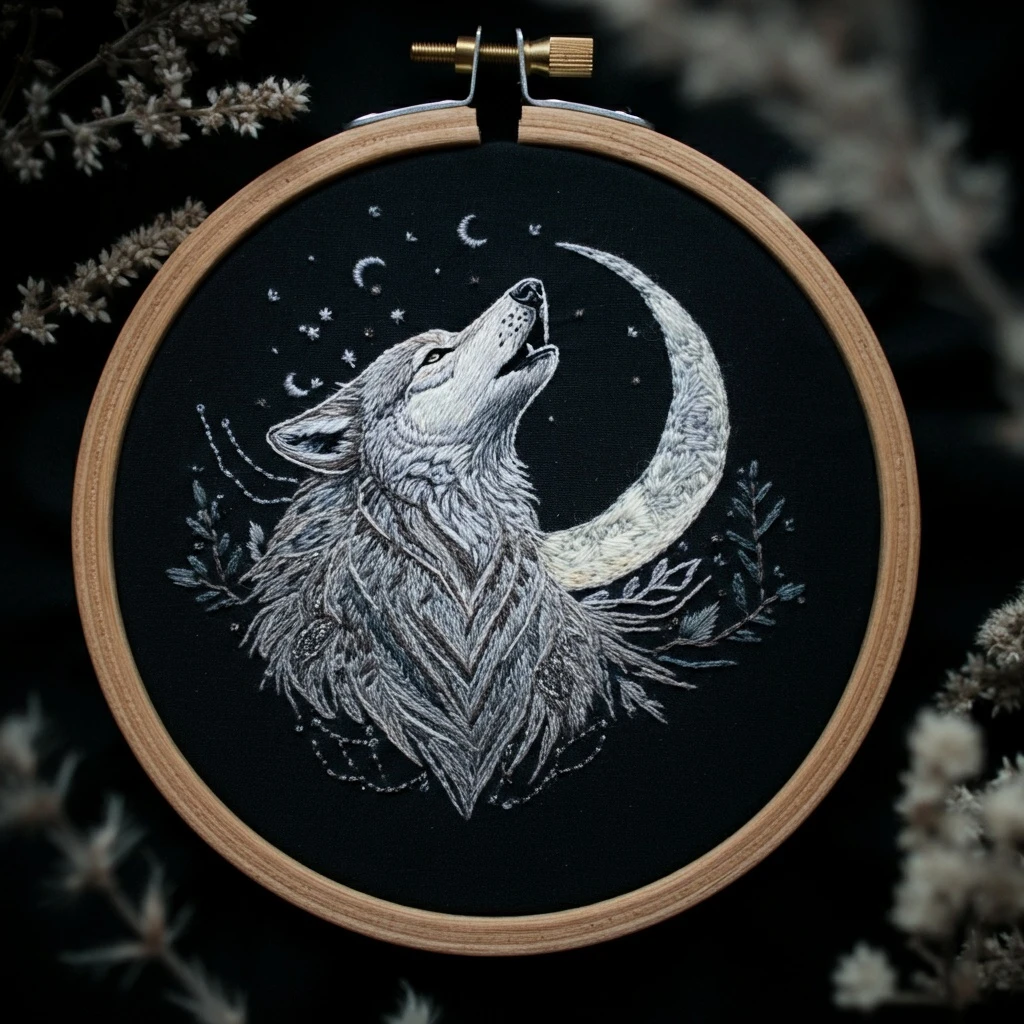
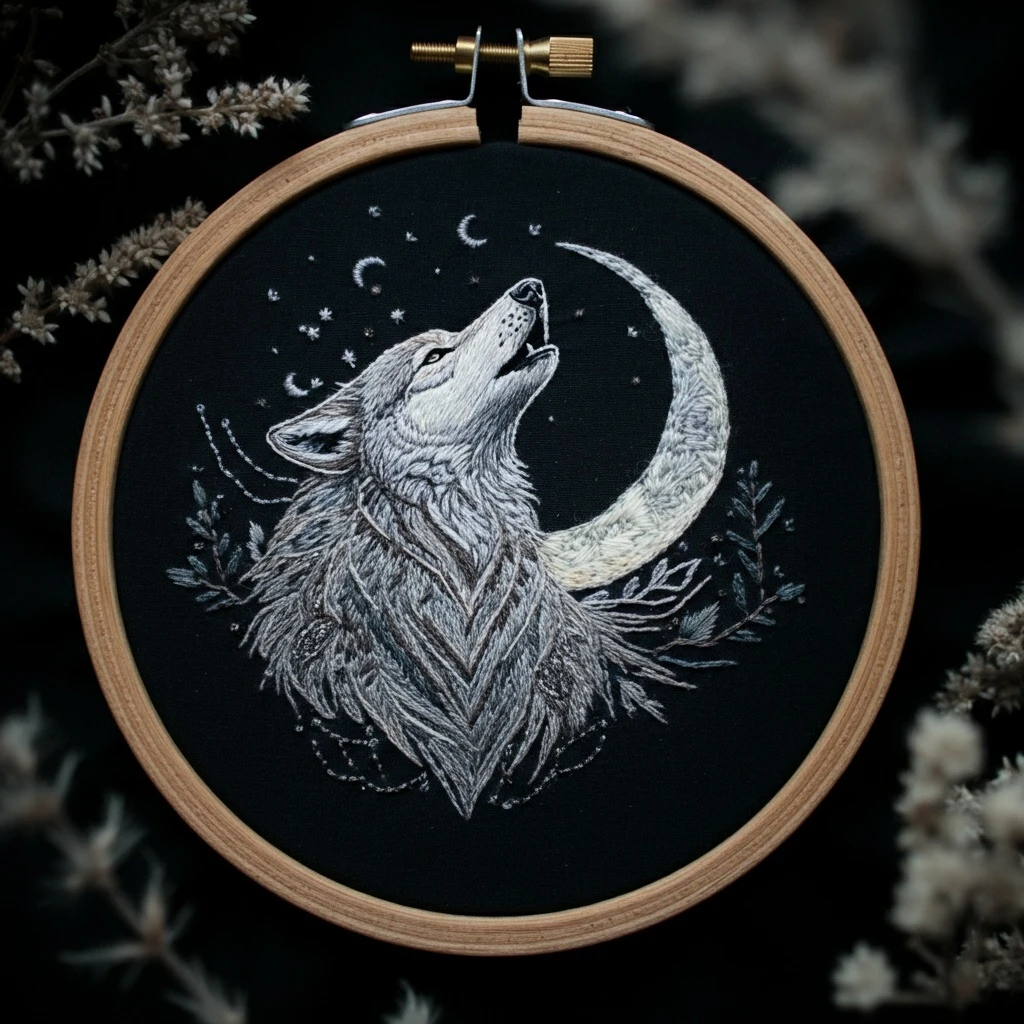
A moonlit wolf portrait worked on black fabric: silvery fur, a glowing crescent moon, tiny stars, and soft woodland sprigs. This guide keeps the palette cool, smoky, and luminous so the stitching reads clearly against the dark ground.
Design reading
The design is dominated by a howling wolf rendered in layered white, pewter, and charcoal strokes on black cloth. A large crescent moon sits behind the muzzle, with small stars, crescent motifs, and thin botanical sprigs around the lower sides.
Suggested DMC floss palette
These DMC choices are matched to the visible black-ground design: luminous whites for moonlight, cool greys for wolf fur, darker greys for depth, and muted natural tones for the hoop-adjacent woodland feel.
Stitch types by design area
Thread-count guidance
| Area | Recommended strands | Why it works |
|---|---|---|
| Face outline, eye, mouth, nose marks | 1 strand | Preserves the delicate illustrated look and prevents facial features from becoming bulky. |
| Main wolf fur | 1-2 strands | Use 1 strand for top detail and 2 strands for base coverage on the chest and neck. |
| Crescent moon | 2 strands, occasionally 3 for padding | Gives the moon enough presence against black fabric without turning it into a heavy patch. |
| Stars and tiny crescents | 1 strand or single-wrap French knots | Keeps celestial details crisp and prevents clutter in the open sky. |
| Leaves and decorative arcs | 1 strand | Creates subtle background texture that does not compete with the wolf. |
Blending, outlining, and shading guidance
- Build a grey base first. Lay the darkest structural fur in 414 and 3799, especially under the jaw, inside the ear, and along the lower chest. This creates depth before highlights are added.
- Blend upward into light. Work 318 into 415, then 762 and 3865 over the top. Stagger each color so the fur looks feathered rather than striped.
- Reserve B5200 for final sparkle. Use pure white sparingly on the top of the muzzle, the sharpest moon edge, a few star points, and select fur tips.
- Use directional stitches as drawing lines. The reference depends on visible fur strokes, so avoid filling large areas with uniform satin stitch. Let every stitch describe hair growth.
- Soften the moon with warm off-white. Combine 3865 + 746 in the center of the crescent, then place 762/415 sketch lines along the inner curve for lunar texture.
Beginner-friendly practical tips
Working on black fabric
Use a bright lamp and place a white cloth or paper on your lap so the holes are easier to see. Transfer with white water-soluble pencil, chalk pencil, or a light-colored stabilizer.
Keep thread tails very tidy on the back. Pale floss can show through black fabric if carried across open areas.
Keeping the wolf expressive
Stitch the eye, nose, and mouth after the surrounding fur has been placed. This lets you correct the expression with tiny dark or bright accents at the end.
For the howling muzzle, use short curved split stitches rather than a thick outline. The face should look lifted and airy.
Texture suggestions
Add a few loose one-strand straight stitches that extend beyond the main chest shape. These stray fibers create the wild, wind-tossed fur seen in the design.
For star clusters, vary French knots with small cross stitches and single straight stitches so they do not look mechanically repeated.
Finishing plan
Press from the back on a towel so raised knots and fur texture are not flattened. If hoop-framing, trim and lace the back rather than gluing immediately; black fabric looks cleaner when evenly tensioned.