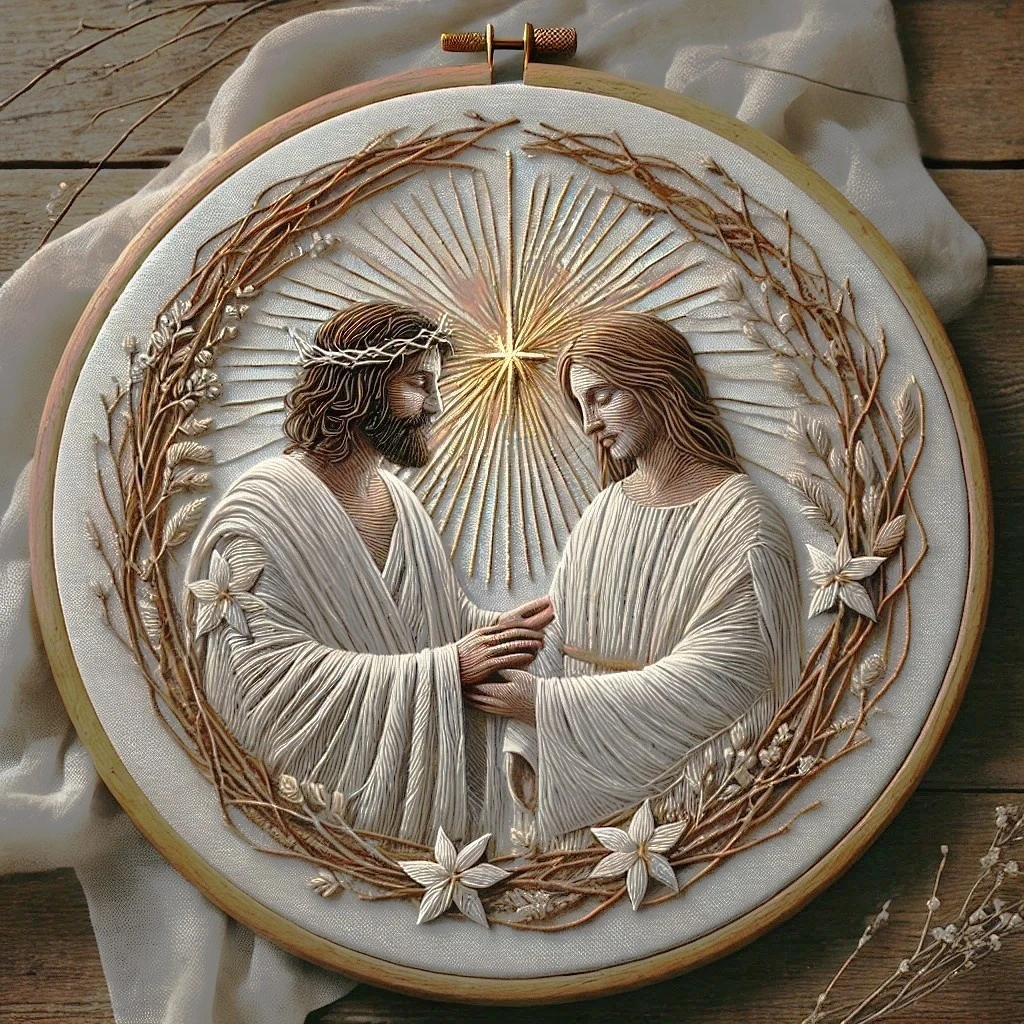
Sacred Embrace Divine Hand Embroidered Portrait

Sacred Embrace Divine Hand Embroidered Portrait - DMC Palette & Stitch Guide
Sacred Embrace  Divine Hand Embroidered Portrait
DMC Palette & Stitching Notes

Sacred Embrace Divine Hand Embroidered Portrait

A warm, reverent portrait guide built around gentle skin shading, muted robes, antique-gold radiance, soft facial features, and clean devotional outlines.

Portrait shadingHalo glowSoft draperyBeginner-friendly layers

Palette and technique notes are tuned for a sacred embrace portrait with warm faces, golden halo light, earthy outlines, and softly folded garments.

Color Story

This design works best when the portrait feels calm rather than high-contrast: creamy fabric space, peach and rose skin tones, honey-gold highlights, weathered browns for hair and outlines, and muted blue-green or taupe robes to keep the sacred focal point glowing.

DMC 945
Tawny
Main warm skin tone for cheeks, hands, and softly lit facial planes.
DMC 948
Very Light Peach
Skin highlights on brow, nose bridge, fingertips, and upper cheeks.
DMC 3778
Light Terra Cotta
Subtle blush, lip warmth, eyelid shadows, and hand crease shading.
DMC 898
Very Dark Coffee Brown
Deep hair, eyelashes, nostril dots, robe creases, and selective outlines.
DMC 3371
Black Brown
Tiny anchoring details only: pupils, darkest hair gaps, and under-chin shadow.
DMC 783
Medium Topaz
Halo rings, golden robe edges, rays, and luminous sacred accents.
DMC 3822
Light Straw
Soft halo highlights and tiny sparkle stitches beside topaz areas.
DMC 931
Medium Antique Blue
Blue robe base, shadowed veil folds, and quiet background contrast.
DMC 932
Light Antique Blue
Robe highlights and feathered fold transitions over DMC 931.
DMC 3012
Medium Khaki Green
Muted mantle shadows, olive-gray fabric, or botanical devotional accents.
DMC 3863
Medium Mocha Beige
Taupe robe sections, background linework, and warm neutral transitions.
DMC 3865
Winter White
Eye whites, veil glints, halo glimmers, and final clean highlights.

Stitch Plan

AreaRecommended stitchesWorking notes
Faces & handsLong-and-short stitch, split stitch edgeUse 1 strand for blended portrait shading. Keep stitches short around eyes, lips, and fingers so curves remain delicate.
Hair & beardStem stitch, split stitch, single straight stitchesFollow the direction of the hair growth. Mix 898 with occasional 3863 strands for warm brown movement.
Halo & raysBack stitch, couching, satin stitch accentsUse 783 for structure and 3822/3865 for light. Couch longer gold lines to keep circular rays smooth.
Robes & veilStem stitch folds, long-and-short fill, satin stitch bordersShade folds from 931 to 932, or 3012 to 3863 for olive-taupe fabric. Leave some fabric visible for airiness.
OutlinesSplit back stitch, whipped back stitchUse 1 strand of 898 for most contours; reserve 3371 for only the darkest accents.

Thread Counts

1 strand: facial features, eyelids, lips, fingers, subtle shading, and tiny highlights.
2 strands: robe folds, hair masses, halo outlines, and general contour lines.
3 strands: bold outer robe edges or decorative gold bands when the pattern needs extra emphasis.
Blended needle: combine 1 strand 945 + 1 strand 948 for skin highlights, or 1 strand 931 + 1 strand 932 for soft robe transitions.
Portrait tip: finish the eyes, mouth, and darkest facial marks last. This prevents the expression from becoming too heavy while the surrounding shading is still incomplete.

Shading, Texture & Blending Guidance

Skin glow Start with 948 in the brightest areas, feather 945 into it, then use 3778 sparingly under cheeks, chin, and hands. Avoid dense satin blocks on faces; small directional stitches look softer.
Sacred light Work halo circles with smooth back stitch or couching. Add short 3822 straight stitches radiating outward, then place tiny 3865 touches only where you want a glint.
Garment folds Stitch folds in the direction fabric would fall. Put darker 931 or 3012 in crease lines, then soften one side with 932 or 3863 so the robes look layered but not bulky.

Outlining details

For a devotional portrait, outlining should support the emotion without flattening the faces. Use split back stitch in 898 around hair, outer robe curves, and hand silhouettes. Use 3371 only for pupils, the deepest nostril point, and a few hair-shadow anchors. For halos, a whipped back stitch in 783 creates a polished raised rim.

Texture suggestions

Add fine straight stitches in hair for natural direction, seed stitch in the background glow for subtle sparkle, and couching over longer robe borders to keep lines even. A few single-strand stitches crossing the robe folds can suggest woven fabric without overfilling the design.
Beginner-Friendly Practical Tips

Transfer the face and hands with the finest pen or pencil line you can manage; heavy transfer marks are difficult to hide under single-strand portrait stitches.
Work from light to dark on the skin, but from dark to light on robe folds. This makes it easier to control expression while keeping the garments dimensional.
Use a 5–6 inch hoop for control, keep the fabric drum-tight, and loosen the hoop between sessions to avoid permanent ring marks.
Separate every floss strand before recombining. This reduces twisting and gives smoother satin, split, and long-and-short stitches.
Step back often. Portrait embroidery can look patchy up close while you are stitching, but the shading blends visually from normal viewing distance.
Designed as a practical DMC palette and stitching companion for the Sacred Embrace Divine Hand Embroidered Portrait pattern.

Leave a Reply

Your email address will not be published. Required fields are marked *