
DMC palette & hand embroidery notes
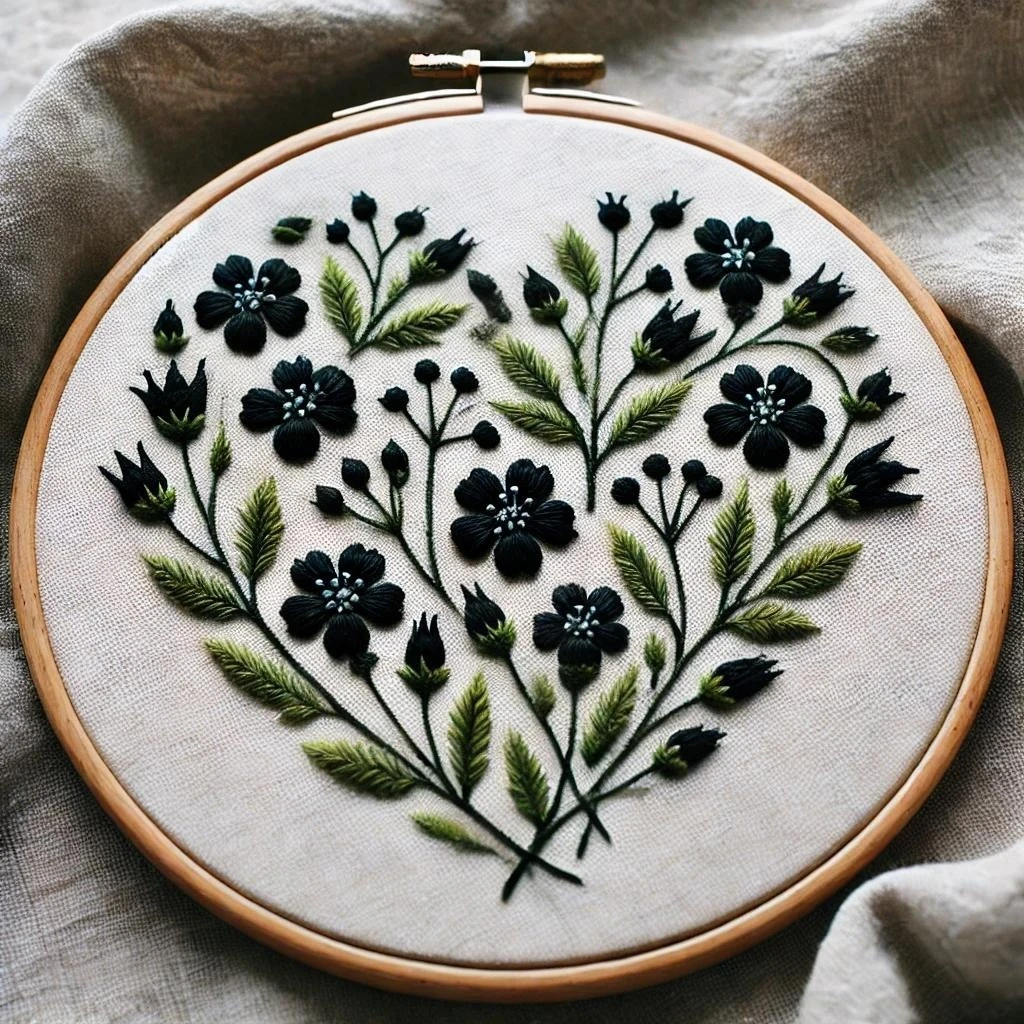
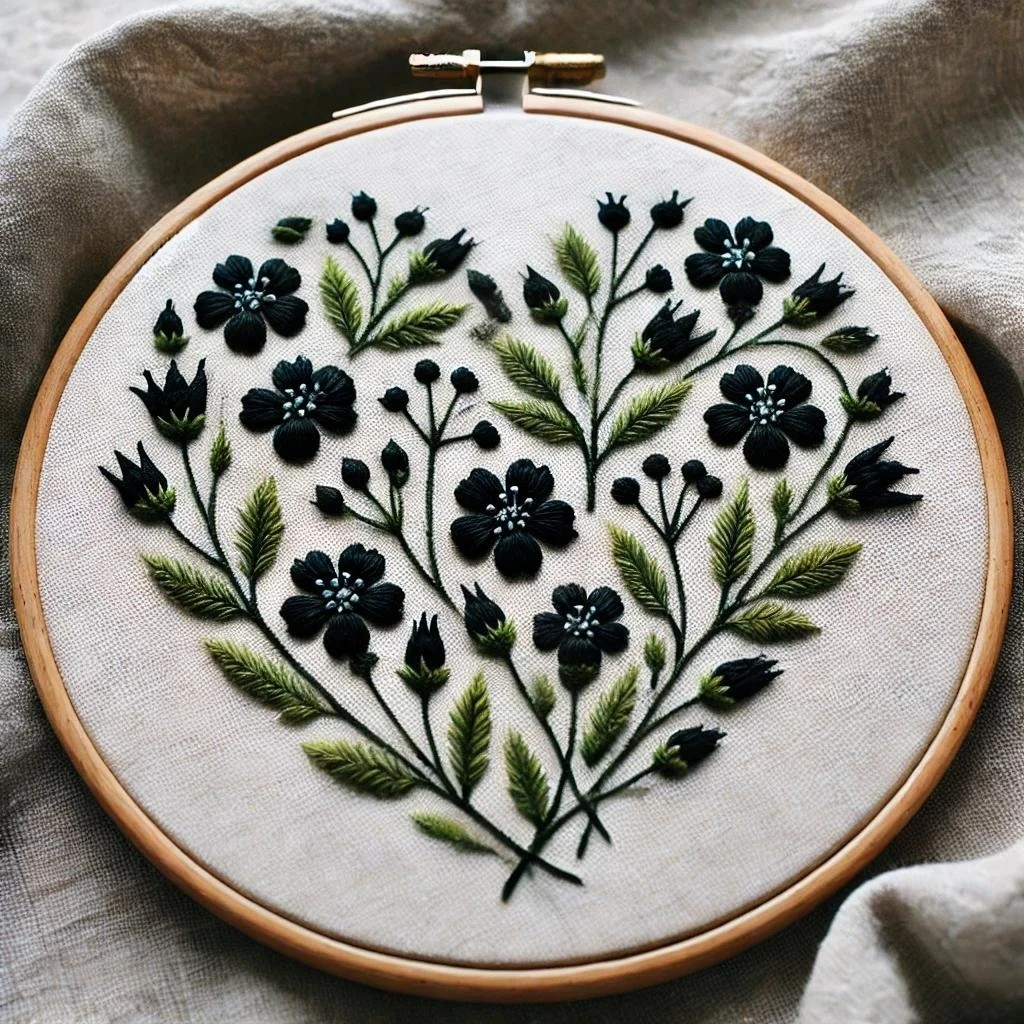
Black and Green Heart Shaped Floral
A refined botanical heart design built from dark graphic outlines, climbing greenery, small floral details, and negative-space curves. The palette should feel elegant and modern: near-black for the heart framework, layered greens for leaves and stems, and restrained ivory, pale yellow, and soft sage highlights to keep the motif dimensional without losing its crisp silhouette.
Design color read
The reference reads as a heart-shaped arrangement where black linework gives the floral shape its drama and the greens soften it with leaves, tendrils, and botanical fill. Keep the black smooth and intentional—too many heavy strands can flatten the design—then build movement with medium and light greens along each stem and leaf vein.
For the most polished result, treat the black areas like fine ink drawing and the greens like watercolor shading: crisp outlines first, then small tonal changes inside the leaves and floral sprigs.
Suggested DMC palette
Stitch plan by design area
| Area | Stitches & handling |
|---|---|
| Heart outline | Use split stitch or stem stitch with 2 strands of DMC 310. Keep curves smooth by shortening stitches around tight turns. |
| Fine vines | Work stem stitch with 1–2 strands in 699 or 895. For wispy tendrils, use 1 strand and small back stitches. |
| Leaves | Use fishbone stitch for small leaves, satin stitch for simple leaf shapes, or long-and-short stitch for larger shaded leaves. |
| Floral dots | French knots, colonial knots, or tiny detached chain stitches in 746 and 676 keep the flowers neat and raised. |
| Dark petals | Satin stitch in 310 with 1–2 strands, then add one 3799 side stitch if you want a softened black highlight. |
| Veins | Use straight stitch or fly stitch in 3053/704. Add veins after filling so they sit cleanly on top. |
Thread-count guidance
- 1 strand: facial-fine detail equivalent—use for tendrils, tiny leaf veins, and hairline black accents.
- 2 strands: best all-purpose choice for the heart frame, stems, small leaves, and neat outlines.
- 3 strands: use only for fuller leaves or bold black sections that need a strong graphic presence.
- 4+ strands: avoid unless the pattern is enlarged; thick black thread can look rope-like on small curves.
Blending ideas
For larger leaves, blend one strand 699 with one strand 702 for a lively mid-green. For shaded leaves, blend one strand 895 with one strand 699. For soft sage foliage, combine 3052 and 3053.
Shading & texture suggestions
- Shade leaf bases with 895 or 3011, then transition through 699 into 702 or 704 at the tips.
- Keep black satin stitches parallel and snug, but do not pull tightly; puckering is more visible with dark floss.
- Add a few 746 seed stitches near the floral centers to brighten the design without changing its black-and-green identity.
- Use couching for any long sweeping black stems if you want the line to stay perfectly smooth.
- Scatter French knots unevenly in groups of three or five for natural floral texture.
Outlining details
Outline the heart and main floral silhouettes after the inner greenery is complete. This lets the black linework clean up edges and gives the design its polished, graphic finish. On curves, rotate the hoop rather than your wrist, keeping stitch length consistent.
A good order is: pale flower centers, green stems, leaf fills, veins, then black final outline. This keeps dark thread from smudging lighter stitches while you work.
Beginner-friendly stitching sequence
Practical tips
- Cut black floss slightly shorter than green floss; it can fuzz visibly with over-handling.
- Wash hands before stitching light areas, then save the darkest outlining for the end.
- Use a laying tool or needle tip to smooth black satin stitches.
Palette balance
Aim for about 35% black, 50% greens, and 15% pale/gold accents. This keeps the heart shape bold while preserving the floral softness.
Optional variations
For a softer look, replace some 310 with 3799. For a fresher spring look, use more 704 and 3053. For a dramatic gothic style, increase 310 outlines and reduce gold accents.