
DMC palette & stitching guide
Vibrant Butterfly and Floral
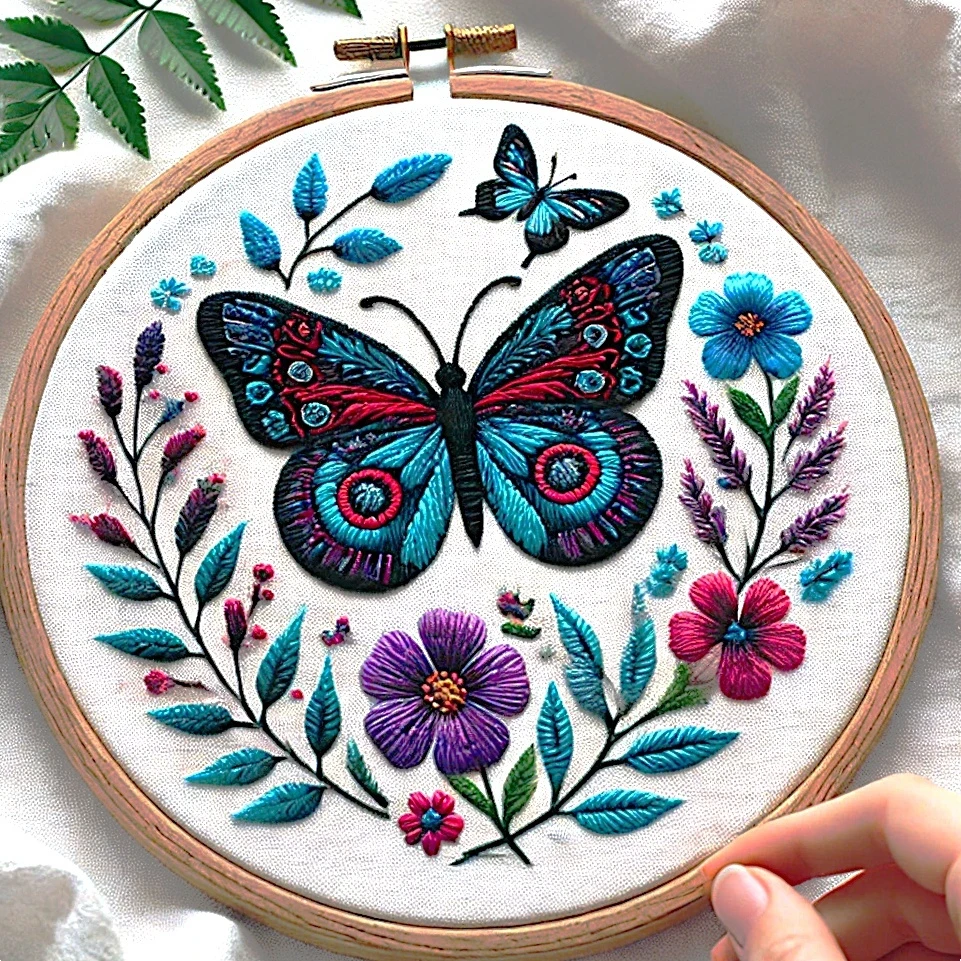
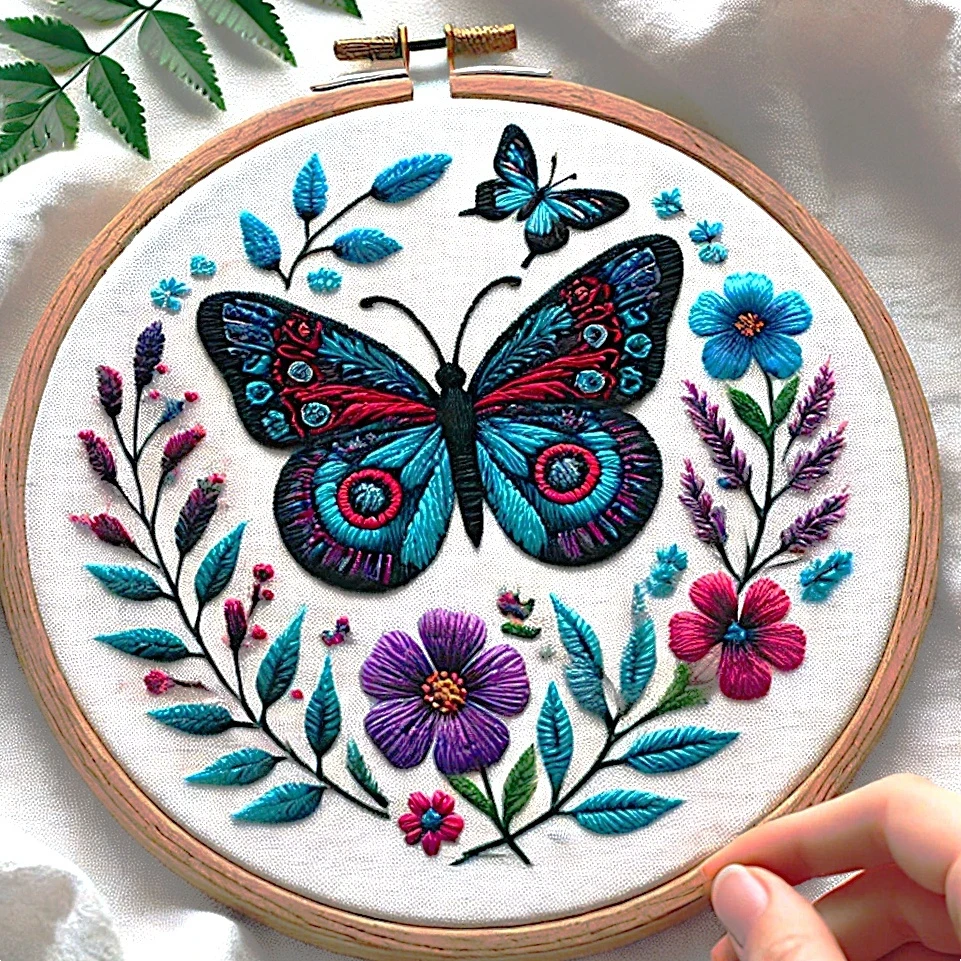
A polished hand-embroidery planning page for a bright hoop design featuring a showy butterfly, lively floral accents, curling stems, and fresh garden greenery.
Design read
The reference reads as a cheerful, high-contrast garden hoop: a saturated butterfly is the focal point, with warm pinks, orange-coral, violet accents, small yellow highlights, and leafy stems framing the movement. Keep the butterfly crisp and luminous, then let the florals feel slightly looser and more organic.
Suggested DMC palette
Use the colors below as practical matches rather than rigid rules. For a softer look, reduce the darkest outline by one strand; for a bolder hoop-art finish, keep the outline clean and consistent.
Stitch map by design area
Butterfly wings
Use long-and-short stitch for each wing segment, changing direction with the wing veins. Blend 604 + 741 for coral-pink warmth, then add 552 at the inner bases for depth.
Wing markings
Work small satin stitches, seed stitches, or detached chain dots in 742, 3845, and 963. Keep marks mirrored but not perfectly identical for a handmade natural feel.
Body & antennae
Use 2 strands of 3371 in padded satin for the body. Stitch antennae with 1 strand in back stitch or stem stitch, finishing tips with tiny French knots.
Flowers
Use satin stitch for larger petals, lazy daisy for smaller petals, and French knots in 742 or 666 for centers. Alternate pinks so the blooms do not look flat.
Leaves & stems
Use stem stitch for vines and fishbone stitch for leaves. Place 895 on the shaded side, 905 through the middle, and 907 on the tips.
Fine outlines
Outline only the most important edges with 1 strand of 3371. Too much outline can flatten the design; reserve it for the butterfly body, wing veins, and selected petal edges.
Thread-count guidance
| Area | Recommended strands | Why it works |
|---|---|---|
| Butterfly wing fills | 2 strands | Gives smooth coverage while still allowing controlled color blending. |
| Wing veins and antennae | 1 strand | Keeps delicate lines crisp and prevents the butterfly from looking heavy. |
| Flower petals | 2 strands, or 3 for bold satin | Creates plush color; use fewer strands on tiny petals. |
| Leaf fills | 2 strands | Balances texture with clean shape definition. |
| French knots and pollen dots | 1-2 strands | Use 1 wrap for subtle dots, 2 wraps for raised centers. |
| Final outline accents | 1 strand | Provides definition without overpowering bright colors. |
Blending, shading & texture
Wing gradient recipe
- Start inner wing shadows with DMC 552 and short stitches.
- Blend outward using alternating stitches of 604 and 741.
- Place 963 along top edges as tiny highlight stitches, not solid blocks.
- Add a few 3845 stitches for a modern cool contrast.
Floral texture recipe
- Use satin stitch for bold petals and vary stitch length slightly.
- Add seed stitches between flowers to suggest small filler blossoms.
- Use French knots in warm yellow and red for lively centers.
- Keep leaves matte and directional so the flowers remain the brightest elements.
Beginner-friendly stitching order
Extra finishing suggestions
For a clean modern hoop
Keep negative space open around the butterfly and avoid overfilling the background. Press from the back on a towel so raised knots and satin stitches stay dimensional.
For more dimension
Add a few detached chain stitches around the blooms, couch a single green vine curve, or pad the butterfly body before satin stitching for a raised center.