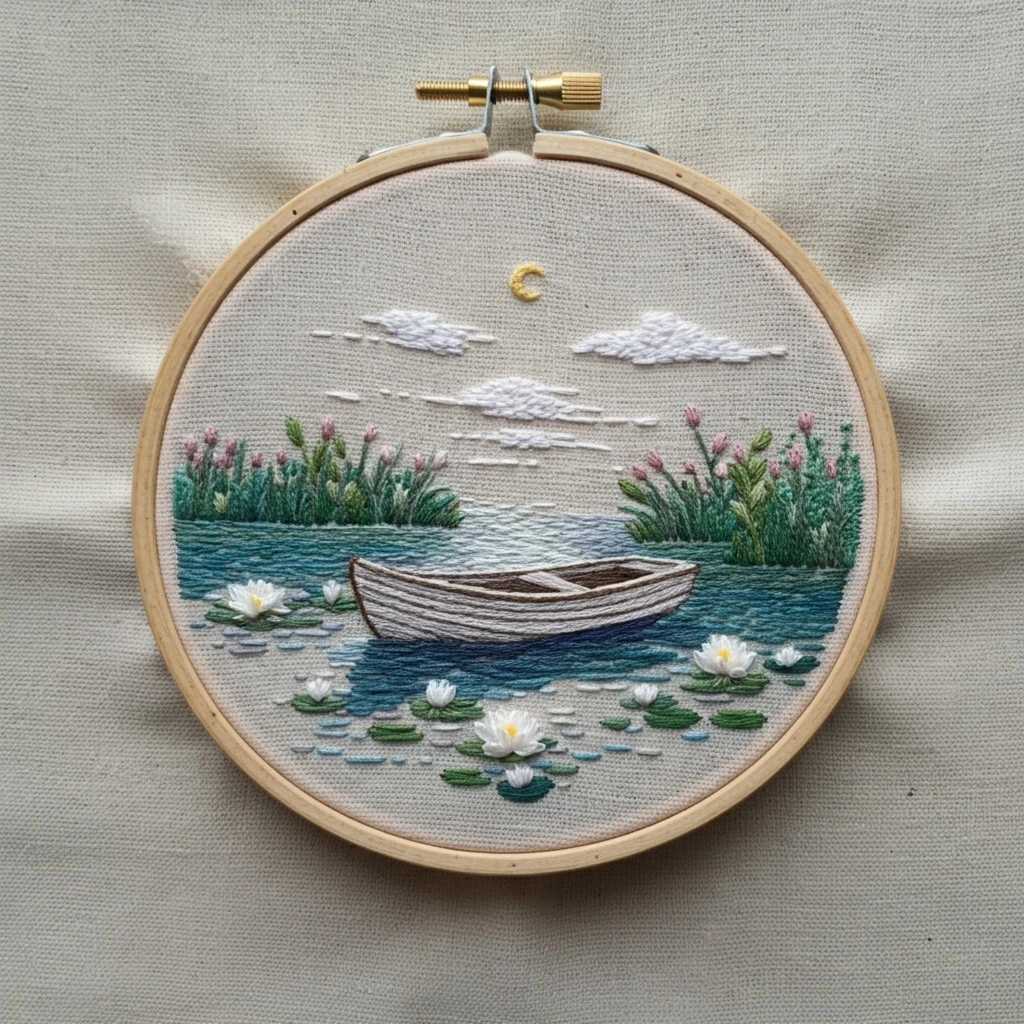

Serene Boat on a Lily Pond
A calm embroidery plan for a quiet pond scene: weathered boat planks, layered lily pads, gentle water reflections, soft blossom accents, and reeds worked with painterly thread blending.
Image-inspired DMC palette
Use the darker shades for structure first, then soften with midtones and single-strand highlights so the pond stays airy rather than heavy.
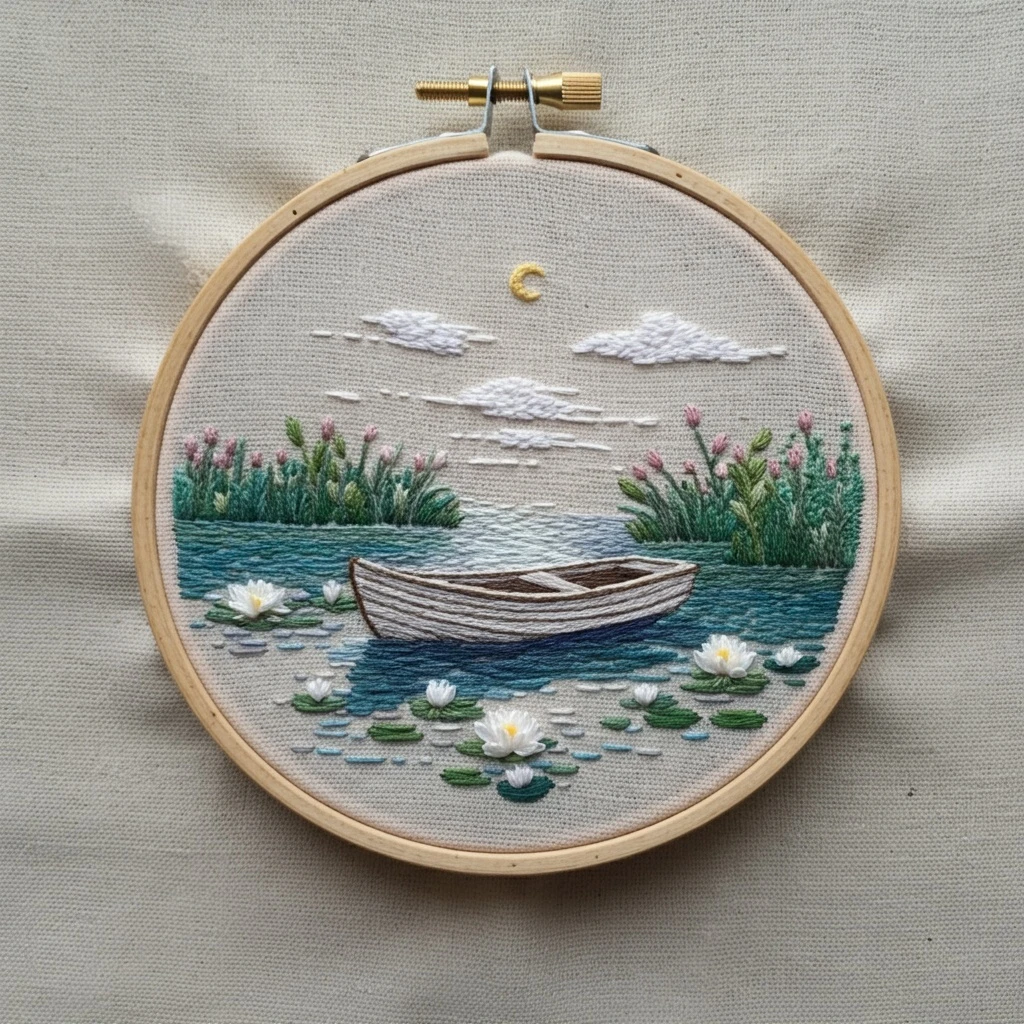
Stitch map
Water ripples
Use irregular horizontal back stitch, stem stitch, and whipped running stitch in 3810, 503, and 747. Keep gaps between ripple lines so the background fabric acts as reflected light.
Lily pads
Work fishbone stitch or satin stitch from the outer rim toward the center notch. Add one-strand curved veins in 936 or 3053 for shape without bulk.
Boat planks
Use long-and-short stitch in 975 and 977, then add broken straight stitches in 738 and 642 to suggest weathered wood grain.
Lily flowers
Use detached chain petals or small satin petals in 3688 and 3689, with French knots in 3822. Add one tiny 3865 stitch at the brightest petal tip.
Reeds and grasses
Work stem stitch for thicker reeds and single long straight stitches for fine grasses. Alternate 936, 3052, and 3012 for a natural bank edge.
Fine outlining
Back stitch the underside of the boat and select pad overlaps with 844 or 642. Avoid outlining every leaf; leave some edges soft to preserve the serene mood.
Blending and shading recipes
These combinations keep the palette cohesive while giving the water, wood, and foliage their own surface character.
Pond depth
Blend one strand 3810 with one strand 503 for mid-depth ripples. Switch to single-strand 747 only at the strongest reflected highlights.
Lily pad roundness
Place 936 near notches and overlaps, 3052 across the body, and 3053 at the upper rim. Curve stitches to follow the pad shape.
Weathered boat
Start with 975 shadows, fill plank sections with 977, then add tiny broken 738 highlights. Keep stitches slightly uneven for rustic charm.
Practical embroidery plan
Work from background to foreground, saving high-contrast details for the very end.
Suggested order
- Transfer the design lightly; mark only the key water lines, boat edges, and largest lily pads.
- Stitch pale water glints first with 747 or 3865 so they stay crisp and clean.
- Add midtone water ripples, then lily pads, then boat planks and reeds.
- Finish with flower centers, fine veins, and selective dark outlines.
Texture suggestions
- Use uneven stitch lengths in the boat to imitate natural wood instead of smooth satin blocks.
- Angle lily-pad stitches toward their central split to make each pad look rounded.
- Use tiny seed stitches in muted greens near the pond edge for moss and distant foliage.
- Keep water stitches flatter and more horizontal than plant stitches for visual contrast.
Beginner-friendly tips
- Test water ripple spacing on scrap fabric; too many lines can make the pond look crowded.
- Use shorter thread lengths for 747 and 3865 so pale highlights do not pick up lint.
- When satin stitching lily pads, outline the shape first so the edge stays neat.
- If a flower feels too bright, add a single 3688 shadow stitch at the base of each petal.
Finishing details
- Press the finished piece face-down on a towel to protect French knots and raised petals.
- Trim jump threads behind pale water areas to prevent shadows showing through light fabric.
- For a gallery-style hoop, wrap the outer hoop with natural cotton tape or use a stained wood hoop.
- Leave a small breathing space around the design so the pond scene feels peaceful and open.