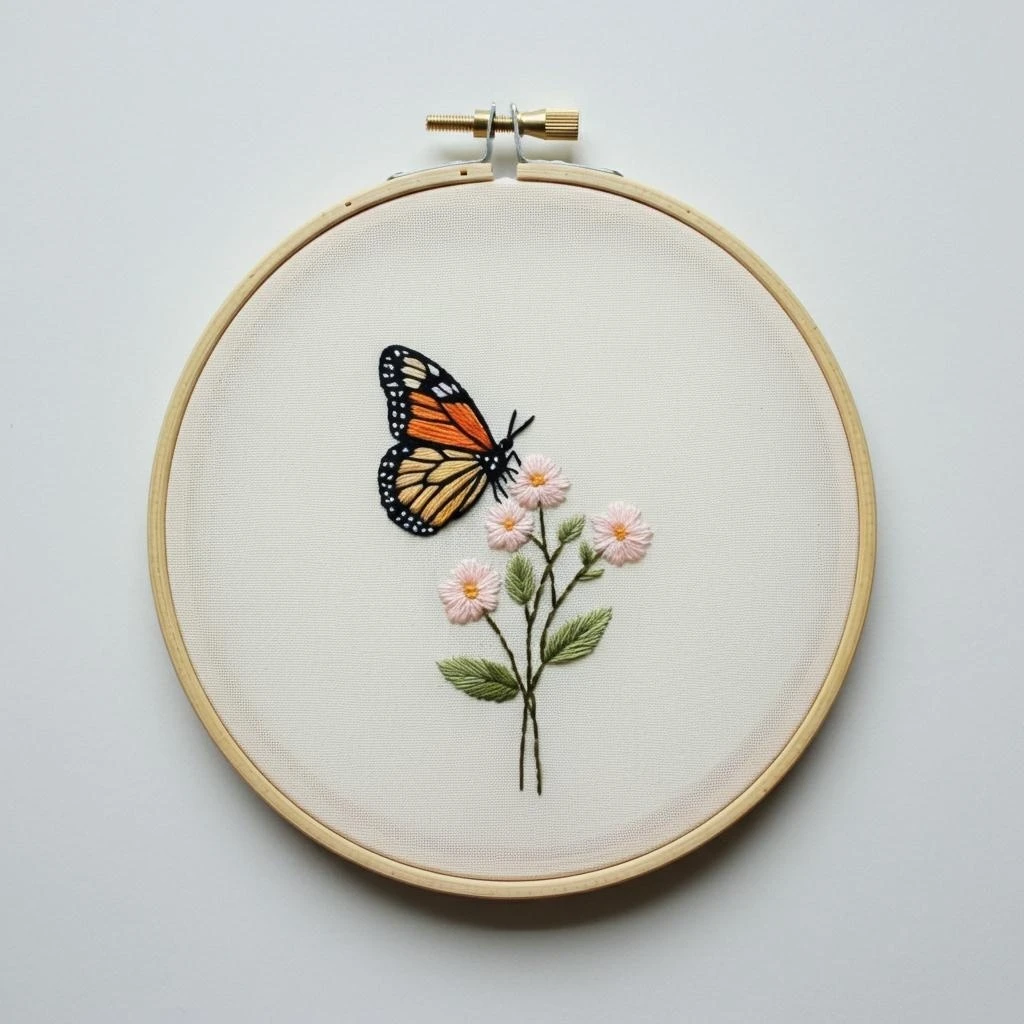

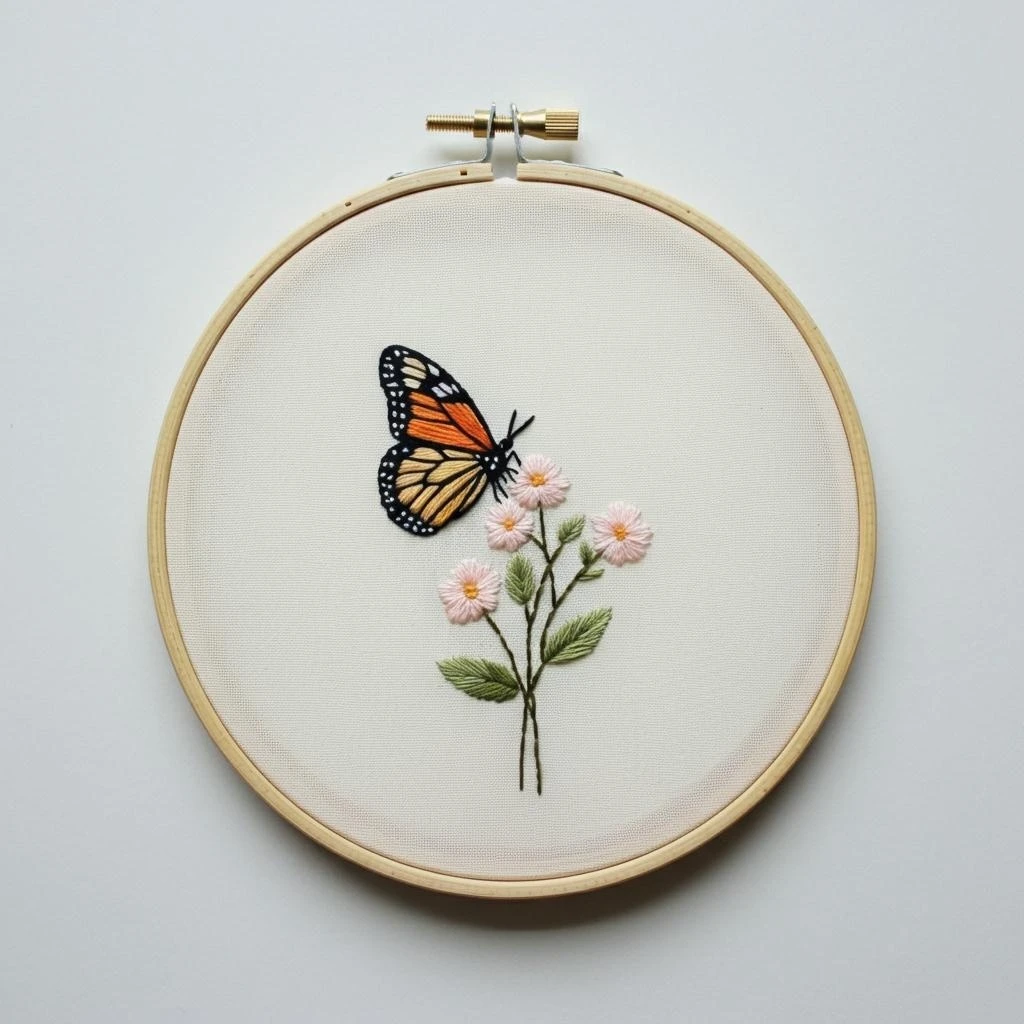
Monarch Butterfly and Pink Flowers
A delicate hoop design with a black-lined monarch, warm orange and honey wing panels, pale pink daisy-like blooms, olive-green leaves, and slender dark stems on natural fabric. The stitching approach should stay airy: crisp outlines, soft flower texture, and controlled satin fills so the butterfly remains the focal point.
Suggested DMC Floss Palette
Use the black and cream marks sparingly but precisely; the design depends on contrast between the monarch’s dark edges and the soft, pastel flower cluster.
Butterfly Stitches
- Back stitch / stem stitch: 1–2 strands of DMC 310 for the outer wing contour, body, antennae, and fine legs.
- Satin stitch: 2 strands for orange and gold panels. Angle stitches to follow each wing compartment.
- Seed stitches: tiny 746 stitches or single-wrap French knots for white dots along the black border.
- Long-and-short: blend 741 into 900 at the wing base for a natural monarch fade.
Pink Flower Stitches
- Lazy daisy: beginner-friendly petals with 2 strands of 818.
- Straight stitch petals: use varied lengths for a more delicate, daisy-like texture.
- French knots: 1–2 wraps in 972, with one or two 3821 knots mixed in for warm centers.
- Petal shading: add 151 near the center and underside petals; keep outer tips pale.
Leaves & Stems
- Fishbone stitch: 2 strands of 3052, alternating with 3053 for leafy highlights.
- Split stitch veins: 1 strand 3011 along leaf centers for crisp botanical structure.
- Stem stitch: 1–2 strands of 3371 for slender stems; switch to 3011 on green side shoots.
- Tiny straight stitches: for small sprigs and leaf tips to keep the bouquet airy.
Thread-Count Guidance
| Area | Strands | Reason |
|---|---|---|
| Butterfly outline | 1–2 | Use 1 strand for antennae and small details; 2 strands for outer wing edges. |
| Wing fills | 2 | Gives solid color without bulky ridges in the small wing sections. |
| Flower petals | 2 | Soft enough for pale petals while still visible on cream fabric. |
| Flower centers | 2–3 | French knots need enough body to stand out from the petals. |
| Stems and fine sprigs | 1 | Keeps the bouquet graceful and prevents dark lines from overpowering the flowers. |
Blending & Shading Ideas
- Blend one strand 741 with one strand 900 in the upper orange wing where the color meets black veins.
- Blend one strand 3821 with one strand 746 for the pale golden wing sections if you want a softer transition.
- Alternate 818 and 151 petals around each flower; avoid making every petal the same shade.
- Use 3052 for the leaf body, then place a few 3053 stitches on the upper edge to suggest light.
Beginner-Friendly Practical Tips
Order of Work
- Transfer only essential lines lightly; the pale petals and cream wing spots should stay clean.
- Stitch stems and leaf veins first so the flower placement feels anchored.
- Complete leaves, then flowers, then the butterfly fills.
- Finish with black outlines, antennae, legs, dots, and flower-center knots.
Texture Control
- Keep satin stitches under 8–10 mm; split long sections into smaller directional fills.
- Use a laying tool or needle tip to smooth orange strands before tightening.
- For fluffy flower centers, cluster knots loosely rather than stacking them too tightly.
- Rotate the hoop as you stitch petals so each lazy daisy loop sits naturally around the center.
Design Notes for a Polished Finish
The reference design balances a detailed monarch against a very simple stem bouquet. Let the butterfly be the boldest area: deep black outlines, bright orange panels, and tiny cream dots. Keep the pink flowers soft and slightly translucent in feeling by using fewer strands and small open spaces between petals. The green leaves should provide texture without becoming heavy, so work them with angled stitches rather than solid satin blocks.
For a framed hoop, press from the back on a towel, avoid crushing French knots, and trim jump threads behind the pale fabric so no dark shadows show through.