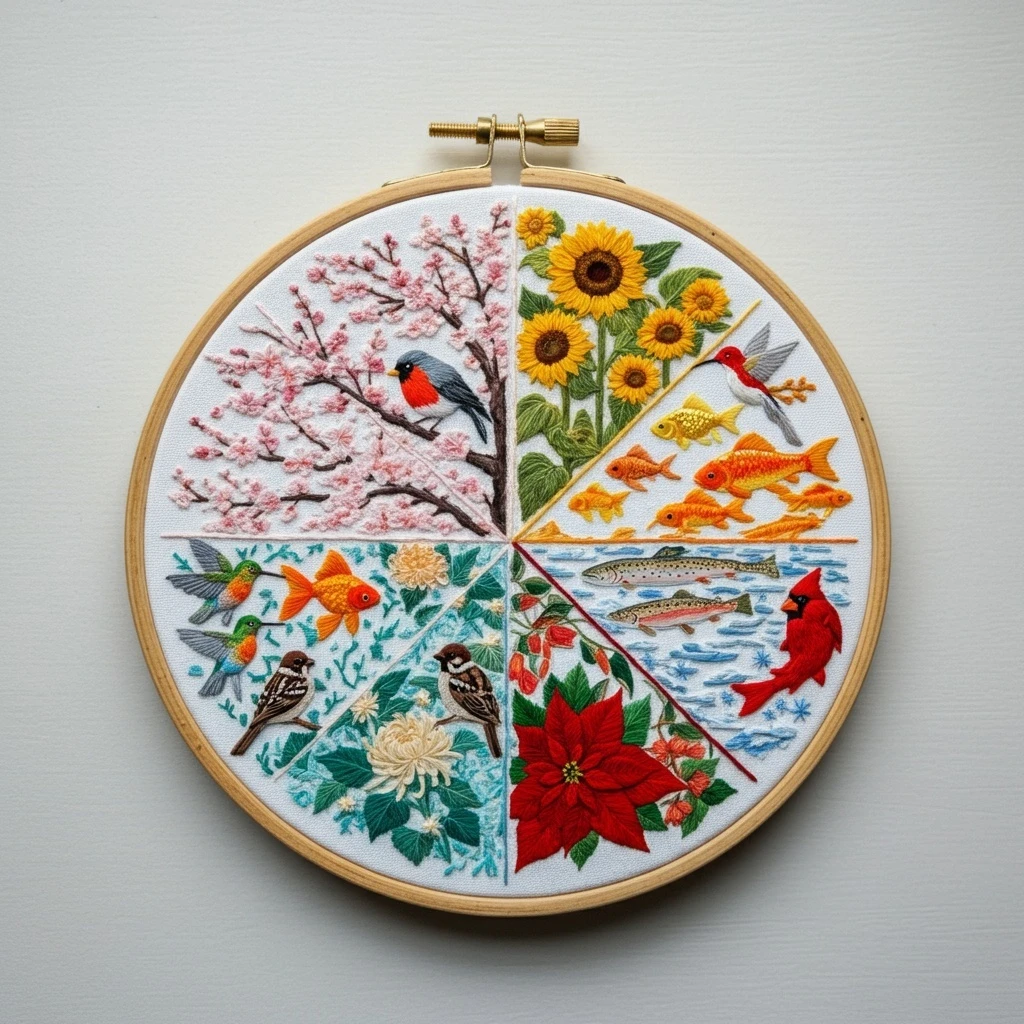

Four Seasons Nature Circle
A colorful hoop-art embroidery guide for a divided seasonal landscape, with spring blossoms, summer sunflowers, autumn garden life, and winter birds, fish, and greenery.
Preview

The visible design is arranged like a round seasonal wheel inside a wooden hoop. Each wedge has its own mood: soft pink blossom branches with a small blue-and-red bird, bright sunflower stems with a hummingbird and golden fish, cool blue water with trout and a red cardinal, and a lower garden section filled with teal leaves, cream flowers, orange fish, hummingbirds, and small brown birds. The composition is detailed but balanced, with thin dividing lines helping the stitcher work one scene at a time.
Likely DMC Color Palette
Use this as a practical starting palette. The design appears to use many small accents, so several shades below may only be needed in small lengths. Percentages are visual coverage estimates from the preview image, not exact skein quantities.
| DMC | Approx. Hex | Official-style Thread Name | Est. Coverage | Where It Appears |
|---|---|---|---|---|
| 310 | #0B0B0B | Black | 5% | Bird eyes, beaks, tiny outlines, fish speckles, and the deepest accents in branches and feathers. |
| 433 | #5B3A26 | Medium Brown | 7% | Tree branches, sparrow bodies, sunflower centers, cabin-like natural shadows, and warm contour details. |
| 3371 | #2D1D18 | Black Brown | 4% | Darkest branch lines, sunflower centers, bird markings, and deeper outlines on the fish and animals. |
| 818 | #F7CACA | Baby Pink | 5% | Pale spring blossoms and soft flower clusters in the upper-left seasonal wedge. |
| 3354 | #E88FA0 | Light Dusty Rose | 4% | Darker blossom petals, pink buds, and scattered spring flower highlights. |
| 972 | #FFB515 | Deep Canary | 8% | Sunflower petals, golden fish scales, warm flower accents, and golden seasonal dividing details. |
| 740 | #FF8C00 | Tangerine | 7% | Orange fish, hummingbird throats, autumn berries, and warm flower shading. |
| 947 | #F15A24 | Burnt Orange | 5% | Deep orange fish shadows, small autumn details, and warmer red-orange accents. |
| 666 | #C9001F | Bright Red | 8% | Cardinal body, poinsettia-style winter flower, red bird breast, and bold holiday-season accents. |
| 815 | #8F0115 | Medium Garnet | 3% | Deep red petal folds, cardinal shadows, berry details, and darker red dividing line accents. |
| 699 | #2F8F39 | Green | 8% | Sunflower leaves, large poinsettia leaves, garden foliage, and main leafy shapes throughout the design. |
| 500 | #135C45 | Very Dark Blue Green | 5% | Deep teal leaf shadows, lower-left foliage, evergreen-feeling accents, and dark green outlines. |
| 3810 | #2AA198 | Dark Turquoise | 6% | Lower-left leafy sprigs, blue-green garden filler, hummingbird accents, and cool seasonal foliage. |
| 3843 | #5CA8C9 | Electric Blue | 5% | Water ripples, cool winter/spring stitch accents, blue bird feathers, and pale blue dividing lines. |
| 3768 | #3D6F86 | Dark Grey Green | 4% | Blue-gray feathers, fish backs, shaded water, and muted cool outlines. |
| 415 | #B7C0C7 | Pearl Gray | 3% | Hummingbird wings, fish body highlights, pale feather details, and cool neutral shading. |
| 3865 | #F6EED8 | Winter White | 5% | Cream flowers, pale petal highlights, light fish bellies, and soft stitched highlights over the white fabric. |
| 3862 | #D9B382 | Mocha Beige | 3% | Hoop-toned natural accents, bird and flower shadows, and subtle warm neutrals in animal details. |
Stitching Suggestions
The visible artwork has fine outlines, filled petals, feathery birds, small fish, and repeated leaf shapes. A combination of outline stitches, satin stitches, detached chain stitches, and small texture stitches will keep it lively without becoming too heavy.
Spring Blossom Branches
- Branches: use stem stitch or back stitch with one to two strands for slender, slightly curved lines.
- Blossoms: try lazy daisy, small straight stitches, or tiny French knots clustered around branch tips.
- Practical note: vary pale and darker pinks so the blossom wedge does not look flat from a distance.
Sunflowers and Golden Fish
- Petals: long-and-short stitch or closely placed straight stitches radiating from each center.
- Centers: French knots, seed stitch, or tight satin stitch in brown and black-brown.
- Fish: satin stitch for bodies, split stitch for outlines, and short straight stitches for fins and tails.
Water, Trout, and Cool Details
- Ripples: use broken running stitch or loose back stitch in two blue shades so the water stays airy.
- Fish bodies: combine gray, beige, and blue-gray with tiny dark speckles after the main shapes are complete.
- Snowflake-like accents: tiny straight stitches or star stitches work well in pale blue or gray.
Birds, Leaves, and Lower Garden Areas
- Leaves: fishbone stitch, satin stitch, or paired straight stitches following the leaf vein.
- Bird feathers: use short directional straight stitches and save the darkest markings for the end.
- Small flowers: French knots, woven wheel centers, or lazy daisies help separate cream blooms from foliage.
Dividing Lines and Center Point
The radial lines are important to the design’s clean circular layout. Work them after transferring the full design but before filling each seasonal scene, using back stitch, whipped back stitch, or couching for straight, crisp borders. Keep thread tension relaxed so the lines do not pull the fabric inward at the center.
Where to Start
- Transfer the full circle and seasonal wedges first. Mark the center point lightly so the dividing lines meet cleanly.
- Stitch the structural lines. Work the main radial dividers and any large branch or stem outlines before adding tiny details.
- Choose one season at a time. Complete the spring blossom wedge, then move to sunflowers, water, and the lower garden sections to avoid carrying too many colors at once.
- Build from large shapes to accents. Fill flowers, leaves, birds, and fish bodies first; add dots, feather lines, speckles, and knots last.
- Step back often. This design has many small motifs, so check balance from arm’s length before adding extra knots or shading.
Helpful Notes
- Use fewer strands for the smallest animals. One strand helps keep bird legs, fish outlines, and tiny beaks clean.
- Keep the white background visible. The design feels bright because the fabric shows between motifs; avoid overfilling every gap.
- Group needles by season. Pre-threading pinks for spring, yellows/greens for summer, reds/greens for winter, and blues/grays for water can speed up stitching.
- Blend similar shades when needed. If you do not own every listed color, substitute within the same family: pale pink for blossoms, golden yellow for sunflowers, deep red for cardinal and poinsettia, and teal/green for foliage.
- Coverage estimates are not thread requirements. They describe how much of the visible stitched image each color family appears to occupy in the preview.
Encouraging Finish
This is the kind of hoop that rewards steady, section-by-section stitching. Treat each wedge like a miniature scene rather than trying to finish the whole circle at once. The spring blossoms can be soft and airy, the sunflowers bold and textured, the water loose and flowing, and the birds full of tiny personality.
When all four seasons are complete, give the hoop a final look for balance: a few extra knots in the blossoms, a sharper dark stitch in the bird eyes, or a brighter highlight on the fish can bring the whole nature circle to life. Enjoy the variety—this design is meant to feel like a full year of small stitched moments gathered into one cheerful hoop.