
Four Seasons of Street Food and Scenery
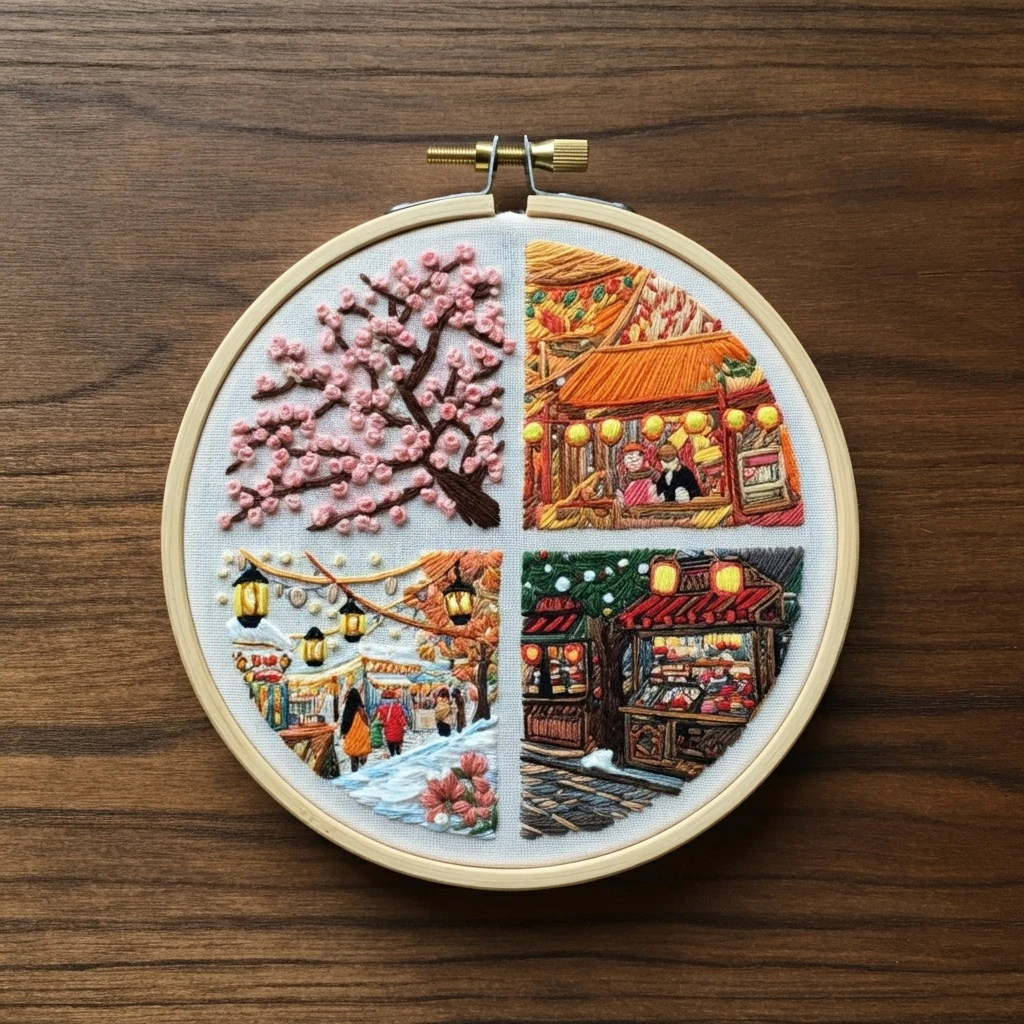
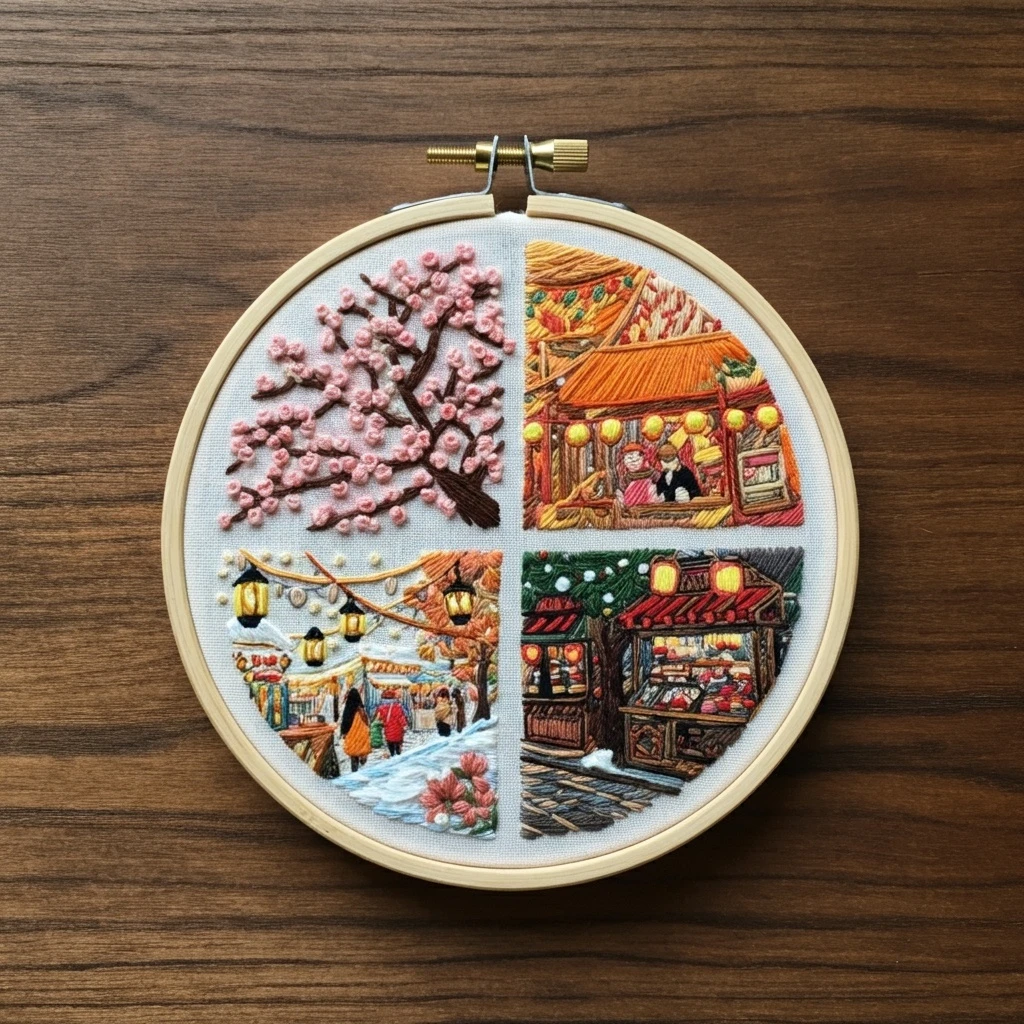
A practical embroidery guide for a round four-quadrant street-market design: pink spring blossoms, golden rooflines, glowing food stalls, lantern-lit night scenery, snowy winter lanes, tiny figures, cobbles, banners, and dense architectural detail.
Suggested DMC Palette
The artwork relies on a wide warm/cool contrast: pale spring blossom, golden lanterns, orange-tan roofs, dark timber stalls, snowy blue shadows, deep night-market greens, and tiny red food accents. These colors keep the seasonal quarters distinct while preserving a cohesive market-scene glow.
Stitch Map by Section
Spring blossom quarter
Work branches first in split stitch or stem stitch using 898, tapering with one strand near the tips. Add blossoms last with French knots and tiny detached chain petals in 761 and 3716. A few Blanc knots in the center make the clusters look fresh and dimensional.
Golden food-stall quarter
Use long-and-short stitch for sloped orange roofs, alternating 741 and 947 so the roof ridges follow the same angle. Work stall frames in 898, counters in 436, and lantern centers in 742 with a tiny Blanc straight stitch highlight.
Snowy street quarter
Stitch the road snow with loose horizontal straight stitches in 747 and 168, leaving fabric gaps for brightness. Lantern cords are best in one strand of 898; hanging lanterns can be padded with 742 so they sit above the pale snow.
Night market quarter
Keep the lower-right stalls dramatic by outlining with 939 and 3371, then filling red awnings with 3777 and 321. Cobblestones should be broken backstitches in 646 rather than solid fill, so the dark ground still breathes.
Blending & Shading
Texture Suggestions
- French knots: Cherry blossom clusters, falling snow, glowing lantern bumps, and tiny food items.
- Stem stitch: Curved branches, hanging wires, market stall trim, and gentle road edges.
- Split stitch: Smooth roof outlines, shop frames, people silhouettes, and dividing architecture lines.
- Satin stitch: Lantern bulbs, bold awning stripes, little jackets, and small roof caps.
- Seed stitch: Cobblestones, distant food texture, snowy ground grit, and background sparkle.
Outlining Details
Avoid a uniform black outline. Use 898 for branches and warm stalls, 939 for night-market depth, 646 for cobbles, and 3777 around red awnings. One-strand backstitch is enough for tiny windows and signs; heavier outlines can crowd the miniature scenes.
Beginner Tips
Work each quadrant from background to foreground: snow/sky first, then buildings, then lanterns, people, food, and knots. Keep thread lengths short when stitching roofs and cobbles, because frequent color changes give the scene its lively market detail.
Finishing Notes
Press face down on a towel to protect raised blossoms and lantern knots. Before mounting, check the four-season balance: add a few pale snow stitches, pink petals, or yellow lantern highlights where a quadrant feels quieter than the others.