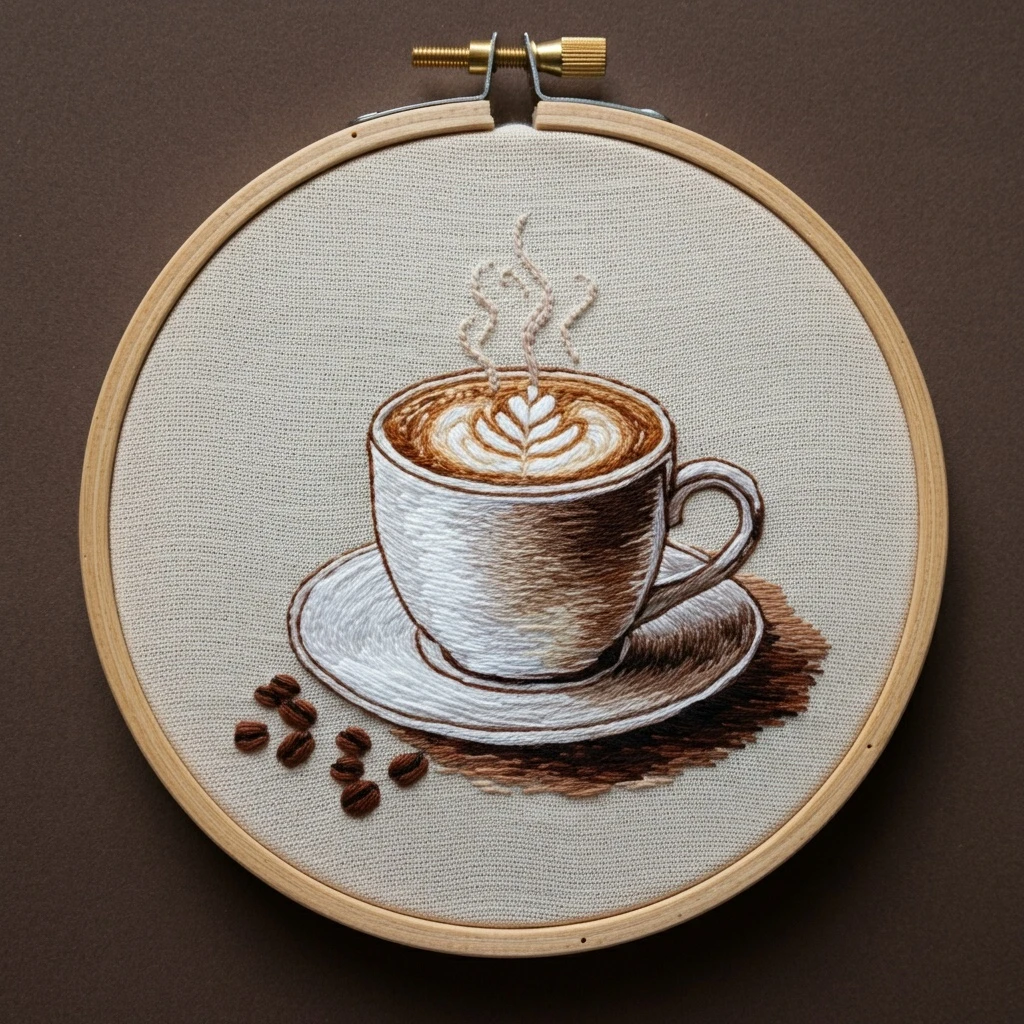

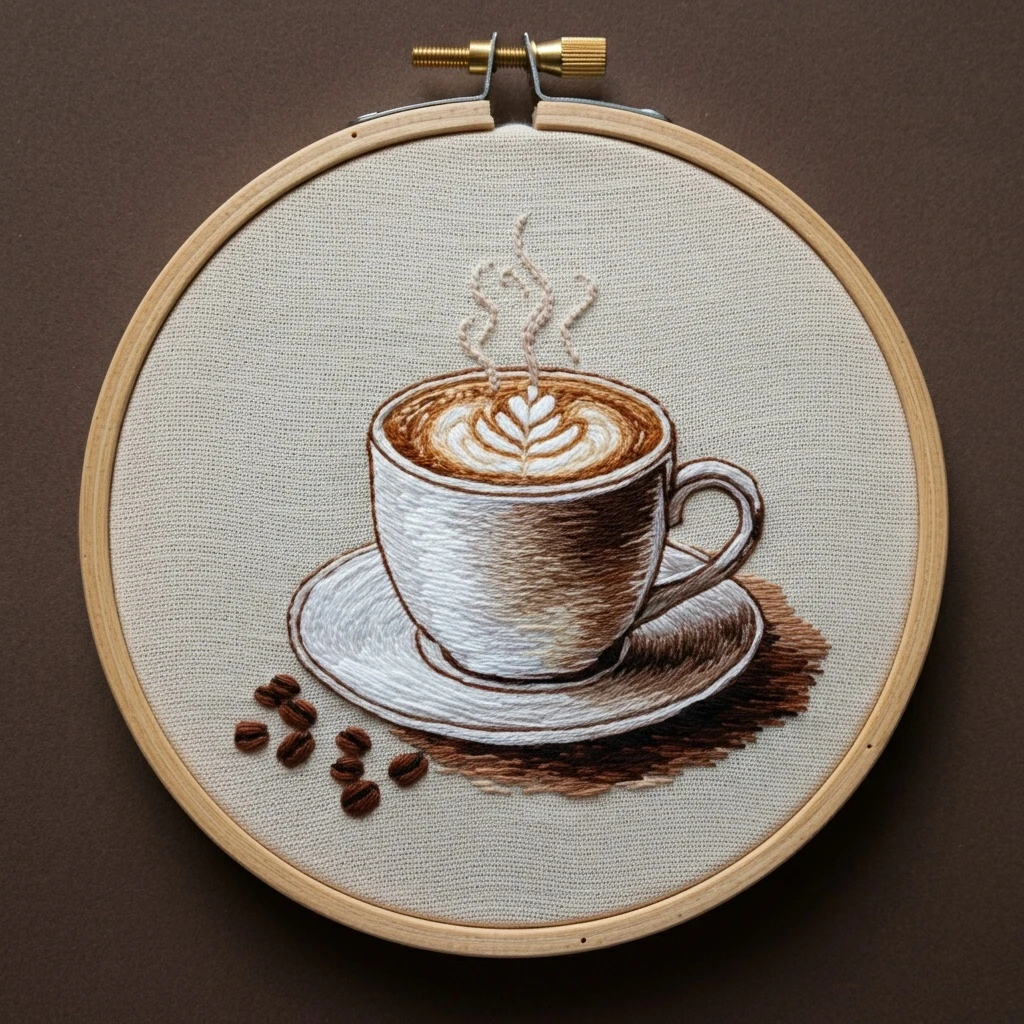
Embroidered Coffee Cup With Latte Art And Beans
A warm café-inspired embroidery with a creamy coffee cup, smooth latte art, roasted beans, soft steam curls, porcelain highlights, and rich brown shadows. These DMC matches are estimated from the visible hoop preview and chosen for practical, polished hand embroidery.
Likely DMC Color Palette
Matched to the porcelain cup, latte foam, coffee crema, saucer shadows, roasted beans, steam curls, table warmth, and optional muted background accents.
Stitching Suggestions
Build the cup and saucer first, then layer the coffee surface, latte art, beans, steam, and final bright highlights.
| Element | Stitch Type | Practical Notes |
|---|---|---|
| Cup body | Long and short stitch | Fill with 3865 and 739, then add 762 and 415 on the shadow side. Keep strokes following the cup curve so the porcelain looks rounded. |
| Cup rim | Whipped backstitch | Backstitch the oval rim in 762 or 739, then whip with 3865 for a raised clean edge. Add B5200 only at the brightest front lip. |
| Cup handle | Satin stitch with split-stitch outline | Use 3865 on the outer curve, 762 inside the handle opening, and 415 or 839 for the deepest interior shadow. |
| Latte surface | Satin stitch | Use 738 and 436 for the coffee base, then blend 739 and 3828 around the foam so the drink looks creamy. |
| Latte art heart or leaf | Stem stitch and satin stitch | Shape the design with 3865 or 739, then shade one edge with 738. Keep the stitches smooth and symmetrical. |
| Crema ring | Split stitch | Use 3828, 975, and 436 around the inside rim. Break the line slightly so it resembles natural coffee crema. |
| Saucer | Long and short stitch | Use 3865 and 739 on the top plane, then 762, 415, and 435 underneath to create a shallow shadow. |
| Cup foot shadow | Backstitch and seed stitch | Use 3031 or 839 sparingly beneath the cup. A small dark crescent grounds the cup without making it heavy. |
| Coffee beans | Padded satin stitch | Pad each bean with a small center stitch, then cover with 801, 898, and 975. Add 3371 in the center groove. |
| Bean center grooves | Split stitch or couching | Use one strand of 3371 or 3031. Make each groove slightly curved rather than perfectly straight. |
| Bean highlights | Tiny straight stitch | Use 436, 3828, or 738 on the upper side of each bean to make the roasted surface look glossy. |
| Steam curls | Stem stitch or whipped backstitch | Use 762, 3865, or 739 in airy curved lines. Keep tension gentle so the curls stay smooth. |
| Steam softness | Seed stitch | Add a few pale seed stitches near the curls using 3865 and 762 for vapor-like texture; avoid overfilling. |
| Table or background | Horizontal straight stitch | Use 739, 436, and 435 in broken horizontal strokes if the design includes a surface under the saucer. |
| Fine outlines | Single-strand backstitch | Use 3031 only where definition is needed: bean edges, cup base, handle interior, and small saucer details. |
| Final highlights | Single straight stitch | Add B5200 and 3865 on the rim, saucer edge, latte art, and bean tops as the final clean sparkle layer. |
Thread Count, Blending & Texture
Use strand changes to make the porcelain smooth, the latte art creamy, the beans dimensional, and the steam light and airy.
Ceramic softness
Use 2 strands for larger cup fills and 1 strand for fold shadows and rim lines. Avoid outlining every white edge so the cup stays porcelain-soft.
Latte art clarity
Mark the latte-art shape before stitching. Use smooth satin stitches and keep the left and right sides balanced for a clean café-style heart or leaf.
Crema blending
Blend 738, 436, 3828, and 975 around the foam. Small broken stitches help the crema look natural rather than like a flat ring.
Glossy beans
Use padded satin stitch for foreground beans. Dark grooves plus tiny tan highlights make the beans look rounded and roasted.
Steam lightness
Use one strand only for steam. Whipped backstitch gives smooth curls, while pale seed stitches add a soft vapor haze.
Beginner control
Complete cup and saucer shapes before adding beans. The beans are darker and can visually dominate if placed too early.
Recommended Stitching Order
This sequence keeps the cup clean and protects raised bean details and tiny highlights from snagging.
Helpful Notes for a Polished Finish
Small finishing choices help the coffee cup look warm, dimensional, and neatly handmade.
- Use firm hoop tension; satin-stitched cup and latte areas show puckering easily.
- Keep the latte-art outline soft. Heavy dark lines can make the foam look printed instead of poured.
- Vary bean angles and sizes slightly so the scattered beans feel natural.
- Use dark brown outlines sparingly; too much 3371 can overpower the creamy cup palette.
- Avoid carrying dark bean threads behind white cup or foam areas where they might shadow through.
- Press the finished hoop face-down on a towel to protect padded beans, steam texture, and raised rim stitching.