
Wildflower Meadow
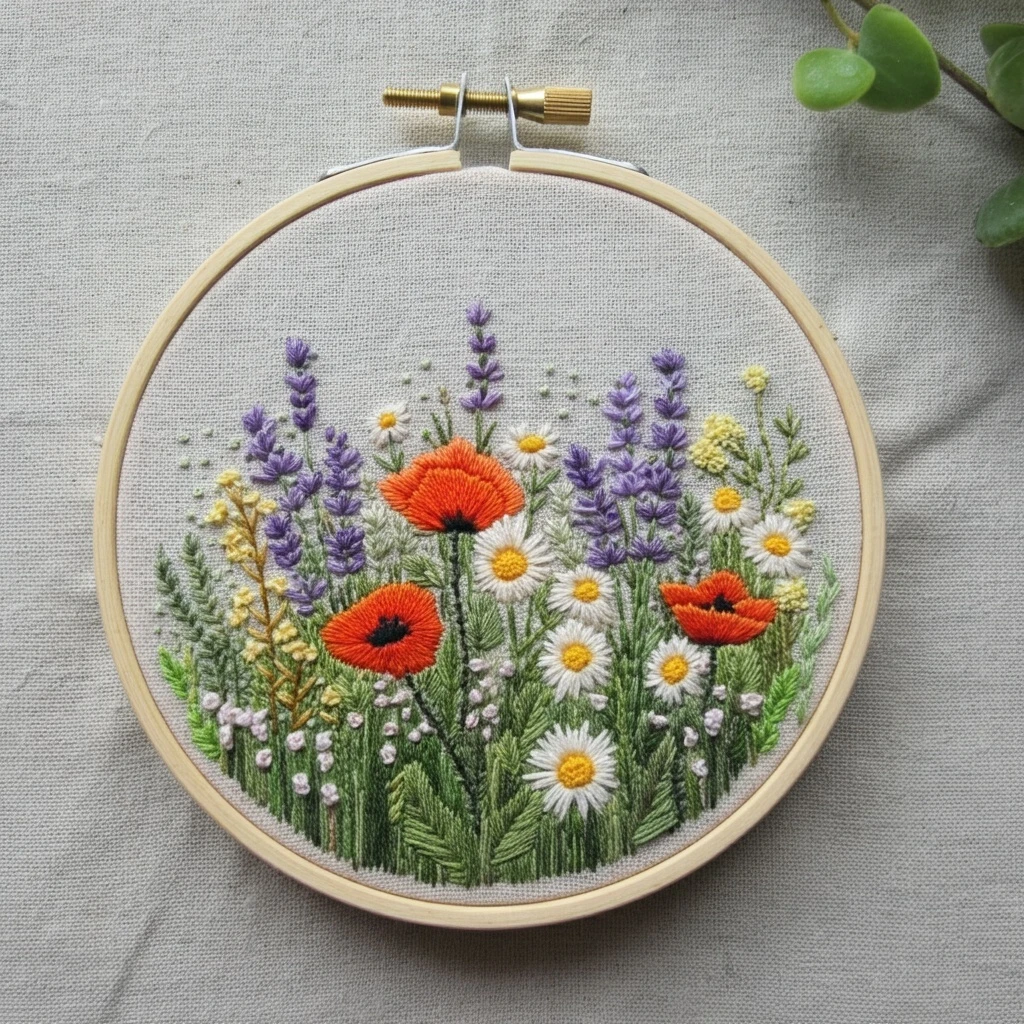
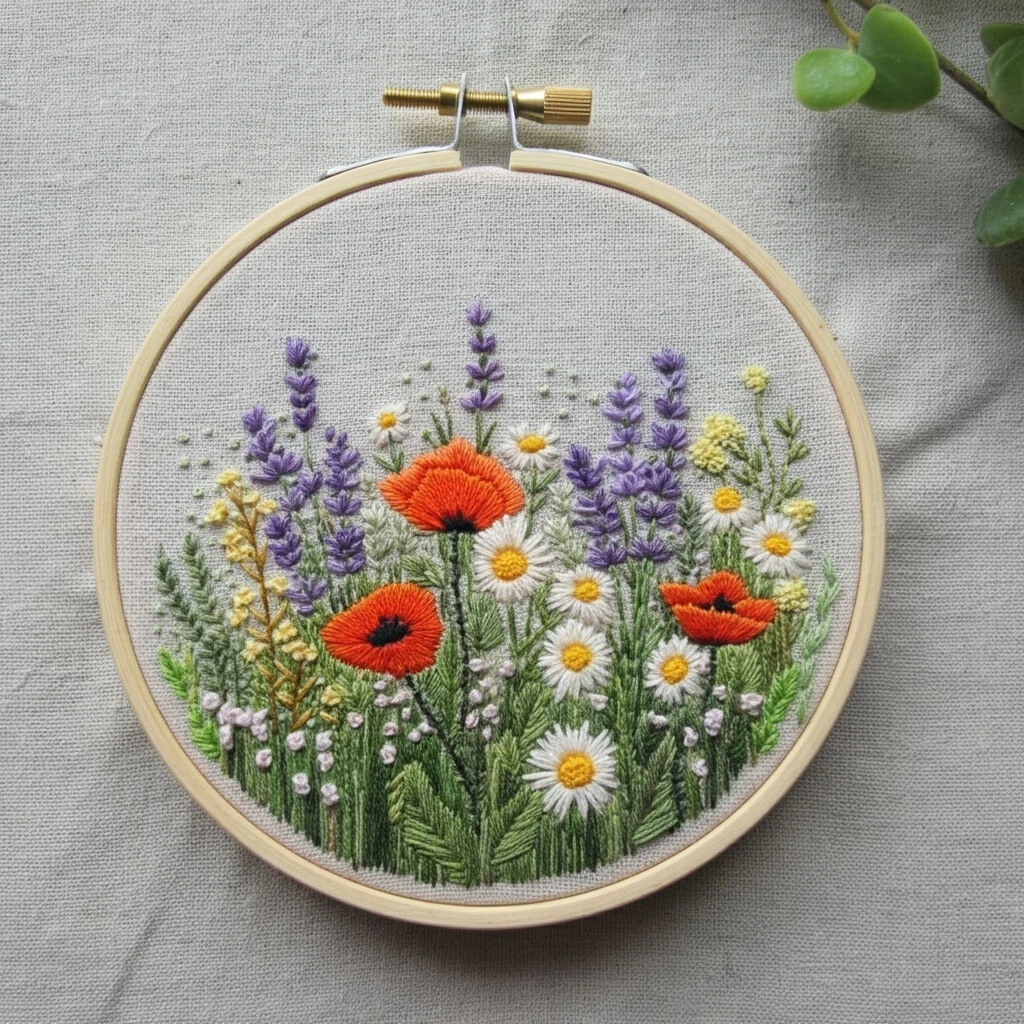
A dense hoop garden with orange-red poppies, white daisies, lavender flower spikes, yellow sprigs, pale pink buds, and layered green grasses. The strongest effect comes from contrast: glowing poppy petals, crisp daisy whites, textured lavender clusters, and many fine stitched stems.
Likely DMC Color Palette
The artwork reads as a bright summer meadow: saturated orange-red poppies sit in front of white daisies and purple lavender, with deep olive stems and ferny green fillers. Coverage percentages are practical stitching estimates, not exact thread usage.
Stitching Suggestions
| Design Element | Recommended Stitch | Practical Notes |
|---|---|---|
| Orange poppies | Long and short stitch, satin stitch accents | Start each petal at the dark center and fan outward. Work 900 near the petal base, then blend into 606 and a few 947-style orange highlights if you want extra brightness. |
| Poppy centers | French knots, tiny straight stitches | Use 310 with one strand for a neat center. Add a few short dark green or brown-black stitches around the base to soften the transition into the petals. |
| White daisies | Lazy daisy, straight stitch, narrow satin stitch | Keep each petal narrow and slightly uneven. Use 3865 for most petals and add a few pure white stitches only on the brightest outer tips if desired. |
| Daisy centers | Clustered French knots | Use 725 on top and 783 toward the underside. One-wrap knots are flatter; two-wrap knots create the raised bead-like centers seen in the reference. |
| Lavender spikes | Detached chain, fly stitch, short straight stitch | Build each spike from the bottom upward, placing darker 208 at the base and lighter 210 at the tips. Leave tiny gaps so the linen breathes between florets. |
| Yellow sprigs | French knots, colonial knots, whipped stem stitch | Stitch the stems first in 469 or 783, then dot the flower heads in 744 and 725. Keep these lighter and looser than the daisies. |
| Fine grasses | Stem stitch, split stitch, straight stitch | Use 1 strand and vary green shades every few stems. Make the lower grass denser and the upper grass airy to avoid a blocky base. |
| Fern leaves | Fishbone stitch, fern stitch | Work from the central vein outward with 3362 underlayers and 3347 or 3052 tips. Directional stitches are more important than perfect symmetry. |
| Tiny pink buds | French knots, seed stitch, small lazy daisy | Use 818 with one strand and place them after the greenery so they sit visibly on top of the meadow. |
Thread Count, Blending & Layering
Strand guidance
1 strand stems2 strands petals2 wraps knots- Use 2 strands for poppy petals so the orange-red flowers remain the focal point.
- Use 1 strand for lavender stems, grass blades, and the fine fern-like greenery.
- Use 2 strands for daisy petals if your fabric is open-weave; use 1 strand on tightly woven linen for a softer botanical look.
- Use 1 or 2 wraps for French knots depending on scale: one wrap for tiny distant buds, two wraps for raised daisy centers.
Blending ideas
- For poppies, blend one strand 606 with one strand 900 in transitional areas to avoid a harsh stripe.
- For lavender, alternate stitches of 208, 209, and 210 instead of blending in the needle; this makes the spikes look naturally speckled.
- For foliage, mix 3363 with 3052 for muted middle greens, then reserve 3347 for the newest leaf tips.
- For daisy centers, place 783 knots first, then add 725 and 744 knots on top for a rounded center.
Outlining, Shading & Texture Details
Outlining details
Avoid outlining every petal. The meadow feels softer if only the strongest silhouettes receive definition: the lower edges of the poppies, the poppy stems, and a few central daisy petals. Use split stitch in matching colors rather than black outlines except at the poppy centers.
Shading guidance
Shade from the flower center outward. Poppies should be darkest near the black center and slightly lighter on the petal rims. Daisies should stay mostly bright, with just a few off-white stitches tucked under overlapping petals. Lavender spikes should be darkest at the bottom and lighter at the tips.
Texture suggestions
Combine smooth satin-like poppy petals with knotty daisy centers and broken lavender florets. The contrast between smooth, raised, and airy stitches is what makes the hoop look full without requiring heavy fill everywhere.
Fabric handling
Keep the linen drum-tight in the hoop. Because this design has many vertical stems, slack fabric can distort the meadow line. Retighten after the dense poppy petals and again before adding final knots.
Where to Start
Use one strand of medium green to stitch the tallest stems and main flower placements first. This keeps the composition balanced before dense details go in.
Work the orange-red petals early because they define the visual weight of the hoop. Keep the centers for later so they remain crisp on top.
Place the white daisies next for brightness, then build purple spikes behind and around them with small detached stitches.
Layer grasses, fern stitch, and small leaf clusters from dark to light. Vary stitch length so the base looks meadow-like rather than combed.
Add daisy centers, yellow sprigs, tiny pink buds, and final one-strand highlights last. These details should sit visibly above the foliage.
Beginner-Friendly Practical Tips
Keep the design readable
- Stitch from background to foreground: stems first, blooms second, knots last.
- Do not fill every blank space. Small linen gaps help individual flowers stand apart.
- Use shorter stitches on curves, especially on poppy petal edges.
Avoid common issues
- Do not pull French knots too tightly; they should sit like little beads.
- Use a needle that opens the fabric enough for knots, but not so large that it leaves holes.
- If the meadow base gets too dark, add a few 3347 or 3052 single-strand highlights between stems.