
Wildflower Meadow
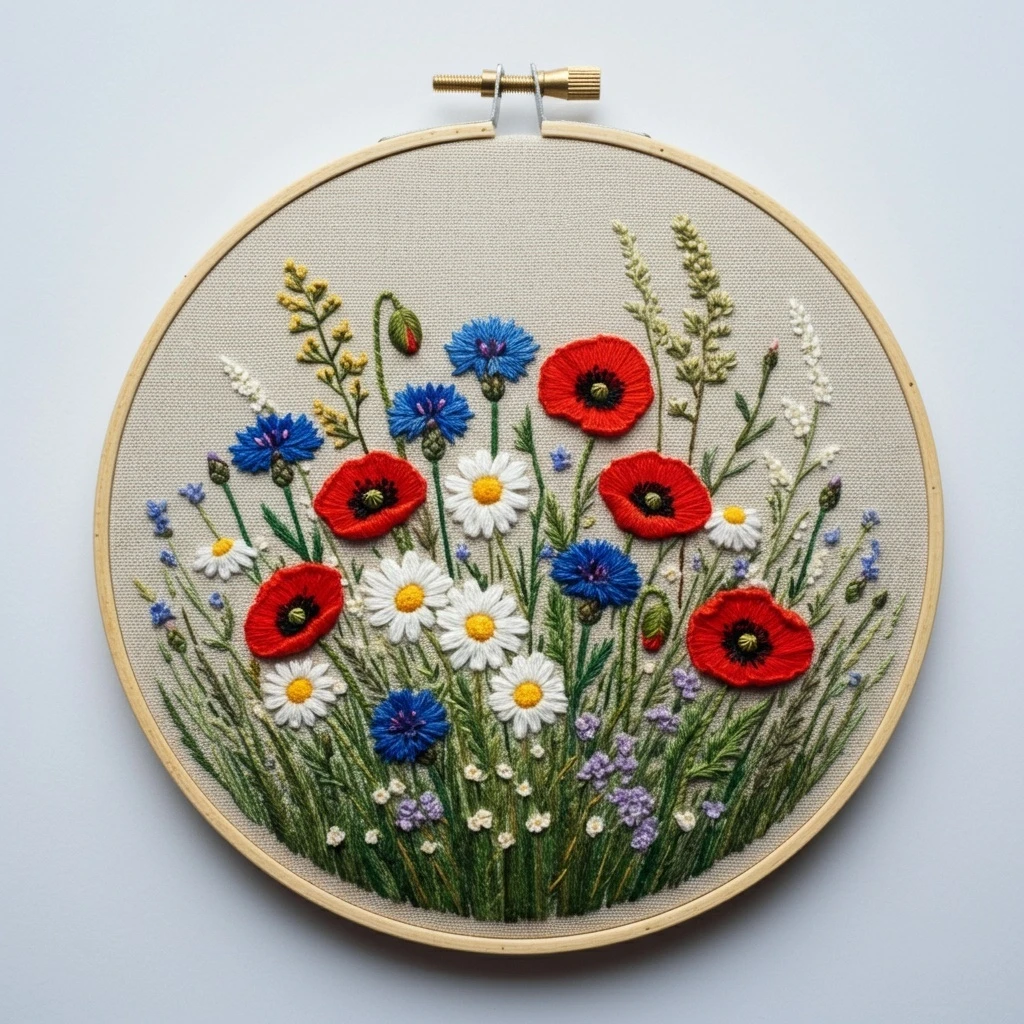
A lively meadow hoop with scarlet poppies, white daisies, vivid cornflower-blue blooms, lavender sprigs, white airy flower spikes, unopened buds, and layered grasses. The palette below is matched to the visible preview and chosen to keep the design bright, dimensional, and beginner-friendly.
Likely DMC Color Palette
Colors are visual estimates from the hoop preview. Use them as a practical floss plan rather than exact thread-usage percentages.
Main poppy petals. Use for the most saturated red areas and petal tips that catch the light.
Poppy petal mid-shadows, lower folds, and curved edges where the red deepens.
Deep petal grooves and the shadow close to each dark poppy center.
Poppy centers and the deepest accent dots. Use sparingly so the centers stay crisp, not heavy.
Daisy centers, small yellow buds, and golden flecks in poppy centers.
Daisy petals, tiny white blossoms, and the pale vertical flower spikes.
Soft shadow on white petals and pearl-like knots so the white flowers do not look flat.
Bright blue cornflower petals. Work radiating stitches outward from the center.
Darker blue petal bases and outer accents on the blue blooms.
Lavender clusters, tiny purple meadow flowers, and cool accents inside blue flower centers.
Light purple highlights on French-knot clusters and delicate side blossoms.
Strong grass bases, poppy stems, and deepest greenery at the bottom of the hoop.
Main stems and leaf strokes for most upright meadow growth.
Olive seed heads, muted grasses, and feathery background stems.
Light grass tips, unopened buds, and highlight stitches on tall seed stalks.
Fine dry-grass accents and warm shadows in the lowest meadow layer.
Stitching Suggestions
The design has high contrast: soft white daisies, bold red poppies, bright blue flowers, and many slim grassy stems. Build the dense meadow in layers so the flowers remain clean and readable.
| Element | Best stitch types | Practical notes |
|---|---|---|
| Red poppies | Long and short stitch, satin stitch, split stitch outline | Shade each petal from 666 into 321 and 816 near the center. Curve stitches with the petal shape rather than filling in straight rows. |
| Poppy centers | French knots, seed stitch, tiny straight stitches | Use 310 for the dark ring, then add 726 knots or short spokes in the middle. Keep knots compact for a raised seed-head effect. |
| White daisies | Lazy daisy, detached chain, satin stitch | Use 3865 for petals with a few 762 shadow stitches at the bases. Make petal lengths slightly uneven for a natural hand-worked look. |
| Blue cornflowers | Straight stitch rays, long and short stitch, fly stitch | Work many narrow stitches outward from the center. Mix 995 with 798 at the base to create spiky, dimensional petals. |
| Lavender and small purple flowers | French knots, colonial knots, tiny lazy daisies | Cluster 340 and 209 knots unevenly along fine stems. One-wrap knots make small buds; two-wrap knots make fuller blossoms. |
| White flower spikes | French knots, pearl stitch, small detached chains | Alternate 3865 and 762 knots up the stems so the pale sprays look airy instead of solid. |
| Grasses and stems | Stem stitch, split stitch, straight stitch, couching | Use 1 strand for distant wispy stems and 2 strands for main flower stems. Vary greens between 895, 987, 3052, and 3051. |
| Unopened buds | Satin stitch, fishbone stitch, tiny split stitch | Fill buds in muted greens, then add a red or purple sliver to hint at the flower inside. |
| Lower meadow base | Layered straight stitch, seed stitch, random fly stitch | Overlap dark green and olive stitches at the bottom edge. Add a few 420 dry-grass lines for warmth and depth. |
Thread Count, Blending & Shading
Strand plan
Use 2 strands for poppies, daisies, blue flower petals, and medium stems. Use 1 strand for fine grass, delicate outlines, and distant meadow sprigs. Use 2-3 strands only for bold French-knot centers.
Blended colors
For smoother poppies, blend 1 strand 666 with 1 strand 321. For softer foliage, blend 987 with 3052. For white petals with visible dimension, blend 3865 with 762 only at petal bases.
Outlining
Outline only where needed. A tiny split-stitch edge in 816 can sharpen poppy folds, while 1-strand 987 works well on main stems. Avoid black outlines around white petals; use 762 instead.
Where to Start
A meadow composition looks best when stitched from back to front, with the tallest grasses and pale sprays behind the showier flowers.
Beginner-Friendly Practical Tips
- Keep the fabric drum-tight in the hoop; long grass stitches can pucker loose fabric quickly.
- Use shorter stitches on the poppies than you think you need. Shorter long-and-short stitches are easier to shade smoothly.
- Stitch the large flowers before filling every grass blade so petals do not disappear under the greenery.
- For the daisy centers, make a compact circle of yellow French knots, then add the petals around it or just after it.
- Do not make every grass blade the same length. The meadow looks natural when the lower edge is dense but irregular.
- Save the smallest purple and white knots for last; they are perfect for hiding tiny gaps or balancing empty areas.
Encouraging Finish
This Wildflower Meadow design shines through contrast: velvety red poppies, crisp white daisies, electric blue flowers, and a textured green base. Work patiently in layers, let the stems overlap naturally, and reserve the final French knots for sparkle and meadow movement.