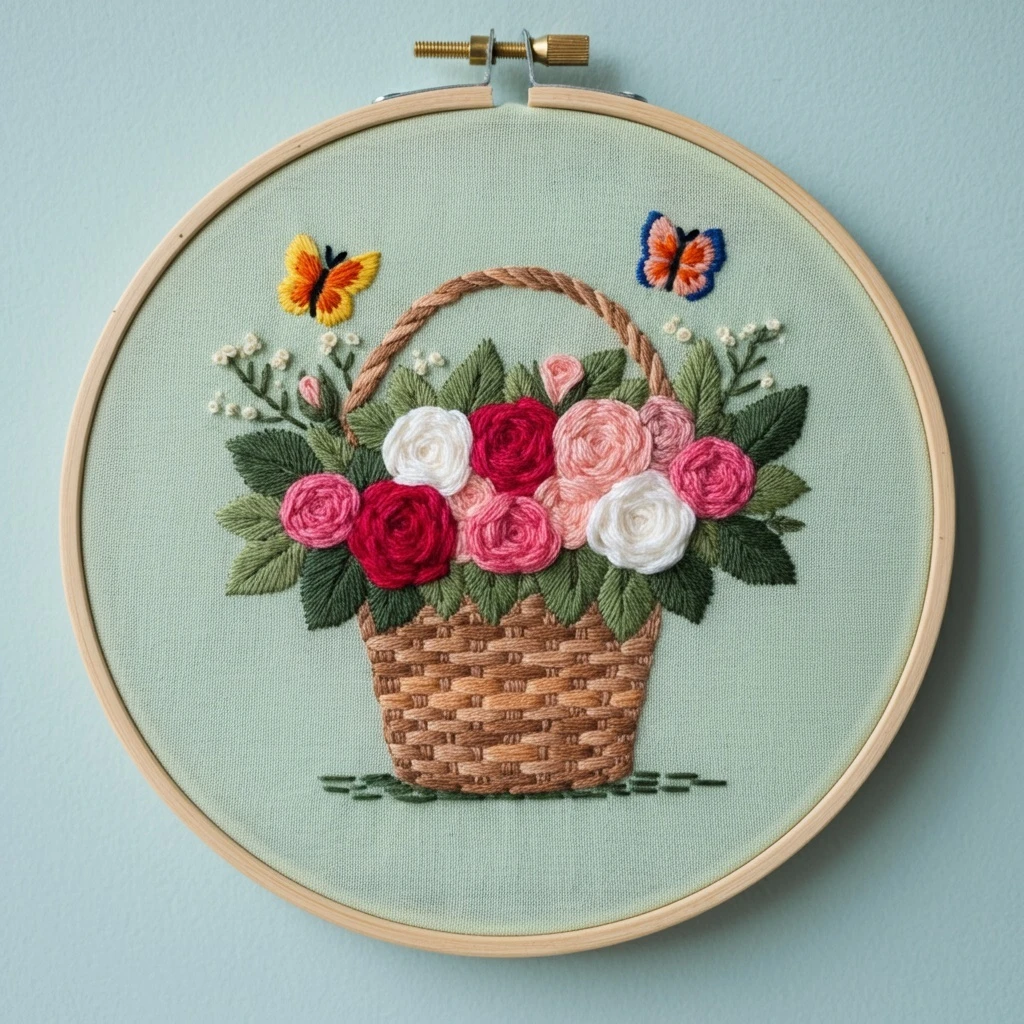

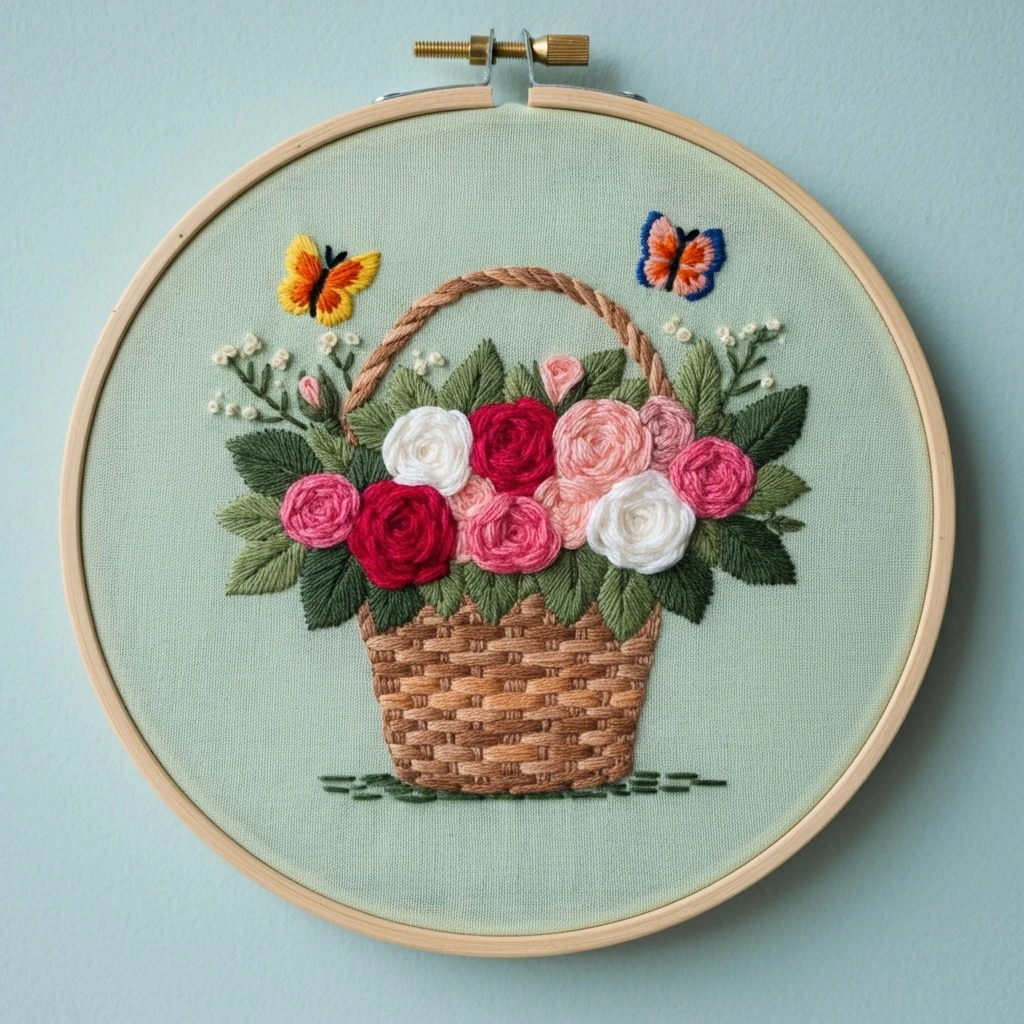
Detailed Floral Basket and Butterflies
A cheerful hoop design built around a woven basket, layered roses, deep leafy greens, tiny white filler blossoms, and two bright butterflies. The palette below balances soft cottage-garden pinks with crisp whites, shaded basket browns, fresh sage foliage, sunny yellow-orange wings, and a small pop of saturated blue.
Recommended DMC Color Palette
Use the darker shades sparingly for depth and outlines, then build most of the visual softness with mid-tones and highlight threads. For a beginner-friendly version, reduce each flower to one shadow, one main color, and one highlight.
Deep rose centers, shaded folds inside the darkest red flowers.
Main hot-pink roses and outer petals with strong color.
Soft pink blossoms, petal highlights, and blended transitions.
Peachy rose highlights and delicate buds tucked into the basket.
White roses, filler flower knots, and sparkle highlights.
Subtle shadow under white petals so the roses do not look flat.
Deep leaf veins, underside shadows, and grounding stitches.
Main foliage, large serrated leaves, and balanced botanical tone.
Leaf highlights, young shoots, and lighter side of greenery.
Basket shadow strips, handle underside, and woven edge definition.
Main wicker rows and basket body stitches.
Raised basket highlights and sunny edges on woven strands.
Butterfly bodies, antennae, tiny accents, and crisp eye-catching contrast.
Orange butterfly wing centers and warm glow around yellow petals.
Yellow butterfly wings and small sunlit wing tips.
Blue butterfly border and cool contrast against warm flowers.
Stitch Plan by Design Area
| Area | Suggested stitches | Thread count & technique notes |
|---|---|---|
| Basket body | Woven filling, satin stitch bands, short straight stitches, couching for the rim. | Use 3 strands for woven rows so the basket looks raised. Alternate DMC 3863 and 975, then add 1-strand DMC 977 highlights only on the top edges of a few strands. |
| Basket handle | Stem stitch, whipped back stitch, or couched chain stitch. | Work two parallel lines in 3 strands of 3863, whip with 975 for a twisted wicker effect. Keep the curve smooth by shortening stitches at the top of the arch. |
| Roses and posy flowers | Woven wheel roses, spider-web roses, padded satin, split stitch spirals. | Use 2 strands for medium flowers and 3 strands for the largest red rose. Place the darkest shade in the center, the main shade around the middle, and the lightest shade on the outer rim. |
| White roses | Woven wheel, satin stitch, tiny split-stitch curves. | Use DMC 3865 with occasional 822 shadow stitches. Avoid pure heavy outlines; instead place 822 at the lower-left petal turns to keep the white flower dimensional. |
| Leaves | Fishbone stitch, leaf stitch, long-and-short stitch, backstitch veins. | Use 2 strands for leaf filling. Start with 934 near the base and under overlaps, blend into 3051, then add a few 3053 stitches along tips and center ridges. |
| White filler blossoms | French knots, colonial knots, tiny detached chains. | Use 2 wraps with 2 strands of 3865 for neat pearl-like flowers. Add 1-strand green stems first, then place knots last so they stay clean and raised. |
| Butterflies | Long-and-short stitch, satin stitch, split stitch outlines, straight-stitch antennae. | Use 1 strand for the black body and antennae; use 2 strands for wing filling. Blend 743 into 741 for the yellow butterfly and edge the blue butterfly with 798. |
| Ground shadows | Seed stitch, straight stitch, broken back stitch. | Use 1 strand of 934 or 3051 in scattered horizontal stitches. Keep the grounding light so it supports the basket without becoming a border. |
Blending, Shading & Texture
Use a three-step petal formula
For each rose, stitch the center with the darkest shade, the main body with a medium shade, and the outer petals with the lightest shade. This keeps the flowers readable even when stitched small.
Alternate row direction
Change the direction of basket stitches row by row. A few darker horizontal bars across lighter vertical stitches will instantly suggest woven wicker.
Keep butterflies crisp
Use fewer strands and sharper outlines on the butterflies than on the flowers. Their clean edges create contrast against the softer bouquet.
Beginner-Friendly Practical Tips
Order of stitching
- Start with the basket handle and basket body so the flowers can overlap the rim naturally.
- Stitch the large leaves next, working from back leaves to front leaves.
- Add the roses from largest to smallest; finish with buds and white filler knots.
- Stitch butterflies last so their edges remain clean and their antennae are not snagged.
Thread-count guidance
- 1 strand: butterfly antennae, fine outlines, leaf veins, tiny stem details.
- 2 strands: most petals, leaves, filler flowers, and butterfly wings.
- 3 strands: raised basket texture, large woven roses, and bold foreground accents.
- 4 strands only if needed: padded basket rim or extra-dimensional rose centers.
Outlining details
- Outline the basket with 1-2 strands of DMC 975 using split stitch or backstitch.
- Use green outlines on leaves instead of black so the foliage stays natural.
- For roses, outline only a few shadowed inner curves; full outlines can make petals look stiff.
Fabric and finishing
- A pale sage or mint fabric echoes the sample and makes white flowers visible.
- Use a 6-8 inch hoop for comfortable spacing and a balanced border around the design.
- Press from the back on a towel after stitching to protect the woven roses and knots.
Quick Shopping Checklist
For a compact kit, prioritize these core colors: DMC 815, 3831, 3689, 3713, 3865, 822, 934, 3051, 3053, 975, 3863, 977, 310, 741, 743, and 798. Add a pale sage cotton or linen, size 7-9 embroidery needles, a hoop, small sharp scissors, and a disappearing fabric marker.