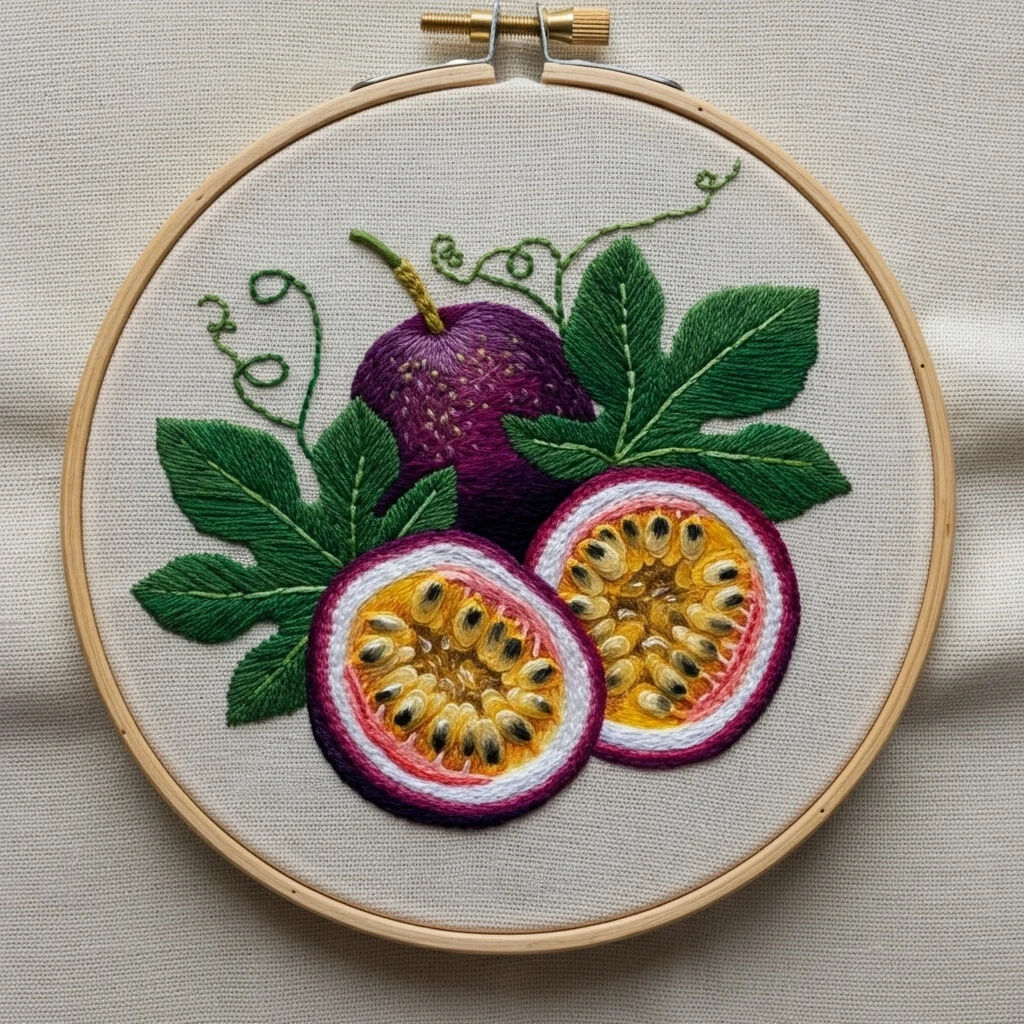

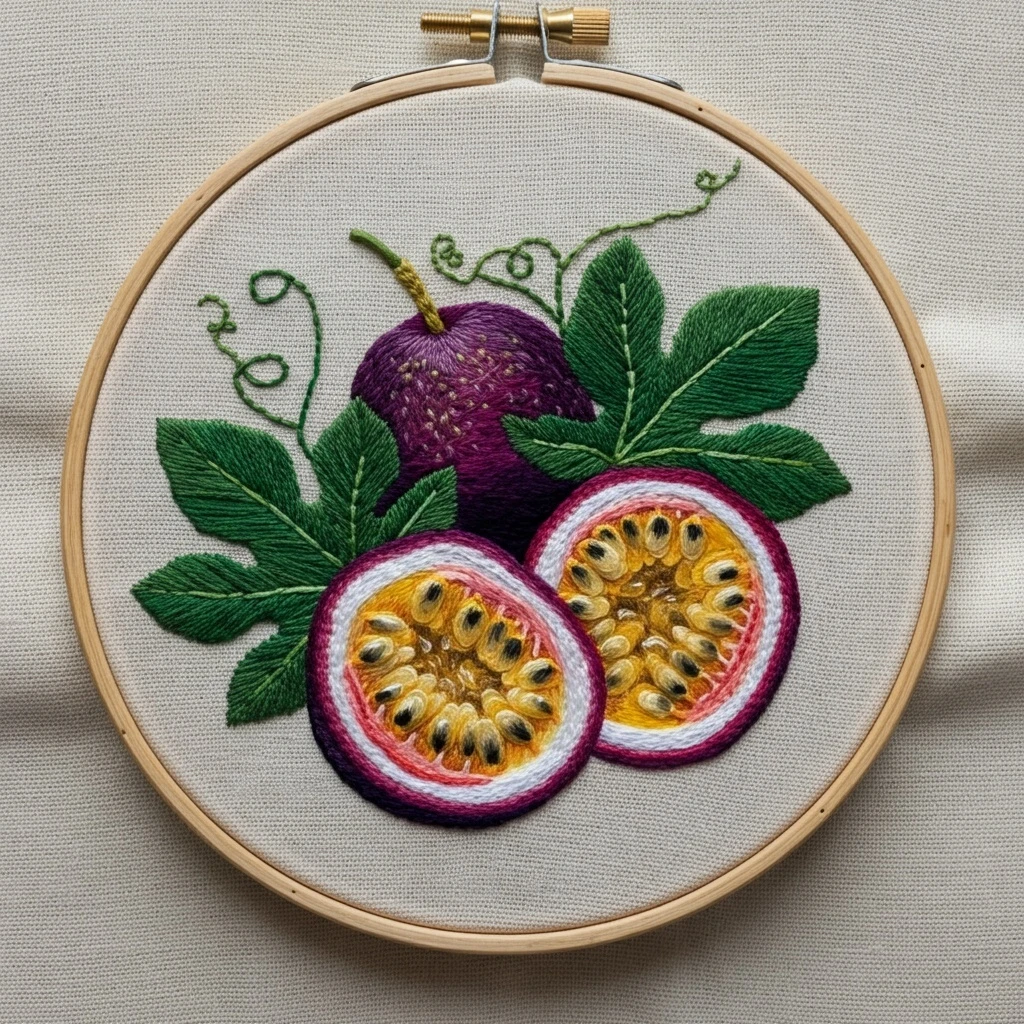
Realistic Embroidered Passion Fruit Hoop Art
A polished stitching guide inspired by the reference artwork: split passion fruit halves with glossy golden pulp, burgundy-purple rind, crisp white pith, a dark whole fruit, and layered green vine leaves on natural linen. The goal is juicy dimension, soft botanical realism, and a clean hoop-art finish.
Color focus
Deep plum rind, pink-red inner rim, creamy white pith, amber seed pockets, olive-black seed accents, and shaded emerald leaves.
Suggested DMC Floss Palette
Use these colors as a realistic working palette. For the most dimensional result, stitch in short directional layers rather than flat blocks, and reserve the lightest shades for final highlights.
Stitch Map & Texture Suggestions
Fruit halves
- Outer rind: long-and-short stitch in curved bands, starting with DMC 154 at the darkest edge, then 915 and 917 toward the light.
- Pink inner membrane: use split stitch or narrow satin stitch with 3803 and 3713, keeping the line slightly irregular for organic realism.
- White pith: padded satin stitch with Blanc, worked in short arcs following the oval shape. Add a few off-white stitches if the white feels too stark.
- Golden pulp: short seed stitch, detached chain, and tiny satin stitches in 972, 726, 783, and 782. Vary stitch length so the center looks wet and uneven.
Leaves, tendrils & whole fruit
- Leaves: fishbone stitch or directional satin stitch from central vein to edge. Layer 890 in shadow, 895 for body, 699 for lifted areas.
- Veins: stem stitch the center vein with 3347 mixed with one strand of 699; add short angled straight stitches for side veins.
- Tendrils: fine stem stitch with one strand of 895, then touch the lit side with 3347. Keep curls airy, not bulky.
- Whole fruit: long-and-short stitch in 154, 915, and 917; scatter small 3713 or 3863 knots for skin speckles.
Thread Counts, Blending & Layering
| Area | Recommended strands | Practical notes |
|---|---|---|
| Rind and whole fruit | 1–2 strands | Use 1 strand for realistic shading transitions; use 2 strands only for stronger dark outer edging. Blend 915 + 917 for soft rounded purple. |
| White pith | 2 strands, then 1-strand highlight | Pad lightly with split stitch underneath if you want raised pith. Finish with smooth satin arcs in Blanc. |
| Pulp and seed sacs | 1 strand for detail, 2 strands for raised seed knots | Mix 972 + 726 in the needle for bright pulp. Add 782 at the base of seed clusters before the light stitches. |
| Leaves | 1–2 strands | For wide leaves, 2-strand satin or fishbone builds coverage. For fine serrations and vein marks, switch to 1 strand. |
| Tendrils and outlines | 1 strand | Use a controlled stem stitch or split backstitch. Thin lines preserve the delicate botanical look. |
Suggested Stitching Order
Transfer the ovals, leaves, tendrils, and main veins lightly. Work the thinnest tendrils first so they remain clean.
Stitch leaves that sit behind the fruit before the passion fruit halves. Keep direction consistent from vein to edge.
Fill the whole fruit and outer rinds with curved long-and-short stitch, adding dark edge shadows last.
Work the white rings with smooth satin arcs, then add pink membrane lines to separate the rind from the center.
Place seed sacs irregularly with yellows and topaz browns; use tiny dark centers only after the gold base is complete.
Add pinprick Blanc highlights, tiny French knots, and selective dark accents. Stop before the center becomes overcrowded.
Outlining, Shading & Beginner-Friendly Tips
Outlining details
- Use DMC 154 for the lowest rind edge and DMC 915 for most visible purple outlines.
- Outline the pith sparingly; a hard line around the white ring can flatten the fruit. Break the line into tiny split stitches instead.
- Place 3371 only in the seed centers and deepest creases. Too much black-brown will make the pulp look muddy.
- For leaf silhouettes, use 890 in shadowed cutouts and 895 for the general edge.
Practical tips
- Use a firm medium-weight linen or cotton-linen blend and keep the hoop drum-tight for smooth satin stitching.
- Shorten thread lengths to about 14–16 inches when stitching pulp; frequent color changes are easier and cleaner.
- Anchor threads under filled areas, not behind open tendrils, so the back does not shadow through the fabric.
- Step back often: the passion fruit should read as bright yellow centers first, with purple rind and leaves supporting the focal point.
Dimension idea: For a subtle 3D effect, pad the white pith and a few seed sacs with one layer of split stitch before covering them. Keep the dark rind flatter so the fruit centers appear raised and glossy.