Classic Rose Bouquet

Classic Rose Bouquet — DMC Palette & Stitching Guide
Classic Rose Bouquet
DMC palette & stitching notes

Classic Rose Bouquet

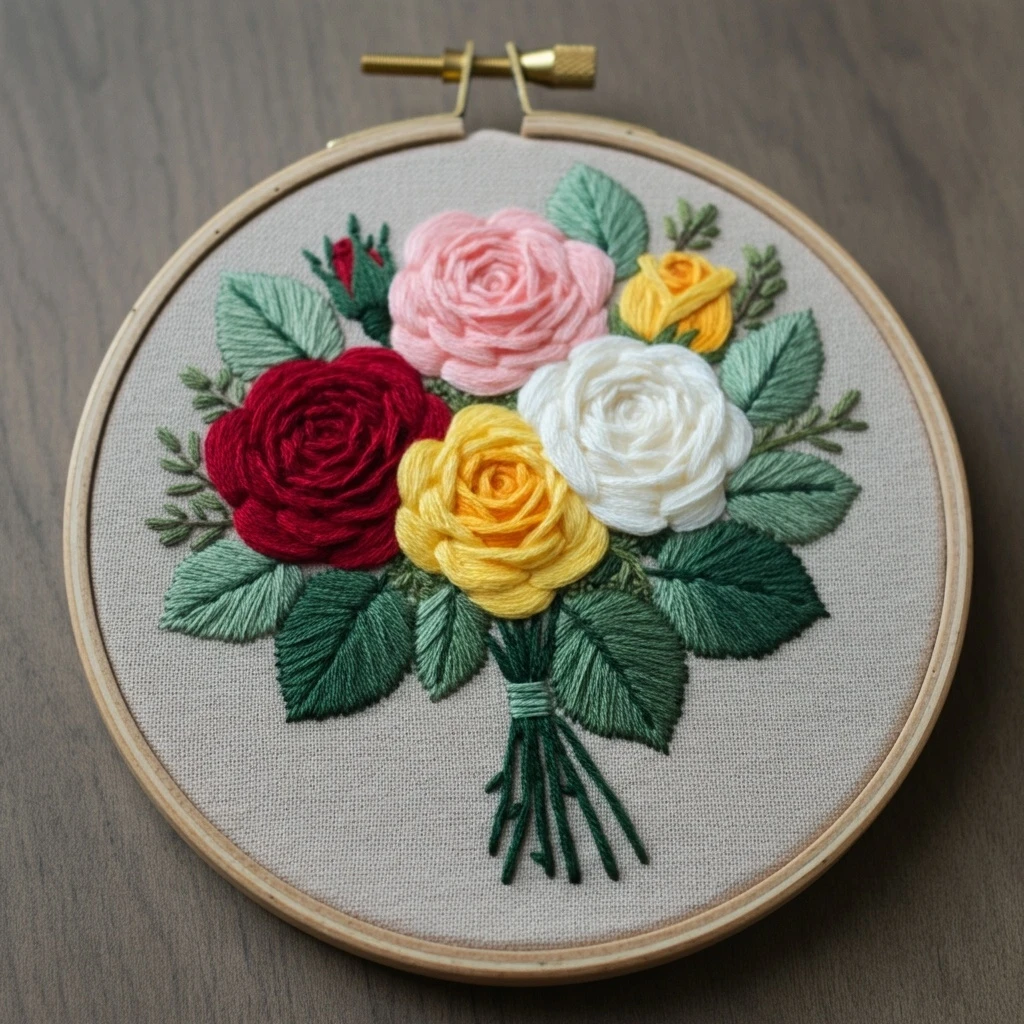
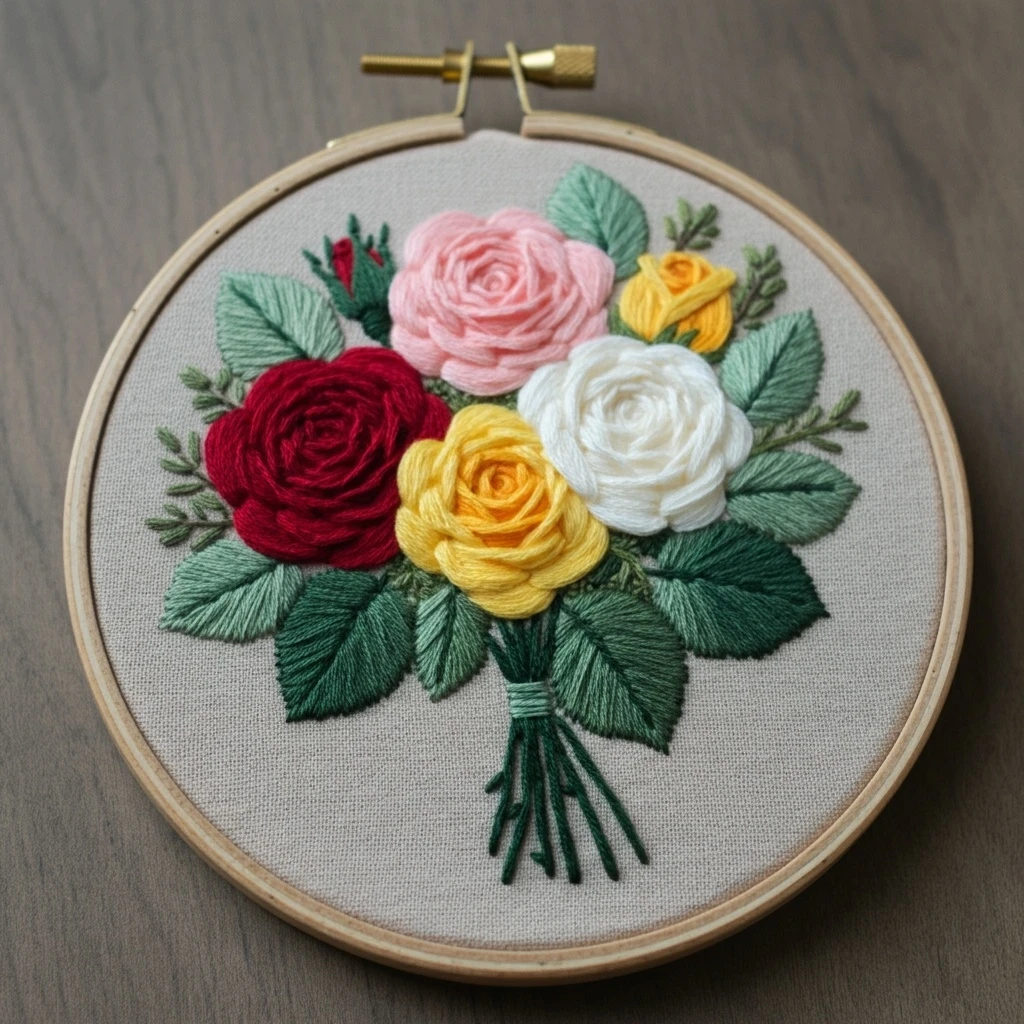
This classic rose bouquet is built around layered rose heads, curved petal folds, soft buds, supporting leaves, and a gathered stem structure. The stitched version should feel romantic and dimensional: darker rose tones tucked into the centers, pale petal tips catching the light, muted sage leaves behind the flowers, and tidy stems that make the bouquet feel arranged rather than scattered.

Polished DMC Color Palette

This palette focuses on classic pink and rose shading with warm cream highlights and muted greens. Use the deepest mauve shades only inside rose centers and under folded petals; keep the outer petals lighter so each bloom looks open and dimensional.

DMC 819
Baby Pink Light
Outer rose petal tips, pale blush roses, and soft lifted petal highlights.
DMC 761
Salmon Light
Main rose petals, soft pink mid-tones, and gentle transitions between shadow and light.
DMC 3722
Shell Pink Medium
Petal bases, bud shading, inner rose folds, and moderate rose depth.
DMC 315
Antique Mauve Dark
Deep rose centers, underside petal shadows, and strongest mauve contrast.
DMC 351
Coral
Warm rose accents, peachy blooms, and lively petal variation in focal flowers.
DMC 352
Coral Light
Warm petal tips, coral highlights, and soft peach-pink transitions.
DMC 3865
Winter White
Bright petal glints, pale rose edges, and final crisp highlight stitches.
DMC 746
Off White
Cream rose highlights, soft pale petals, and warm transition stitches.
DMC 822
Beige Gray Light
Subtle shadow on cream petals and muted highlight control on pale roses.
DMC 3821
Straw
Tiny rose-center highlights, pollen dots, and warm floral accent stitches.
DMC 783
Topaz Medium
Golden center shadows, small seed knots, and warm detail accents.
DMC 3051
Green Gray Dark
Leaf shadows, foliage tucked behind roses, and darker stem bases.
DMC 3052
Green Gray Medium
Main leaves, rose stems, bouquet framework, and muted botanical structure.
DMC 3053
Green Gray
Leaf highlights, small sprigs, and light-facing foliage edges.
DMC 3013
Khaki Green Light
Pale leaf tips, tiny buds, and delicate new-growth accents.
DMC 801
Coffee Brown Dark
Fine stem shadows, rose-center depth, twig accents, and small outline corrections.
DMC 433
Brown Medium
Warm stem variation, seed texture, and natural detail lines near the bouquet base.
DMC 932
Antique Blue Light
Optional cool shadow under pale petals and soft background accent stitches.
DMC 211
Lavender Light
Optional cool filler flower, soft bud highlight, or gentle contrast beside roses.
DMC 210
Lavender Medium
Optional shaded filler bud or cool accent to balance the pink bouquet.

Stitch Map by Design Element

Open roses
Use woven wheel, long-and-short stitch, satin stitch, or layered detached-chain petals. Start in the center with 315 or 3722, build the petal body with 761, and finish the outer edges with 819, 746, or 3865.
Rose spirals
Use tight stem stitch, split stitch, or short satin strokes following the spiral. Keep inner stitches darker and outer stitches lighter so the rose reads as folded petals rather than a flat circle.
Closed buds
Use small satin stitches or padded satin dots. Shade the base with 315 or 3722, fill with 761 or 819, and add a small 3051 or 3052 sepal beneath each bud.
Leaves
Use fishbone stitch for larger leaves, lazy daisy for small leaves, and straight stitches for tiny sprigs. Work 3051 at the base, 3052 as the main leaf, and 3053 or 3013 along the tip or central vein.
Stems
Use one- or two-strand stem stitch in 3051, 3052, 801, or 433. Let stems converge naturally near the bouquet base and disappear behind rose heads where appropriate.
Rose centers
Use tiny French knots, seed stitches, or tight short stitches in 315, 783, 3821, and 801. Add bright center highlights sparingly; most roses only need a tiny glint.
Filler accents
Use small lazy daisy stitches, French knots, or tiny straight stitches in 3865, 211, 932, 819, and 3013. Keep them secondary so the roses remain the focus.

Thread Count & Blending Guide

Fine detail

Use 1 strand for petal-edge lines, tiny rose centers, leaf veins, bud sepals, delicate stems, and final correction stitches. One strand keeps the bouquet refined.

Main petals and leaves

Use 2 strands for most rose petals, leaves, bouquet stems, and buds. Two strands gives soft coverage while preserving the curved petal structure.

Raised centers

Use 2–3 strands for selected French knots or textured centers on larger roses. Use three strands sparingly so rose centers do not become bulky.

Blending idea: Blend 761 with 819 for soft rose petals, 3722 with 315 for inner petal shadows, 351 with 352 for warmer peach-pink roses, 746 with 822 for pale cream roses, and 3052 with 3053 for fresh leaf transitions.

Shading, Outlining & Texture Suggestions

Rose petal depth

  • Place the darkest rose shades inside the center and under overlapping petals.
  • Use mid pink for the main petal body and pale pink or cream on lifted outer tips.
  • Follow petal curves with stitch direction so each bloom feels rounded.
  • Outline only selected petal folds; heavy outlines can flatten the roses.

Bouquet structure

  • Stitch back leaves and stems before the main rose heads.
  • Let some greenery peek between roses to separate overlapping blooms.
  • Angle stems toward a shared base for a gathered bouquet effect.
  • Use buds around the outside edge to soften the bouquet silhouette.

Soft highlights

  • Use winter white only for the brightest petal edges and final tiny glints.
  • Use off white when you want a softer highlight that does not look stark.
  • Add highlights at the end so they stay clean on top of the petal shading.
  • Keep highlight placement consistent with one light direction.

Outlining approach

  • Use mauve, rose, or green-gray outlines rather than black.
  • Use split stitch for petal curves and stem stitch for greenery.
  • Break outlines where petals overlap naturally.
  • Add outlines after base fills but before final centers and white highlights.

Beginner-Friendly Stitching Order

  1. Transfer the bouquet: mark rose centers, outer petal shapes, buds, main leaves, and stem direction. Keep tiny filler accents for later placement.
  2. Stitch back greenery: add darker leaves and stems first so the roses can sit visually on top.
  3. Build the roses: start with the darkest centers, then add mid-tone petals, then pale outer petal highlights.
  4. Add buds: place closed buds around the bouquet edge and add small green sepals underneath.
  5. Refine leaves and stems: add leaf veins, pale leaf tips, and tidy stem lines where the bouquet gathers.
  6. Finish details: add rose-center knots, petal-edge accents, tiny filler flowers, final highlights, and outline corrections last.

Practical Tips for a Clean Finish

Fabric & hoop

Warm cream, natural linen, pale blush, or oatmeal cotton-linen pairs beautifully with classic roses. Keep the hoop drum-tight so layered petals and small knots do not pucker.

Needle choice

Use a sharp embroidery needle size 7–9 for one- and two-strand work. For raised center knots with three strands, choose a slightly larger needle for smooth pull-through.

Keeping roses distinct

Give each rose its own shadow side and light side. If several blooms touch, separate them with a small leaf, darker petal fold, or one-strand outline.

Avoiding muddy pinks

Do not mix too many rose shades in one small petal. Choose one shadow, one main color, and one highlight per bloom for a clean classic look.
Best beginner shortcut: use woven wheel or satin stitch for roses, stem stitch for stems, fishbone stitch for leaves, and tiny French knots for rose centers.
Best polish upgrade: shade each rose in three layers: dark center fold, soft mid-tone petals, and pale lifted outer edges with one-strand detail lines.
Designed as a practical DMC floss and stitch-planning companion for the Classic Rose Bouquet embroidery artwork.

Leave a Reply

Your email address will not be published. Required fields are marked *