

DMC Color Palette & Hand Embroidery Tips
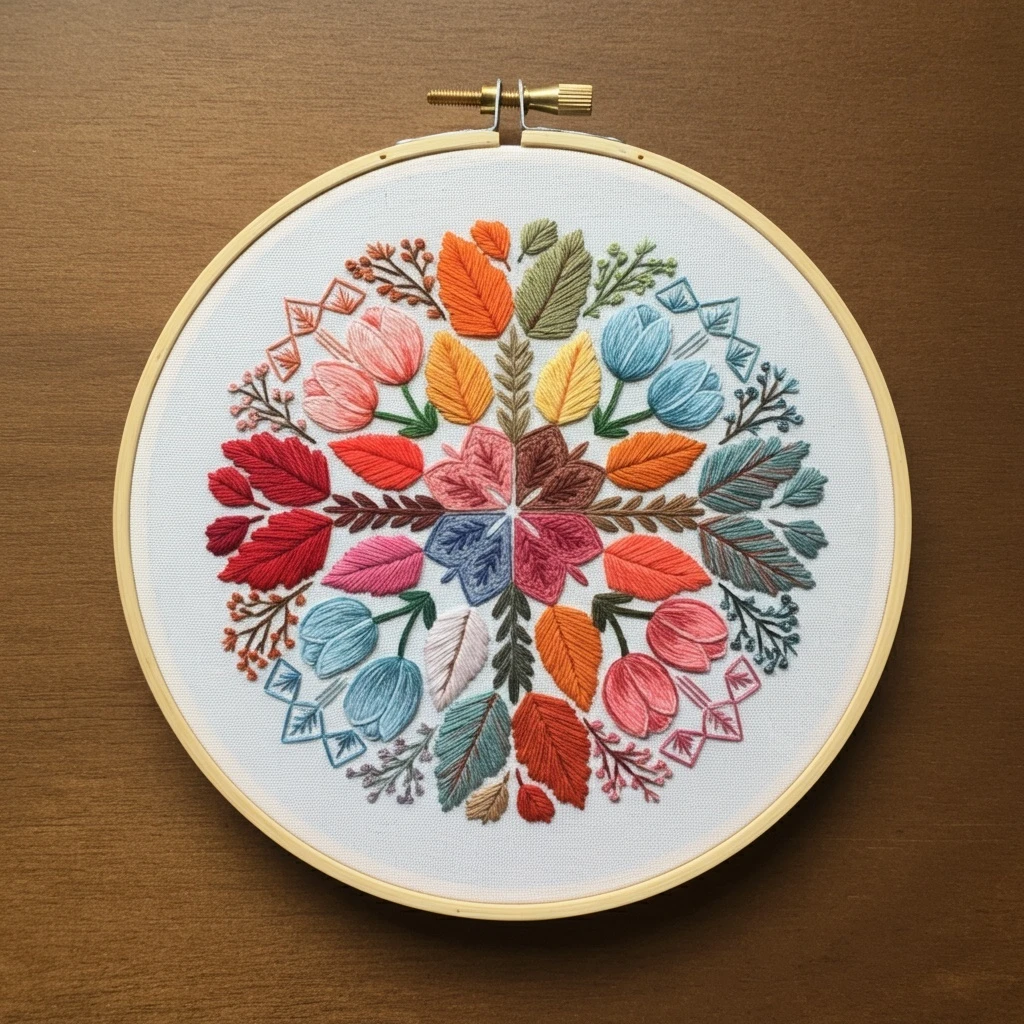
Autumn Harvest Bloom Mandala Leaf And Flower
A polished stitching plan for a radial autumn mandala filled with layered leaves, tulip-style blooms, berry sprays, geometric accents, and warm harvest color movement.
Design Color Read
The artwork is built like a floral compass: a star-like central bloom anchors the design, with repeated leaves and flowers radiating outward in balanced wedges. The dominant mood is autumnal—rust, persimmon, berry red, dusty rose, golden yellow, olive, sage, blue-teal, and bark brown—softened by pale linen ground and delicate linework.
Keep the center slightly darker and richer, then let outer petals and leaves shift brighter, cooler, or softer so the mandala keeps its circular rhythm without becoming flat.
Suggested DMC Palette
Stitch Map by Motif
| Area | Best stitches | Notes |
|---|---|---|
| Large leaves | Fishbone, raised fishbone, long-and-short | Begin at the tip, angle stitches toward the center vein, and alternate two close shades for natural leaf texture. |
| Tulip flowers | Satin stitch, long-and-short, split stitch outline | Use 2 strands for curved petal fill; keep stitches following the petal arc rather than straight vertical lines. |
| Center bloom | Long-and-short with backstitch dividers | Work each wedge separately so colors stay crisp. Add a tiny pale highlight near the center for a faceted look. |
| Berry sprays | French knots, colonial knots, stem stitch | Use one or two wraps for small berries; vary red, rust, and coral for a clustered harvest effect. |
| Geometric accents | Backstitch, whipped backstitch, straight stitch | Use 1–2 strands so the diamond and triangle outlines stay delicate and do not overpower the florals. |
Thread Count Guidance
1 strand fine outlines, tiny berry stems, geometric linework, delicate inner veins.
2 strands most petals, leaves, stems, and mandala outlines. This is the best default for clean coverage.
3 strands bold red leaves, heavy satin sections, or areas where you want a fuller hand-stitched texture.
4–6 strands optional only for chunky French knots or raised leaf ribs; avoid using this throughout or the mandala may lose detail.
Blending, Shading & Texture Suggestions
Warm leaf blending
Blend one strand DMC 720 with one strand DMC 742 for glowing orange leaves. For darker leaf bases, switch to DMC 347 or DMC 898 near the stem end.
Rose-to-coral flowers
Use DMC 352 at petal tips, DMC 3830 through the middle, and DMC 335 or 815 in the deepest fold. Feather the color changes with long-and-short stitch.
Cool blue contrast
Pair DMC 3811 and 3809 for turquoise blooms. Add a single strand of DMC 500 along one edge to make the blue motifs sit comfortably with the greens.
Natural stems
Use stem stitch in DMC 3011 or 898, then add occasional single-strand straight stitches in DMC 3012 to prevent branches from looking too dark.
Outlining Details
- Use split stitch for flower outlines where you want a soft, embroidered edge.
- Use backstitch for crisp geometric accents and the small triangular motifs.
- Use a slightly darker color than the fill for leaf ribs: DMC 898 over rust, DMC 3011 over sage, DMC 3809 over pale teal.
- Keep outlines to 1 strand in crowded areas so the negative space between motifs stays visible.
Beginner-Friendly Workflow
- Start with all main stems and central guide lines first; they help preserve radial symmetry.
- Stitch the center bloom next, then work outward in opposite pairs to keep color balance even.
- Complete large leaves before small berries, because knots and tiny details can snag working thread.
- Use shorter thread lengths, about 14–16 inches, especially with satin and long-and-short stitch.
- Press from the back on a towel after finishing to keep raised stitches dimensional.
Finishing Notes
For a clean hoop finish, leave the background fabric mostly open and let the mandala breathe. The design benefits from visible negative space around the outer leaves and berry sprays. If displaying in a hoop, wrap the inner hoop with cream cotton tape for extra grip and a refined edge. For a framed finish, mount over acid-free backing and avoid flattening the textured knots.