
DMC palette & hand embroidery notes
Elegant Crescent Floral Wreath
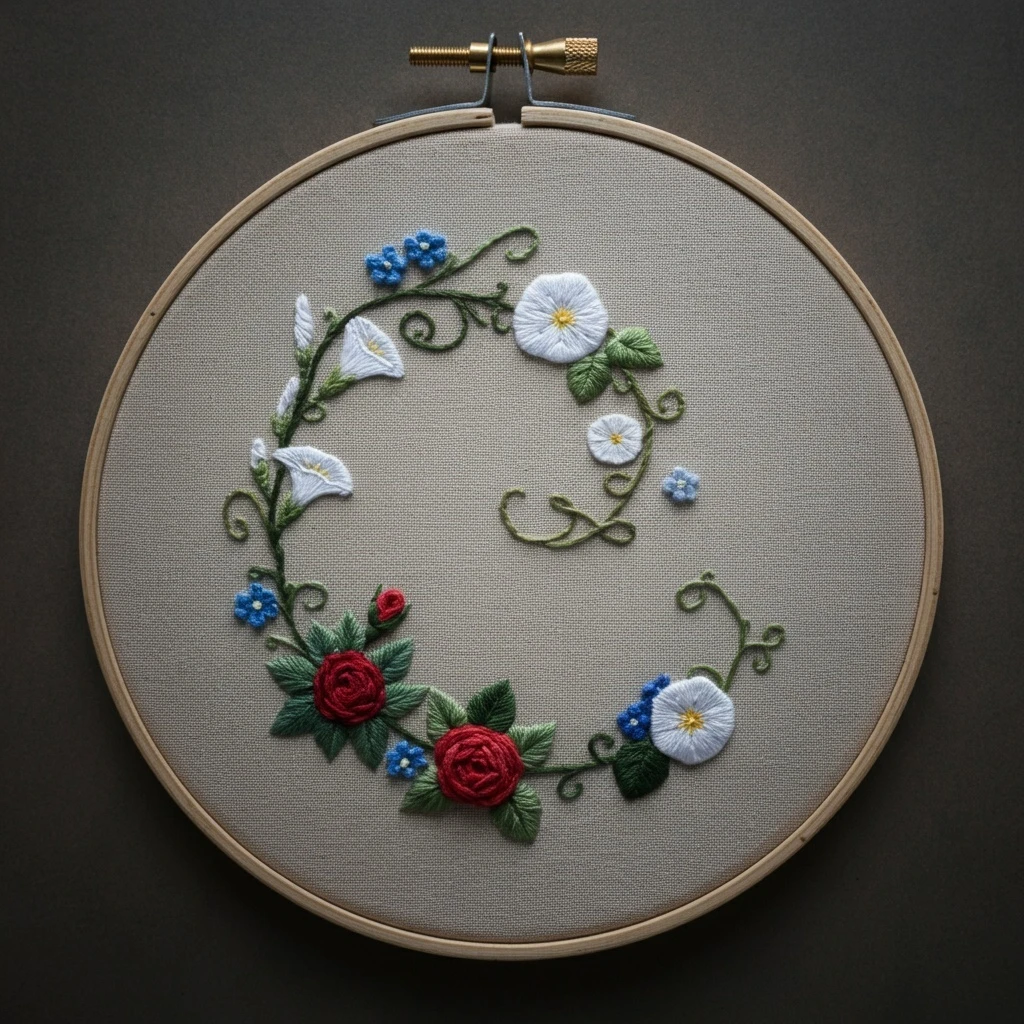
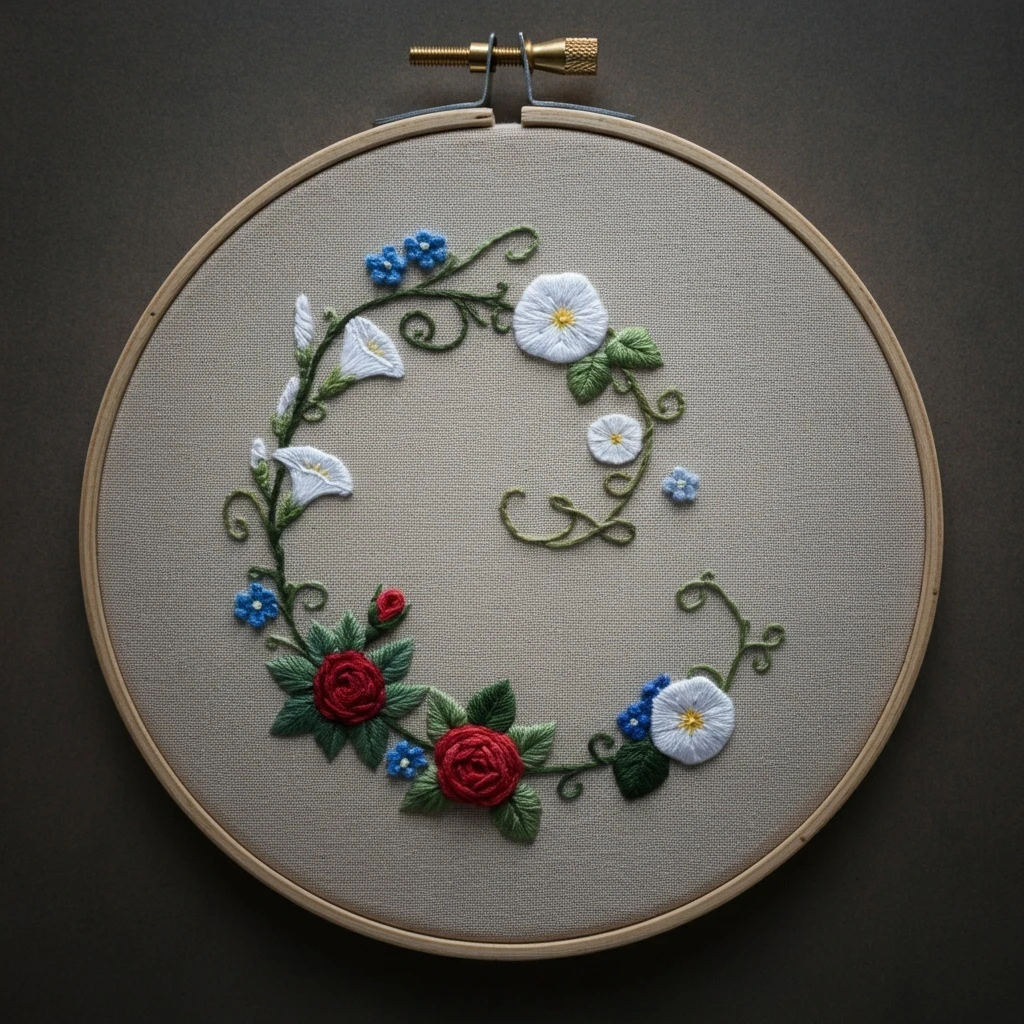
A refined crescent composition with deep red roses, white trumpet blooms, small blue forget-me-not clusters, layered green leaves, and curling vine tendrils on natural linen. The stitching plan below keeps the wreath airy while adding dimension to the roses and soft movement to the scrolling greenery.
crescent wreathraised roseslinen-friendlybeginner adaptable
Suggested DMC Color Palette
Use the palette as a practical match to the photographed sample: cool whites for the open blossoms, saturated crimson for the roses, bright blue for accent flowers, and several greens to separate vine, leaf shadow, and new growth.
DMC B5200
Snow White
Main white petals; use 2 strands for padded satin or long-and-short petals, 1 strand for fine petal ridges.
DMC 762
Pearl Gray
Cool petal shadows on white flowers; blend sparingly with B5200 to stop the whites looking flat.
DMC 726
Topaz Light
Tiny flower centers; French knots or seed stitches add a sunny focal point.
DMC 321
Red
Primary rose petals and bud highlights; strong enough to read clearly against neutral linen.
DMC 814
Garnet Dark
Rose inner spirals, tucked petals, and deepest shadow at the base of raised stitches.
DMC 798
Delft Blue Dark
Blue flower clusters; make small detached chain petals or knots for forget-me-not texture.
DMC 3841
Baby Blue Pale
Blue flower highlights and optional tiny glints on upper petals.
DMC 895
Hunter Green Very Dark
Dark leaf bases, vine underside, and contrast around the rose cluster.
DMC 936
Avocado Green Very Dark
Main curling vine lines and tendrils; use stem stitch for smooth curves.
DMC 3012
Khaki Green Medium
Mid-tone leaf stitches and lighter vine tips.
DMC 3013
Khaki Green Light
Leaf highlights, new shoots, and the top edge of curled tendrils.
DMC 842
Beige Brown Very Light
Optional hoop/linen-toned grounding stitches or very soft shadow under raised florals.
Stitch Map & Texture Suggestions
Vines and tendrils
- Work the main crescent vine in stem stitch with 2 strands of DMC 936, changing to 1 strand near tight curls.
- For smooth spirals, shorten each stitch as the curve tightens. A split stitch guide line underneath helps beginners keep the curl clean.
Red roses
- Use woven wheel roses for the large blooms: DMC 814 near the center, DMC 321 on outer wraps.
- Add a few straight stitches in 814 between wraps to deepen the spiral and make the flower look tucked.
White blossoms
- Use long-and-short stitch or padded satin stitch in B5200. Place DMC 762 at the base and inner folds.
- For trumpet-shaped flowers, angle stitches toward the throat and use 1-strand gray lines for creases.
Blue accent flowers
- Use detached chain petals or grouped French knots in DMC 798 with tiny 3841 highlights.
- Add one small yellow knot in DMC 726 only where the flower face is visible.
Leaves
- Fishbone stitch is ideal for pointed leaves: begin with 895 at the base, shift to 3012, and finish with 3013 at the tip.
- For small leaves, a single lazy daisy stitch with a straight center vein keeps the wreath delicate.
Outlining details
- Use 1 strand of 895 to define leaf undersides and rose contact shadows.
- Avoid heavy outlining around white petals; a few partial stitches in 762 are softer and more realistic.
Blending & Shading Plan
- Rose blend: pair one strand DMC 321 + one strand DMC 814 in the middle wraps for a gradual transition between highlight and shadow.
- White petal blend: blend B5200 + 762 only at the base of petals, then switch back to pure B5200 for the lifted edges.
- Leaf blend: use 895 at the stem end, 936 through the central vein, and 3012/3013 on the sunlit outer half.
- Blue flower sparkle: dot 3841 on the upper-left side of blue clusters to mimic the photographed light catching raised stitches.
Beginner-Friendly Working Order
- Transfer the crescent vine first and stitch all long scrolling stems before adding flowers.
- Complete leaves next so the flower edges can sit naturally on top.
- Stitch white flowers before red roses; this keeps dark red fibers from catching in pale petals.
- Add woven roses and blue knots last, because raised elements can snag while you work nearby areas.
- Press only from the back on a folded towel to protect the dimensional roses and French knots.
Practical Finish Notes
Fabric choiceNatural linen, cotton-linen, or a warm oatmeal ground will suit the muted greens and bright white flowers. Avoid very loose weave if you plan many French knots.
Needle choiceUse a size 7 or 8 embroidery needle for 2 strands; switch to a sharper size 9 for single-strand vine curls and fine petal veins.
Hoop tensionKeep the fabric drum-tight while stitching the crescent. Re-tighten before woven roses so the spokes do not pucker.
Dimensional controlFor raised roses, fewer wraps create tidy small blooms; extra wraps create a lush bouquet effect. Stop before the flower crowds nearby leaves.
Clean whitesWash hands before white flowers and cut shorter lengths of B5200 to prevent dulling from repeated pulling through linen.
Final balanceStep back before adding extra blue knots. The design works best when the blue accents remain secondary to the roses and crescent line.
Palette is intended as a stitcher-friendly DMC interpretation of the reference image; adjust one shade warmer or cooler to match your fabric and lighting.