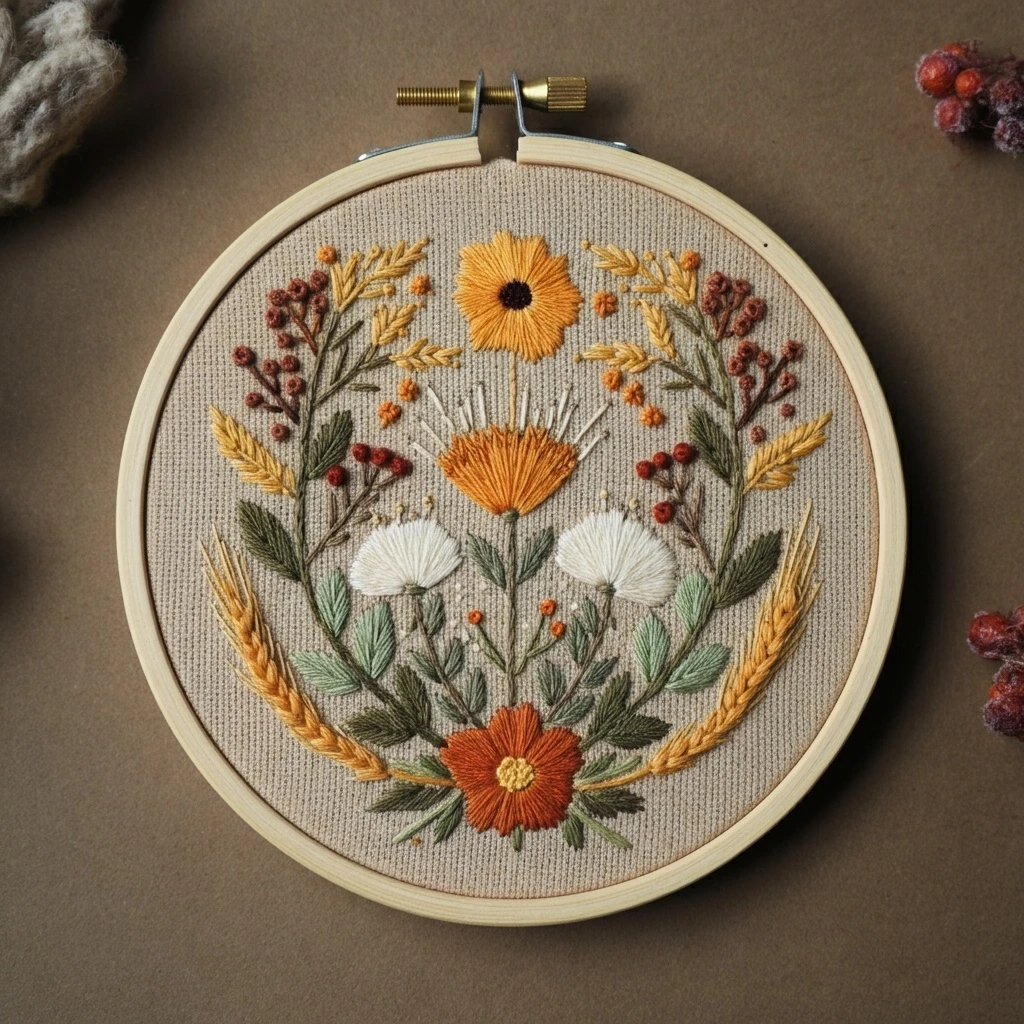

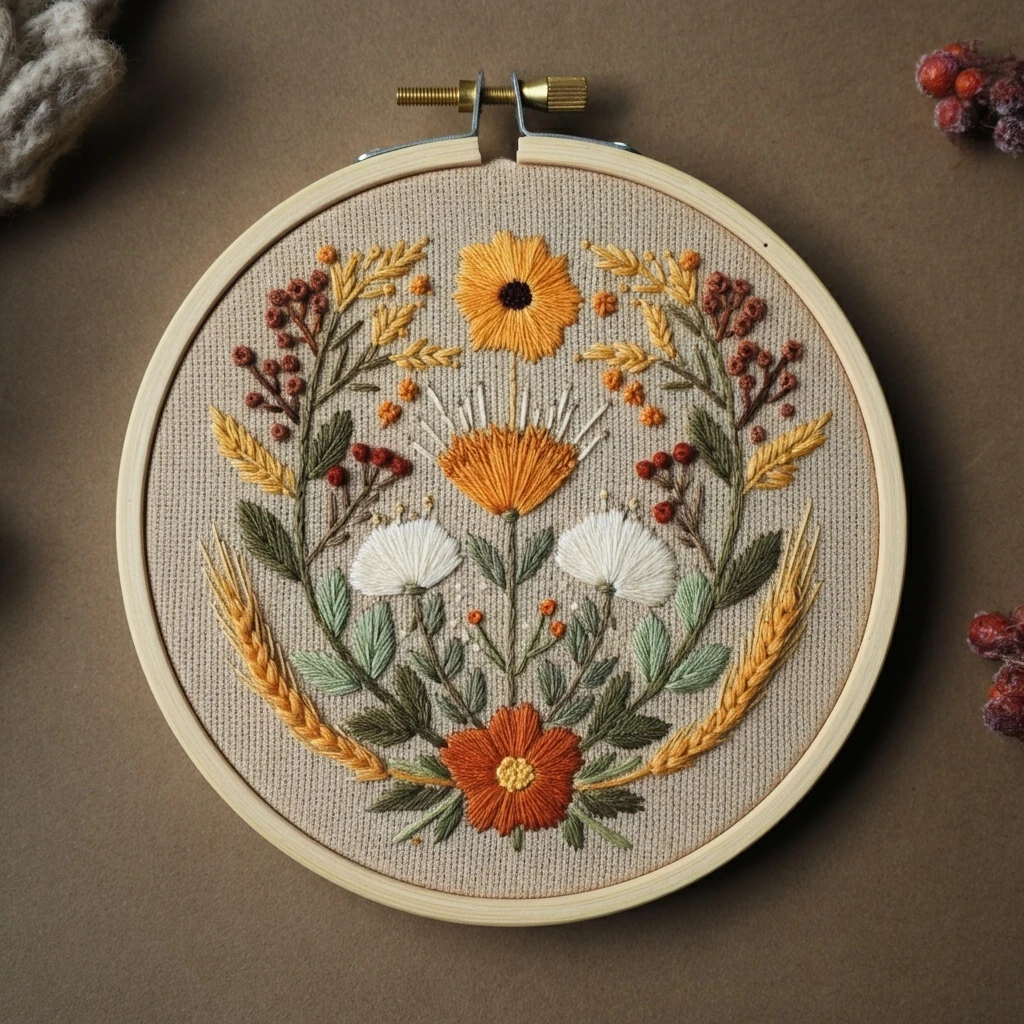
DMC palette & stitching notes
Symmetrical Autumn Harvest Wreath
A polished embroidery guide for the balanced harvest wreath design: golden wheat sprays, rust and ivory flowers, rounded berries, sage leaves, fine stems, and a warm seasonal palette arranged in a graceful hoop composition.
Likely DMC Color Palette
Colors are estimated from the visible hoop preview and matched to close DMC cotton floss shades. Use the palette as a practical stitching map rather than an exact thread-usage chart.
Stitching Suggestions
| Design area | Recommended stitch | Practical notes |
|---|---|---|
| Large golden top flower | Long and short stitch, satin stitch center rays | Work from the dark center outward. Alternate DMC 725 and 782 so the petals radiate like a sunflower and avoid a flat fill. |
| Rust flower at bottom | Long and short stitch with split-stitch outline | Outline first with one strand of 921 or 3777, then fill petals from the outside edge toward the center for a neat circular bloom. |
| White side blossoms | Satin stitch or closely spaced straight stitches | Use 3865 for the main petal fans and a few 822 stitches near the base for depth. Keep all stitches angled toward the flower center. |
| Wheat and grain sprays | Detached chain, fly stitch, and straight stitch | Use two strands for plump wheat heads. Add a darker 782 line at one side of each grain to create a raised harvest texture. |
| Red-brown berries | French knots or colonial knots | Use 3777 for most berries and 898 for the shadow side. One or two wraps is enough; crowd knots slightly for full clusters. |
| Sage leaves | Fishbone stitch | Stitch each leaf from tip to base, alternating 3052, 3363, and 524. This makes the symmetrical foliage feel lively rather than mirrored too perfectly. |
| Fine stems and twigs | Stem stitch, backstitch, or couching | Use one strand of 646, 3363, or 898. Stitch stems before berries and flowers so knots and petals can sit cleanly on top. |
| Pale seed sprays | Straight stitch with tiny French knots | Use 822 or 3865 for the upright seed lines, then add small knots at the tips for airy meadow texture. |
Thread Count & Blending Guide
Suggested strands
- 1 strand: fine stems, twig outlines, pale seed sprays, and delicate detail lines.
- 2 strands: most leaves, wheat heads, berries, and flower petal filling.
- 3 strands: occasional bold petal edges or larger berry knots if the design is stitched on a slightly larger hoop.
Easy color blends
- Golden wheat: one strand 725 + one strand 782 for rich, dimensional grain.
- Copper petals: one strand 921 + one strand 922 for a glowing rust-orange fill.
- Sage leaves: one strand 3052 + one strand 524 for soft highlighted leaves.
- Deep berries: one strand 3777 + one strand 898 for the darkest berry clusters.
Outlining, Shading & Texture
Outlining details
Because the wreath is symmetrical, crisp placement matters. Use a one-strand split stitch around the larger flowers before filling them. For leaves, outline only the central vein or one shadow edge; too much outline can make the foliage look heavy.
Shading guidance
Place darker shades at flower centers, petal bases, and the underside of leaves. Keep lighter tones toward petal tips, upper wheat edges, and mint-green leaf highlights so the wreath keeps its sunny harvest glow.
Texture suggestions
Contrast smooth satin petals with raised French-knot berries and directional fishbone leaves. For wheat, stagger each grain stitch slightly to mimic natural seed heads rather than making every stitch identical.
Symmetry tip
Stitch matching left and right elements in pairs: left wheat spray, then right wheat spray; left berry cluster, then right berry cluster. This keeps color balance and density even across the hoop.
Where to Start
Beginner-Friendly Practical Tips
- Keep fabric drum-tight in the hoop; loose fabric makes long petal stitches uneven.
- Use shorter thread lengths, about 14–18 inches, to reduce fuzzing in the warm copper and gold shades.
- When making French knots, hold the working thread taut until the needle has nearly passed through the fabric.
- Do not overfill the wreath. The open linen background is part of the airy autumn look.
- Step back every few sections to check that the left and right sides have similar color weight.
- Press finished embroidery face down on a folded towel so knots and raised wheat texture are not flattened.