
DMC palette & hand embroidery guide
Jewel Toned Rose And Lavender Bouquet
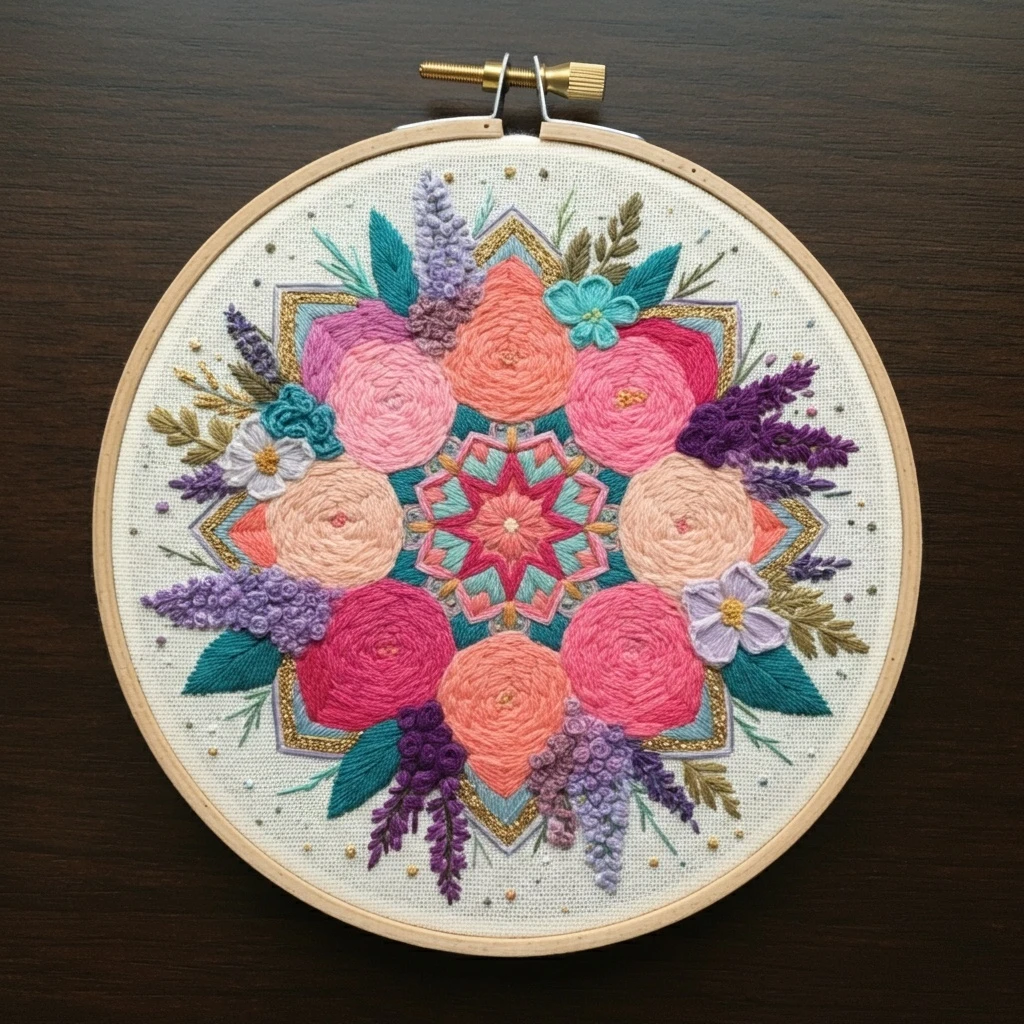
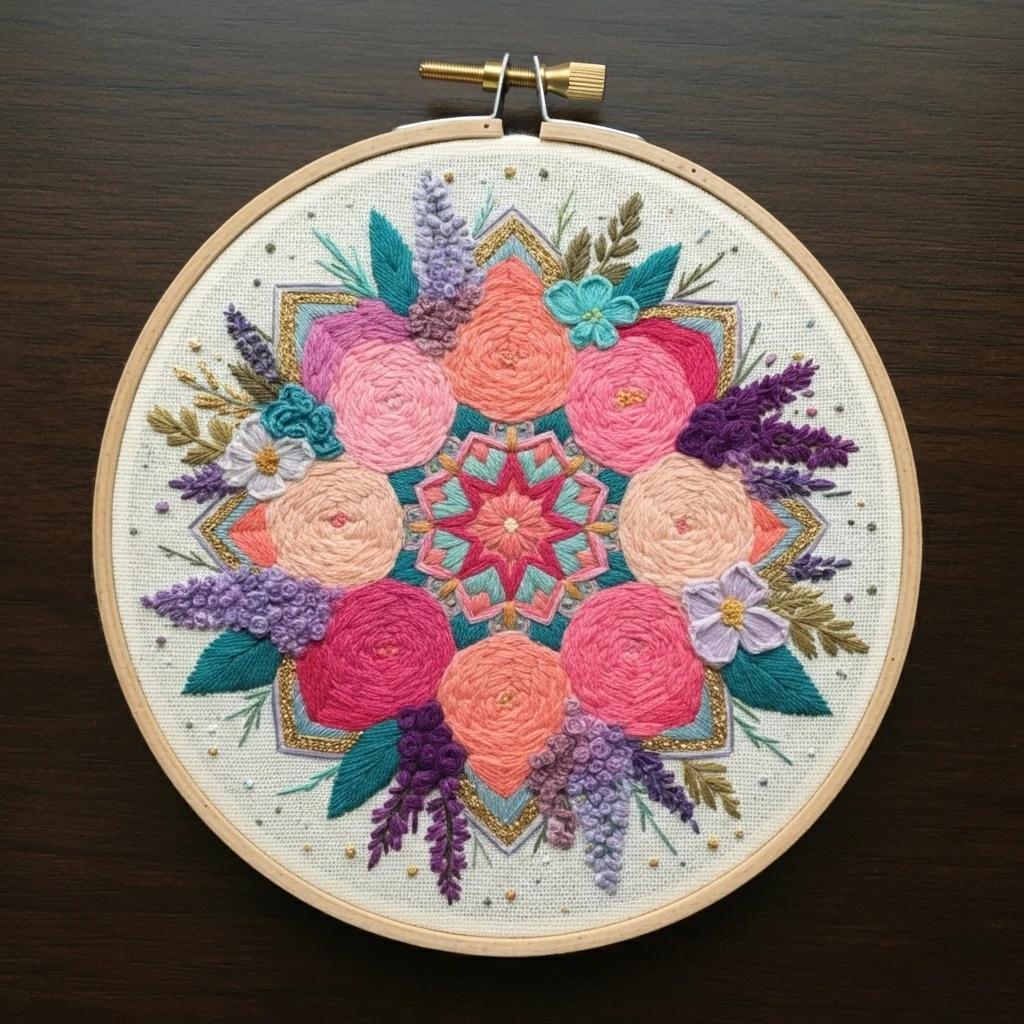
A rich botanical bouquet design with full rose blooms in berry, garnet, plum, and magenta tones, framed by lavender sprigs, blue-violet buds, deep green leaves, and softly curved stems. The overall effect is romantic and saturated: velvety roses provide the focal weight, while lavender spikes and airy foliage keep the arrangement graceful and light.
Design color read
The reference image reads as a dense hand-stitched bouquet with jewel-toned roses as the focal flowers and narrow lavender stems rising above and around them. The roses need a velvety value range: pale blush or mauve highlights on the curled petal edges, saturated berry and garnet in the petal bodies, and dark plum or wine inside the spiral folds. Lavender sprigs add cooler blue-violet notes, while sage, pine, and olive greens provide enough contrast to frame the blooms.
The key is controlled richness. Let the roses be dark and dramatic, but keep the lavender tips airy and the leaves directional so the bouquet still feels fresh rather than heavy.
Thread-count snapshot
- Rose petals: 2 strands for satin, long-and-short, or woven rose stitches; 1 strand for crease lines.
- Lavender florets: 2 strands for detached chain or tiny lazy-daisy buds; 1 strand for the narrow stems.
- Leaves: 2 strands for fishbone or long-and-short fill; 1 strand for veins and edge shadows.
- Stems and tie: 2 strands stem stitch; use 1 strand for small overlaps and fine curves.
- Centers and sparkle: 1 strand French knots so the gold details stay delicate.
Suggested DMC palette
Stitch suggestions
Best order of work
Blending & shading guidance
Velvet rose depth
Build roses with the deepest values first: 154 in the tight central spiral, 814 and 915 in the shadowed folds, 3685 for the main petal body, and 3688 or 225 only on raised edges. For a soft jewel blend, thread one strand 3685 with one strand 915 for mid-shadow petals, then one strand 3685 with one strand 3688 for petal surfaces catching light.
Lavender sprig contrast
Keep lavender sprigs cooler than the roses. Place 208 near the stem or on tucked bud bases, use 209 and 210 through the middle, and finish every few buds with 211. This four-step range makes the sprigs read as delicate clusters rather than flat purple lines.
Foliage balance
Dark greens should sit behind the bouquet to frame the jewel colors. Use 500 only where flowers overlap leaves, then soften outward with 501, 3363, and 3052. A few muted sage stitches beside plum roses give the bouquet an elegant, vintage botanical tone.
Texture notes
- Vary rose petal stitch length so the blooms look layered and organic.
- Do not fill lavender stems too thickly; the buds should be the texture, not the stalk.
- Let a few leaves tuck under rose edges with dark tone-on-tone backstitch for depth.
- Use small fabric gaps between lavender buds to preserve the airy spike shape.
- Save gold knots for accents only. Too many warm dots can distract from the jewel palette.
Outlining details
Use tone-on-tone outlines rather than black. For roses, 154 and 814 can mark the deepest spiral lines, while 915 works for curved petal separations. Lavender outlines should be 208 or 209 in one strand only. Leaf edges can be defined with 500 or 501, but outline only the shadow side; the highlighted side should be softened with 3052 or left open for a natural botanical finish.
Beginner-friendly practical tips
- Transfer the rose spirals, main petal shapes, lavender stems, and leaf outlines; place tiny buds as you stitch.
- Use short floss lengths for dark plums and greens to prevent fuzzing and dullness.
- Turn the hoop frequently while stitching roses so each petal follows its natural curve.
- Start with fewer outline stitches than you think you need; add more only after the fills are complete.
- If shading feels difficult, choose three values per flower: dark center, mid body, light edge. That is enough for a polished result.
Compact stitch plan
Roses: woven wheel, satin, or long-and-short stitch using 154, 814, 915, 3685, 3688, and 225. Lavender: one-strand stems in 208 or 501 with detached-chain buds in 209, 210, and 211. Leaves: fishbone or long-and-short stitch in 500, 501, 3363, and 3052. Accents: 729 French knots and selective tone-on-tone backstitch for petal folds, bud bases, and leaf shadows.