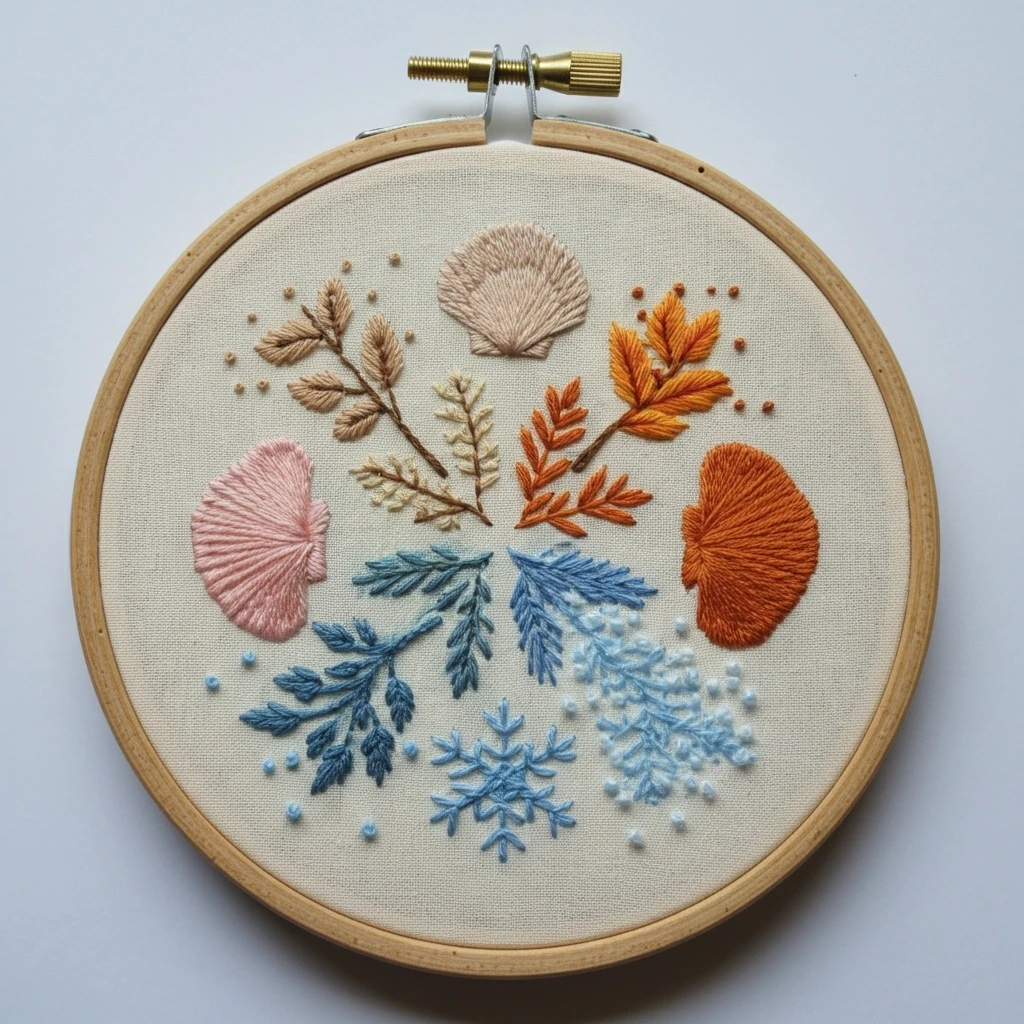


Seasonal Coastal Foliage Shells Color Blending Practice
A calm shoreline sampler built around sea-glass blues, soft shell neutrals, coral warmth, sandy gold, and seasonal botanical greens. The guide below is designed for color blending practice: small motifs, visible texture, gentle tonal shifts, and beginner-friendly stitches that still create a polished hand-embroidered finish.
Recommended DMC Color Palette
Use 14–18 colors for a refined sampler. The shades below give enough range for shells, foliage, water-worn shadows, and seasonal accents without making the project feel crowded.
Stitch Map & Practical Use Notes
| Design area | Recommended stitches | Thread count & handling |
|---|---|---|
| Shell ridges | Stem stitch or split stitch for curved grooves; add short straight stitches between ridges for raised texture. | Use 1 strand for fine grooves, 2 strands for the outer shell contour. Keep curves smooth by taking very small stitches. |
| Shell bodies | Long-and-short stitch, satin stitch in small sections, or fishbone-style filling for fan shapes. | Blend 950 + 948, then shift into 754 or 3778 near the base. Work from light edge to darker center. |
| Sea grasses | Fly stitch, straight stitch, whipped back stitch, and lazy daisy for narrow blades. | Use 2 strands for grasses. Mix one strand 3012 with one strand 3052 for natural, uneven greenery. |
| Leaf sprigs | Fishbone stitch for larger leaves; detached chain for small leaves; back stitch for central veins. | Use 2 strands for leaf fill and 1 strand for veins. Alternate 3012, 3052, and 3810 to avoid flat green blocks. |
| Buds, berries, seed heads | French knots, colonial knots, seed stitch, and tiny satin dots. | Use 2 wraps for small knots and 3 wraps only for foreground berries. Coral and old-gold accents should be sparse. |
| Outlines | Back stitch, split back stitch, or couching for heavier rustic lines. | Use 1 strand 611 or 839 for delicate outlines. Use 2 strands only on the main composition silhouette. |
Color Blending Ideas
3865 → 948 → 754. Use in long-and-short stitch, keeping the lightest shade on the shell rim.
948 → 754 → 3778. Place the darkest tone only where ridges overlap or curl inward.
964 → 959 → 3810. Excellent for cool leaves or stylized coastal sprigs.
3011 → 3012 → 3052. Work leaf clusters with mixed strands for a naturally varied botanical look.
950 → 642 → 611. Use for driftwood lines, shadow beneath shells, and understated grounding stitches.
3822 → 3829 → 3778. Keep these as tiny knots so the palette stays refined.
Texture, Shading & Finishing Guidance
Thread-count plan
- 1 strand: shell grooves, fine veins, tiny star-like seed marks, and delicate outlines.
- 2 strands: most leaves, stems, shell bodies, and visible curved outlines.
- 3 strands: only for bold foreground knots or padded shell lips; use sparingly.
Shading approach
- Shade shells from pale outer rim to warmer base; avoid harsh stripes by staggering stitch lengths.
- Place darker teal or green at the underside of leaves and where stems tuck behind shells.
- Use beige-gray shadows around shell edges instead of black for a softer coastal finish.
Outlining details
- Use split back stitch for shell contours when you want a clean illustrated edge.
- Use whipped back stitch on long stems for a smooth raised cord effect.
- Keep 839 very thin; it is best as a quiet shadow rather than a dominant outline.
Beginner-friendly workflow
- Start with the longest stems and largest shells so the composition is anchored.
- Work from background foliage to foreground shells; raised knots should be last.
- Rinse or steam-block only after testing floss colors for colorfastness, especially saturated coral shades.
Polished Stitching Suggestions
For a refined sample-page look, leave small breathing spaces between motifs. The coastal subject works best when it feels airy: do not overfill every leaf or shell. Let the fabric act as the lightest highlight, especially inside shell fans and around pale sea-glass leaves.
For extra dimension, couch a single strand of 642 along one side of a shell, then add one-strand 3865 highlights on the opposite rim. On foliage, blend one strand of 3012 with one strand of 3052 in the needle for natural variation, then add occasional 964 stitches to tie the greenery back to the coastal palette.
Hoop finish: mount in a natural wood hoop, trim the back cleanly, and pair with oatmeal or sand-colored backing felt to emphasize the muted shell and foliage tones.