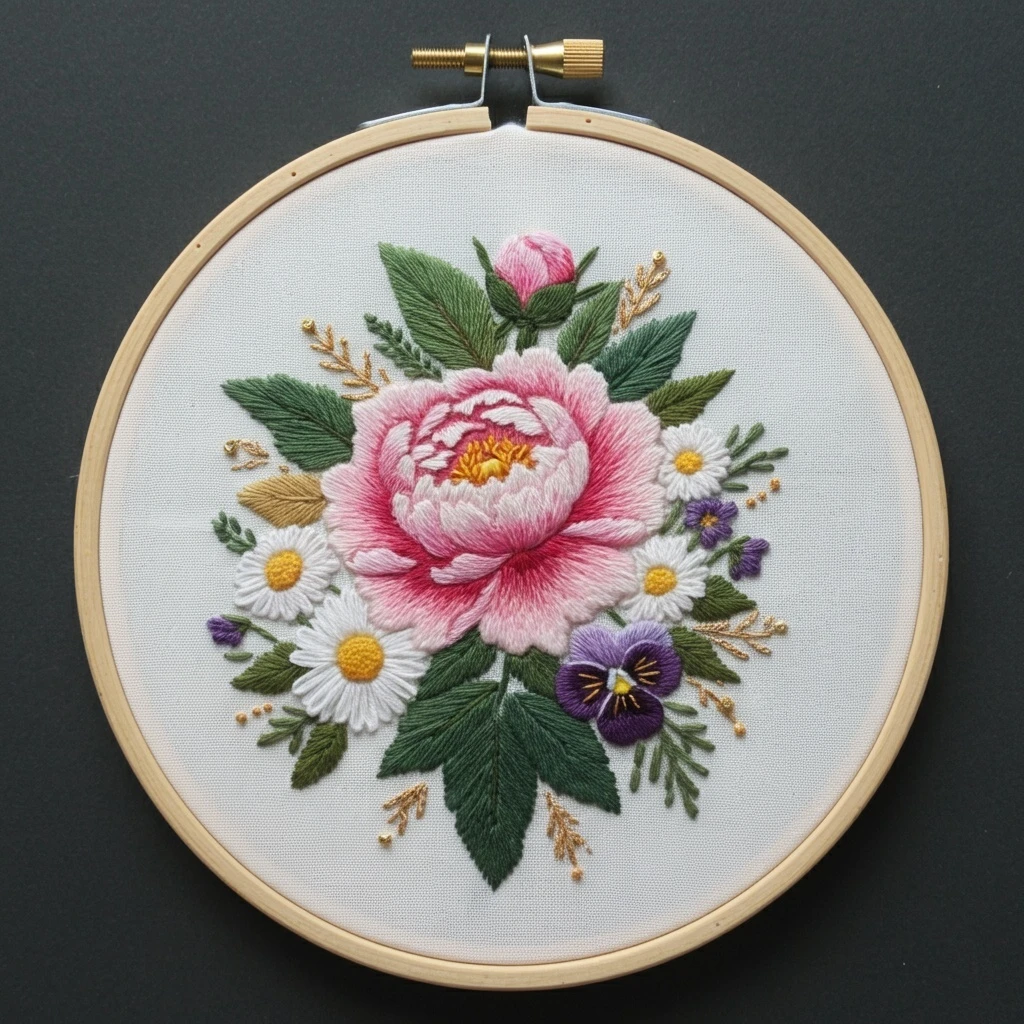


Soft Pink Rose with Sage Green Foliage
A romantic botanical guide for stitching a gentle pink rose surrounded by muted sage foliage. The palette favors dusty blush petals, gray-green leaves, warm brown details, and soft cream highlights for a calm heirloom finish.
Design Reading
This design is built around a full, soft pink rose with curved petal layers and airy sage-green leaves. Keep the overall contrast low and graceful: the rose should feel rounded and plush, while the foliage should sit slightly behind it with cool gray-green restraint.
Main visual priorities
- Petal curves need clean directional stitches that follow the rose spiral.
- Leaf veins should be narrow and slightly darker than the leaf fills.
- Use brown outlines sparingly; too much dark line can overpower the pastel palette.
Thread Count Snapshot
2 strands for satin/long-short fill; 1 strand for final crease lines.
2 strands for fishbone leaves; 1 strand for veins and small stems.
1 strand split stitch or stem stitch for refined botanical edges.
For a softer watercolor effect, blend one strand of DMC 818 with one strand of DMC 3713 on transition petals, and one strand of DMC 3013 with one strand of DMC 3052 on shaded leaves.
Suggested DMC Color Palette
| Color | DMC | Where to Use | Practical Note |
|---|---|---|---|
| DMC 818 Baby Pink |
lightest petal highlights and outer rose turns | 1 strand for delicate lines; 2 strands for filled petals | |
| DMC 3713 Salmon Very Light |
soft mid-pink petal body and gentle rose blush | 1 strand for delicate lines; 2 strands for filled petals | |
| DMC 761 Salmon Light |
warm petal shadows, folded petal bases | 1 strand for delicate lines; 2 strands for filled petals | |
| DMC 225 Shell Pink Ultra Very Light |
barely-there pink wash on open petal tips | 1 strand for delicate lines; 2 strands for filled petals | |
| DMC 3721 Shell Pink Dark |
deepest rose creases and small accent shadows | 1 strand for delicate lines; 2 strands for filled petals | |
| DMC 3013 Khaki Green Light |
main sage leaves and calm foliage fill | 1 strand for stems/veins; 2 strands for leaves | |
| DMC 3052 Green Gray Medium |
leaf undersides, vein shadows, stems | 1 strand for stems/veins; 2 strands for leaves | |
| DMC 522 Fern Green |
secondary muted greenery and transition leaves | 1 strand for stems/veins; 2 strands for leaves | |
| DMC 3363 Pine Green Medium |
darkest stem lines, leaf bases, contrast details | 1 strand for stems/veins; 2 strands for leaves | |
| DMC 3865 Winter White |
soft highlight stitches and fabric-friendly light accents | Use sparingly as accent or outline | |
| DMC 632 Desert Sand Ultra Very Dark |
optional warm sepals or vintage outline touches | Use sparingly as accent or outline | |
| DMC 839 Beige Brown Dark |
fine outlining where stronger definition is needed | Use sparingly as accent or outline |
Stitch Suggestions
Shading & Blending Plan
Rose petals
Place DMC 225 or 818 on the petal tips, DMC 3713 through the main body, and DMC 761 or 3721 where petals tuck under one another. Blend by alternating stitch lengths rather than making hard bands of color.
Sage foliage
Use DMC 3013 as the calm base, DMC 522 for slightly warmer leaves, and DMC 3052 or 3363 at the base of leaves and along veins. Keep the darkest green to the inner foliage so the rose remains the focal point.
Outlining
Choose DMC 632 for a warm vintage outline or DMC 839 for stronger definition. For the softest result, outline only the shadow side of petals and leaves.
Beginner-Friendly Practical Tips
- Start with the stems and leaves first, then stitch the rose on top visually so the bloom feels forward.
- Use a hoop that keeps fabric drum-tight; loose fabric makes satin stitch petals pucker.
- Separate all six floss strands before recombining the number you need. This keeps the thread smoother and less rope-like.
- For petal fills, stitch from the petal edge inward on one side, then from the center outward on the next row to avoid a striped look.
- Keep thread lengths around 14–18 inches. Pastel floss shows fuzz and wear more quickly than dark floss.
- Step back often. A soft floral design should read as gentle and balanced from a distance, not overly outlined.
Texture Notes
Let the rose have the smoothest texture by using longer, directional stitches. Give the leaves more visible structure with fishbone stitch and fine vein lines. This contrast makes the bloom look velvety while the foliage feels botanical and crisp.
Finishing Advice
After stitching, gently press from the back on a towel so raised stitches are not flattened. If framing in a hoop, trim excess fabric only after the design is centered and tensioned evenly.