
DMC Palette & Hand Embroidery Guide
Spring Crocus Mandala
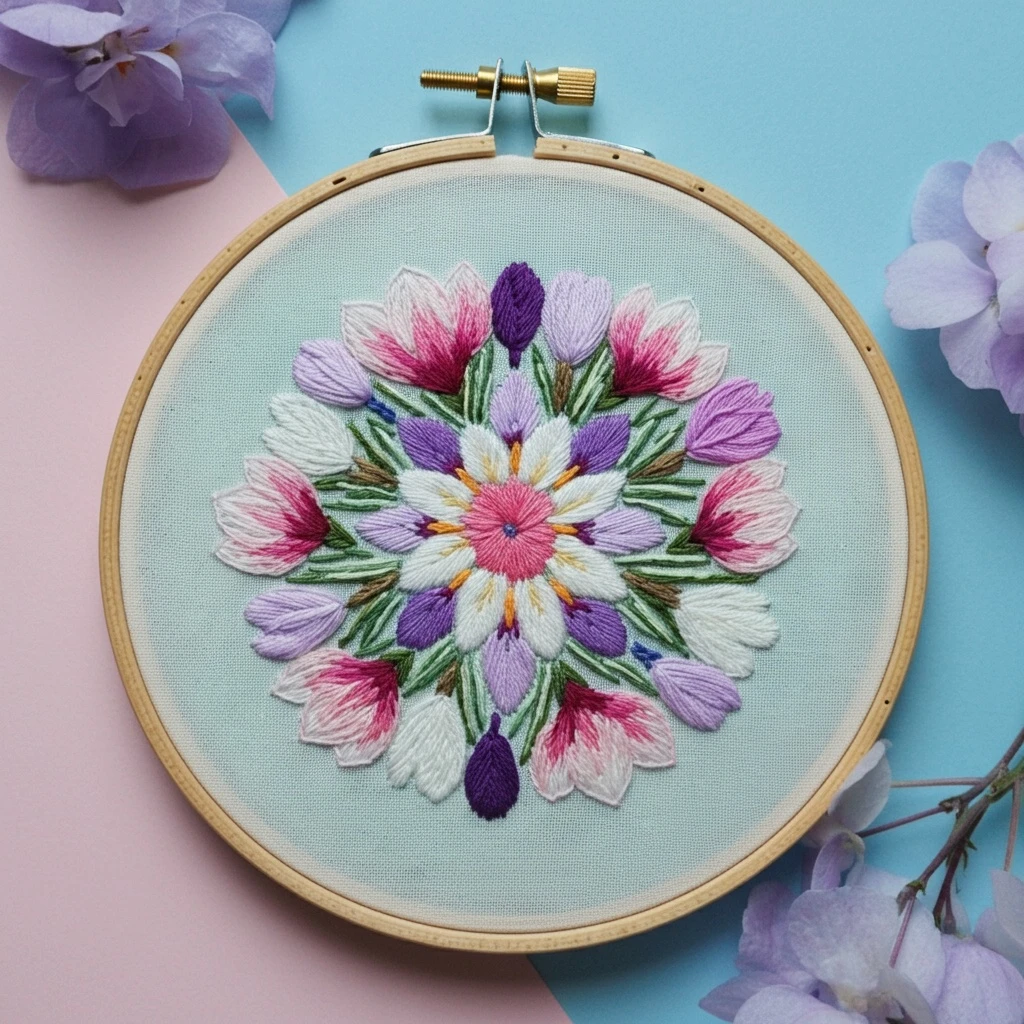
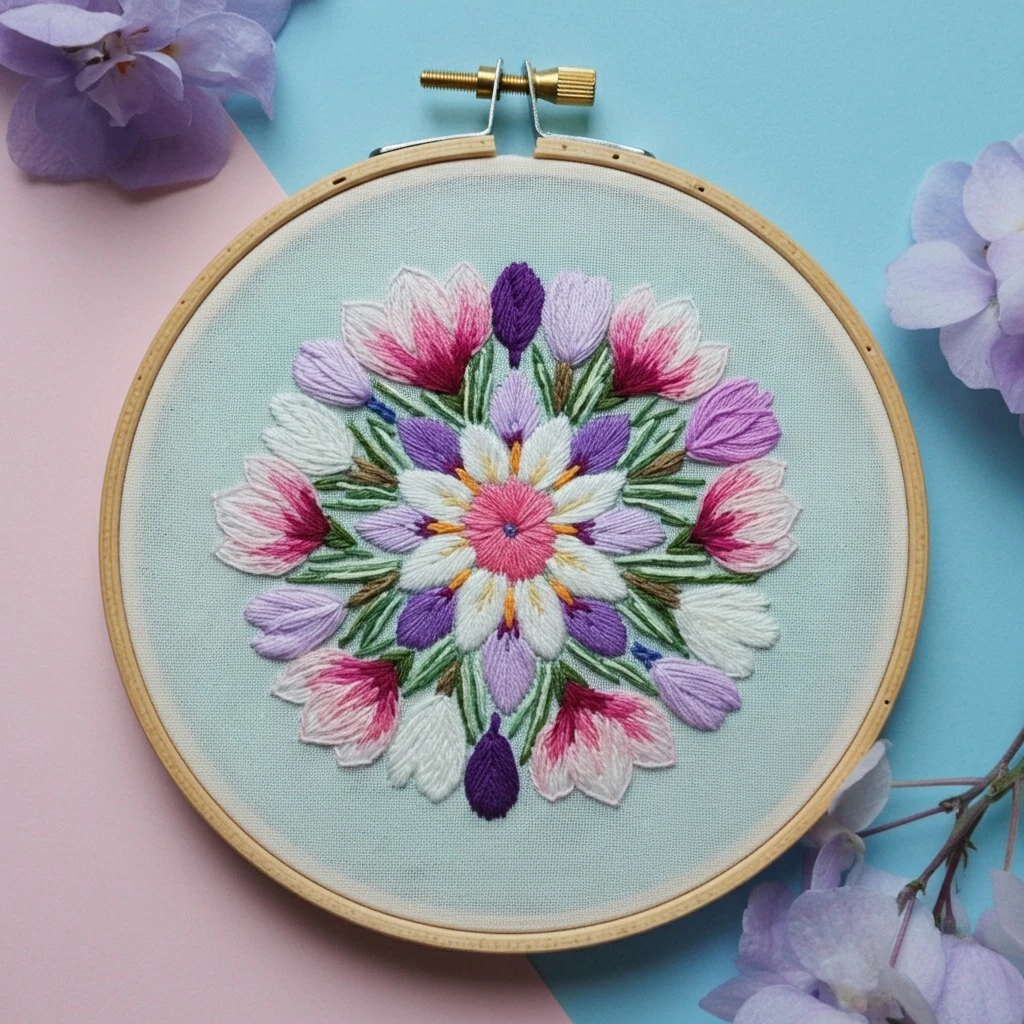
A soft spring mandala built from pink, purple, and white crocus blossoms. This guide keeps the design fresh and airy while giving enough color depth for shaded petals, clear radial symmetry, bright flower centers, and graceful green leaves.
Visual Analysis
The composition reads as a circular spring floral mandala, with crocus blossoms arranged around the center in a balanced repeat. The main visual effect comes from alternating pale petals, violet-purple cups, rosy pink accents, slim leaves, and small golden centers. Because the design relies on symmetry, consistent stitch direction and repeated color placement are more important than heavy filling.
Keep the whites softly shaded rather than flat, use purple sparingly for petal depth, and reserve the brightest pinks for focal tips and inner petal folds. Fine green lines should support the blossom ring without overpowering the delicate spring palette.
Recommended DMC Color Palette
| Area | Main DMC Colors | Close Matches / Substitutions | Use Notes |
|---|---|---|---|
| White crocus petals | Blanc, 3865, 762 | 746, 822, 415 | Use Blanc or 3865 for clean petal faces; add 762 only in creases or where petals overlap. |
| Soft pink petals | 819, 3354, 604 | 605, 151, 963 | Blend 819 into 3354 for natural petal blush; reserve 604 for tiny bright petal tips. |
| Purple crocus petals | 153, 209, 552 | 210, 3837, 3041 | Use 153 for pale lilac areas, 209 for mid folds, and 552 at the deepest petal bases. |
| Leaves and stems | 3364, 3347, 3051 | 368, 3012, 520 | Choose muted greens so the blossoms stay dominant; 3051 is useful for shadowed leaf undersides. |
| Flower centers | 742, 743, 3852 | 744, 3821, 783 | Small golden knots bring warmth and help each crocus read clearly from a distance. |
| Fine outlines and shadows | 3042, 3740, 3799 | 317, 413, 844 | Use only one strand for fine definition; avoid heavy dark outlines around pale flowers. |
Stitch Suggestions by Design Area
Crocus Petals
Use long and short stitch for shaded petal sections, following the natural curve from petal base to tip. Work the lightest color first, then feather mid tones inward so the transition stays soft. For narrow petals, satin stitch with a split-stitch border keeps the edges clean.
Petal Veins and Folds
Add one-strand split stitch or stem stitch in 153, 209, 3042, or a pale grey-lilac. Keep vein lines broken and tapered instead of continuous; this prevents the flower from looking too graphic.
Centers and Stamens
Use French knots, colonial knots, or tiny straight stitches in 742 and 743. Place the knots after petal stitching so the centers sit cleanly on top and add a raised focal point.
Leaves and Stems
Use stem stitch for curved stems and fishbone stitch for small leaves. For longer leaves, use two shades: a mid green on the light-facing edge and a deeper green through the center crease.
Thread-Count Guidance
For fabric, medium-weight cotton, linen, or cotton-linen blend works well. A 6-inch or 7-inch hoop gives enough room for the circular layout while keeping tension firm.
Placement and Order of Work
- Mark the center point first, then lightly transfer the main circular guides so the mandala remains even.
- Stitch the repeated blossoms in pairs opposite each other. This helps maintain color balance around the ring.
- Work pale petals before dark purple accents to avoid dragging deep color fibers across white or cream areas.
- Add stems and leaves after the blossoms so green lines can tuck neatly behind petal edges.
- Finish with flower centers, tiny highlights, and any final outline stitches only after the main filling is complete.
Texture and Shading Notes
For the white crocuses, shade with very pale grey and cream rather than strong color. A few stitches of 762 or 746 near the base will give depth while preserving the clean white blossom effect. For pink petals, blend 819 into 3354 and use brighter pink only on the outermost tips or inner folds.
Purple petals benefit from a three-step gradient: 153 on the lightest areas, 209 through the body of the petal, and 552 only at the deepest base or tucked fold. Keep stitch direction consistent within each repeated flower so the mandala has a calm, orderly rhythm.
Finishing Tips
- Press the finished embroidery face-down on a folded towel so knots and raised centers are not flattened.
- If displaying in a hoop, back the fabric with felt or cotton to hide carried threads behind pale petals.
- Trim jump threads carefully behind white blossoms; dark threads can shadow through light fabric.
- For a framed finish, leave generous fabric around the mandala so the circular design has breathing room.
- A simple white, natural wood, or pale lavender hoop complements the spring palette without competing with the flowers.