
DMC palette & hand embroidery guide
Cute Pastel Dinosaur
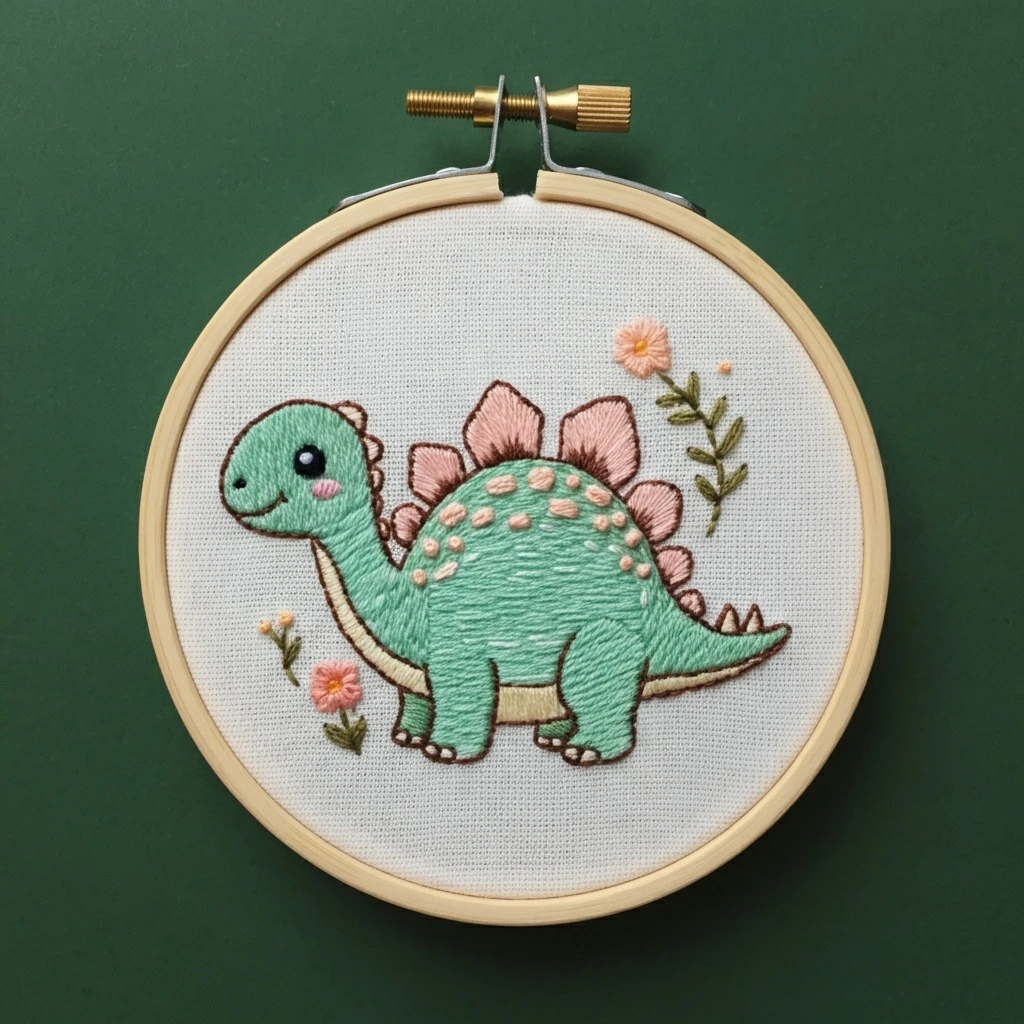
A sweet pastel dinosaur design works best with gentle mint, aqua, lavender, peach, and soft yellow tones rather than heavy prehistoric browns. Keep the body smooth and rounded, use tiny details for the face and toes, and add controlled pastel accents along the spikes, cheeks, belly, and decorative motifs so the finished embroidery feels playful, clean, and nursery-soft.
Visual analysis of the design
Main dinosaur shape
The dinosaur should read as cute, soft, and rounded rather than scaly or sharp. Use a pale mint or aqua body color as the base, then shade the underside of the belly, tail, legs, and cheek with slightly deeper teal-green so the form stays dimensional without losing its pastel character.
Pastel accents
Spikes, belly plates, cheeks, spots, or small decorative marks are the best places to introduce lavender, peach, pink, and butter yellow. Repeat each accent color in more than one area so the design feels balanced rather than patchy.
Expression and small details
The face needs the crispest stitching: tiny dark eyes, a fine smile, small nostrils, and gentle blush. Use dark grey-brown instead of pure black where possible to keep the expression soft and friendly.
Overall mood
The finished piece should look light, cheerful, and handmade. Smooth fills, small highlight stitches, and softly curved outlines will support the toy-like dinosaur style and prevent the design from becoming visually heavy.
Recommended DMC color palette
Use the mint-aqua family for the body, then choose two or three accent families for spikes, cheeks, spots, flowers, stars, or background details if they appear in the transferred pattern.
Close color matches and substitutions
| Design area | Primary DMC | Close alternatives | Use note |
|---|---|---|---|
| Main pastel body | 955, 954 | 369, 772, 3813 | Use 369 for a warmer spring green, 3813 for a cooler aqua dinosaur, or 772 for a very soft muted look. |
| Body shadows | 913, 3761 | 912, 3814, 597 | Keep shadow shades close in value; strong contrast can make the dinosaur look striped instead of rounded. |
| Spikes and spots | 211, 210 | 209, 153, 554 | Choose lavender for a gentle magical look or muted violet for slightly stronger definition. |
| Cheeks and blush | 605, 353 | 761, 818, 351 | Blend blush with only a few stitches; solid pink circles can overpower the tiny face. |
| Yellow accents | 745 | 744, 3823, 3078 | Use for stars, flower centers, or small sunny details. Avoid heavy yellow fills unless the design calls for them. |
| Facial linework | 3799 | 3371, 535, 844 | Dark grey or brown-black keeps the expression softer than true black while still readable. |
Stitch suggestions by area
Body and tail
- Long and short stitch: best for smooth pastel shading across the belly, head, tail, and legs.
- Split stitch fill: creates a neat, soft surface for rounded cartoon-style shapes.
- Satin stitch: works well for small belly panels, spots, and toes when the shapes are compact.
- Stem stitch: use for the outer contour when you want a smooth curved outline.
Spikes and decorative spots
- Satin stitch: fill each spike from base to point so it keeps a tidy triangular shape.
- Detached chain: ideal for oval spots, flower petals, or tiny scale-like accents.
- Straight stitch: add a single darker line at the base of larger spikes for subtle dimension.
Face
- French knots: make sweet round eyes, especially on smaller versions of the pattern.
- Back stitch: stitch the smile, nostrils, and eyelash details with one strand.
- Tiny satin stitch: use for larger eyes if the preview shows oval or glossy eye shapes.
- Single straight stitch: place a small white highlight on each eye after all dark stitching is complete.
Background and small extras
- Lazy daisy: use for small flowers, leaves, or cheerful surrounding motifs.
- Seed stitch: scatter lightly for ground texture or confetti-like pastel decoration.
- Star stitch: add tiny stars or sparkle details using pale yellow or white.
- Couching: useful for curved rainbow lines, banners, or decorative borders if included.
Thread-count guidance
| Element | Recommended strands | Reason |
|---|---|---|
| Main body fill | 2 strands | Gives even pastel coverage without creating a bulky surface. |
| Large shaded transitions | 1-2 strands | Use 2 for base shading, then add 1-strand feathering to soften color changes. |
| Outer outline | 1-2 strands | Use 1 strand for a delicate pastel illustration style or 2 strands for a bolder storybook edge. |
| Eyes, smile, nostrils | 1 strand | Keeps the expression clean and prevents dark details from becoming too heavy. |
| Spikes and spots | 2 strands | Provides smooth fill and enough color strength against the pale body. |
| Tiny flowers, stars, blush | 1 strand | Preserves the small scale and keeps accents light and airy. |
Placement and stitching order
Texture and dimensional tips
Soft toy-like body
Use curved stitch direction to suggest a plush rounded dinosaur. On the head and belly, let stitches fan gently outward from the center, then taper into the darker shades at the edges.
Smooth pastel blending
Pastel colors show harsh borders quickly, so overlap long-and-short stitches with feathered ends. Mix one strand of 955 with one strand of 954 for a custom transition when the color jump feels too strong.
Raised spikes
For slightly dimensional spikes, lay one small padding stitch inside each spike before covering it with satin stitch. Keep the padding short so the points remain sharp and tidy.
Cheeks and charm
Use two or three tiny pink stitches on each cheek instead of a filled circle. A very small 3865 eye sparkle can make the dinosaur look friendly without adding extra complexity.
Shading notes
Treat the dinosaur as a rounded pastel character with light coming from the upper front. Keep 964 or 955 on the top of the head, upper back, belly center, and tail tip. Use 954 and 913 along the underside, beneath the chin, near the feet, and where the tail curves away from the viewer.
For the spikes, use the lighter lavender or peach on the outer tips and a slightly darker shade at the base. For spots, place the darker color on the lower edge only if the shape is large enough; tiny spots usually look cleaner as a single flat pastel color. Keep facial shadows minimal so the expression remains open and sweet.
Finishing tips
- Use cream, pale mint, light blue, blush, or white cotton-linen fabric to support the pastel palette.
- Back the fabric with a lightweight stabilizer if the design has many satin-filled spots or tightly stitched spikes.
- Keep dark thread tails away from pale body areas; run them under darker stitches or trim them short.
- Press the finished embroidery face down on a folded towel so French knots, satin spikes, and eye highlights are protected.
- If framing in a hoop, add a thin layer of white or cream felt behind the work to prevent thread shadows from showing through.
- For a nursery or child-themed finish, consider a pastel painted hoop or a neat felt backing in mint, lavender, or pale yellow.