
DMC palette & hand embroidery guide
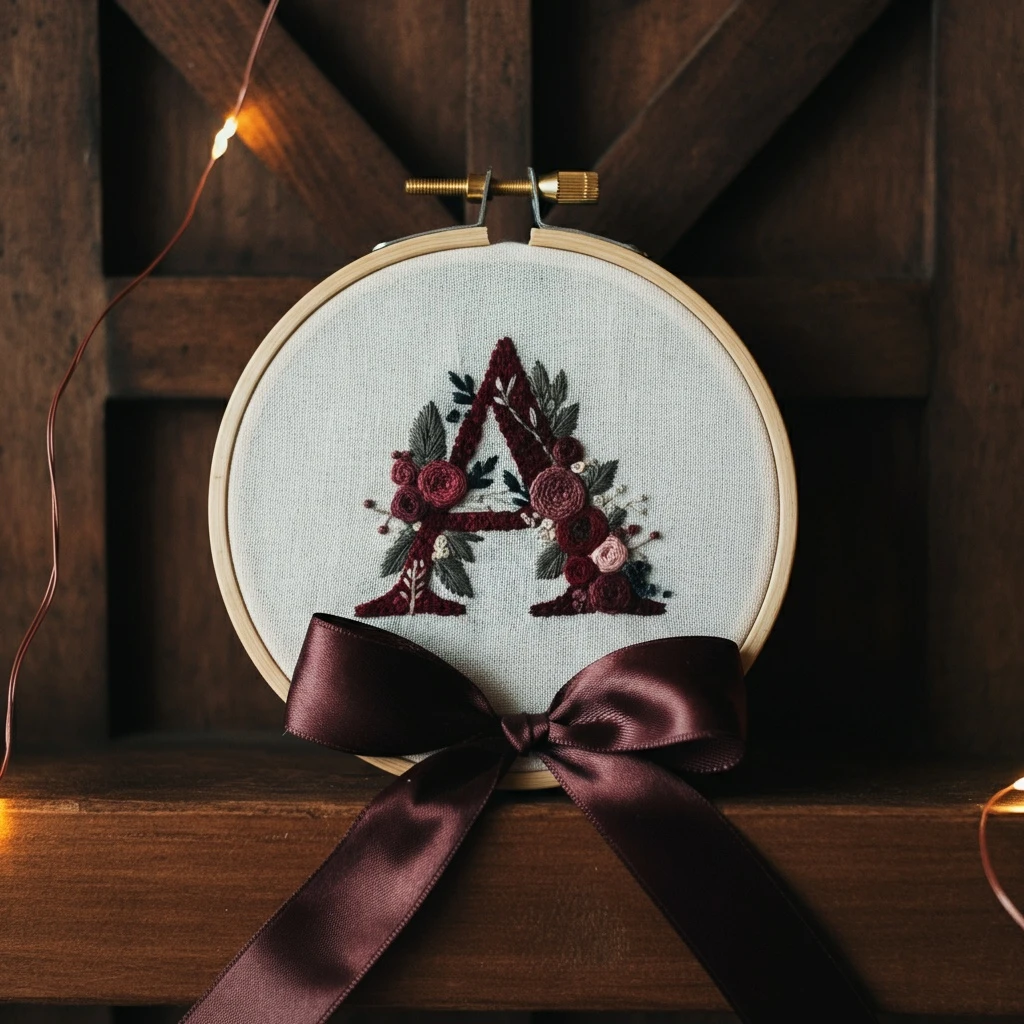
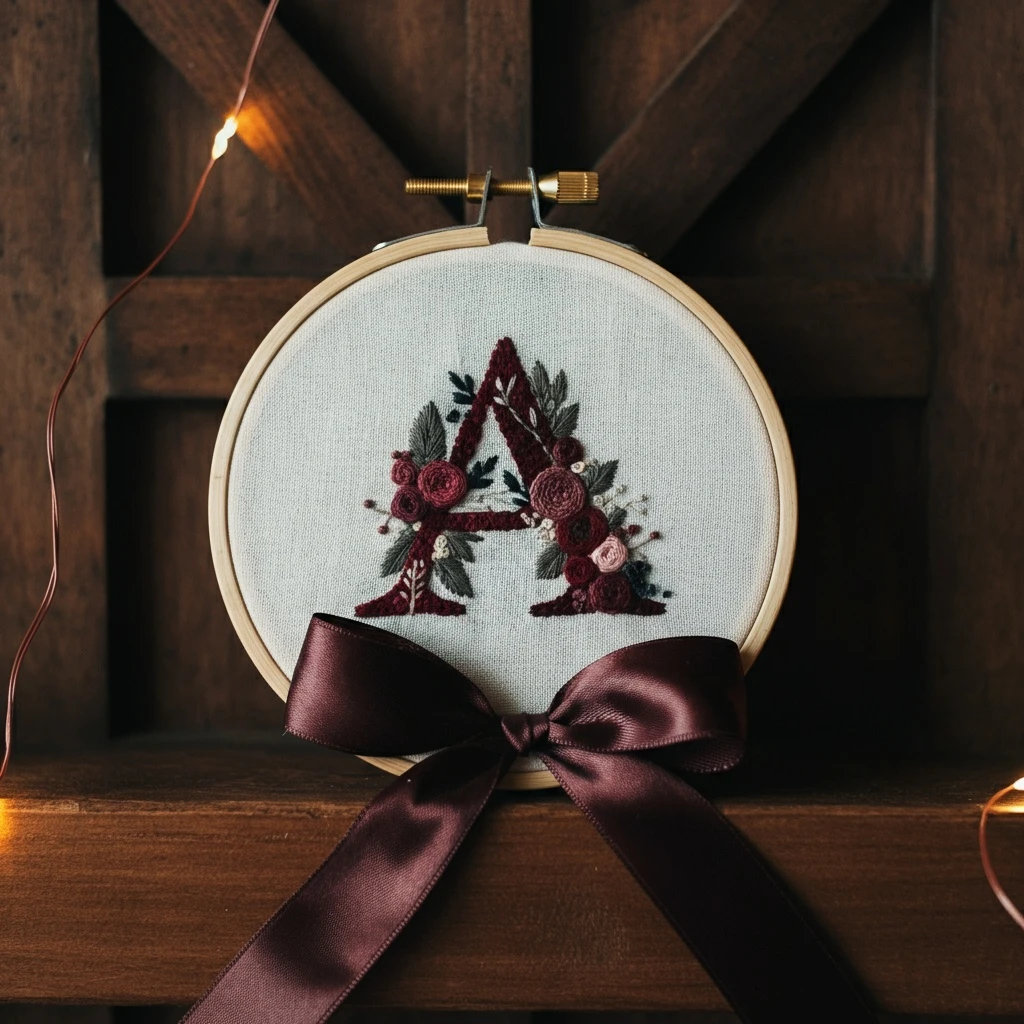
Floral Monogram Letter A
This floral letter A works best when the two angled strokes stay crisp and the crossbar remains readable beneath the botanical details. Use blossoms as clustered accents at the lower feet, shoulder, and crossbar area, then let fine vines and leaves soften the geometry without hiding the recognizable monogram shape.
Visual analysis of the design
Letter structure
The A is built around two slanted stems, a pointed top, and a central crossbar. The strongest stitching should define these three structural parts first, so the floral decoration reads as ornament rather than visual clutter.
Floral placement
Blossoms look most balanced when placed at the lower left foot, lower right foot, and one upper shoulder. Keep the top point lighter so the A remains elegant, not bulky.
Leaves and vine flow
Leaves can climb the angled strokes like a garland. Angle the leaves in the same direction as the letter strokes, then use a few outward-facing sprigs to soften the corners and lower feet.
Overall mood
The design suits a romantic keepsake or personalized initial hoop. A palette of blush pink, mauve, lavender, ivory, and muted greens keeps the monogram polished while still allowing the flowers to feel abundant.
Recommended DMC color palette
This palette is designed for a floral monogram A with soft petals, readable letter strokes, and gentle botanical movement. Use the darkest shades sparingly at petal bases, leaf veins, and tiny centers so the overall effect remains delicate.
Close color matches and substitutions
| Design area | Primary DMC | Close alternatives | Use note |
|---|---|---|---|
| Blush pink blossoms | 818, 761, 605 | 963, 3713, 776 | Use 963 for a softer nursery-style monogram or 776 for clearer rose contrast on cream fabric. |
| Deep rose accents | 603 | 604, 335, 3806 | Choose 604 for softer shading; reserve 3806 for very small dark petal folds. |
| Lavender flowers | 211, 209 | 210, 554, 153 | 153 gives a dusty heirloom look, while 554 brightens the purple accents. |
| Ivory highlights | 3865 | B5200, 746, 712 | B5200 is crisp and bright; 712 blends more naturally with unbleached linen. |
| Vines and foliage | 772, 522, 3052 | 368, 3013, 3363 | Muted greens keep the letter elegant; brighter greens make the design feel more springlike. |
| Centers and fine shadows | 3822, 801 | 744, 3821, 433 | Yellow centers brighten the florals; brown centers create a softer botanical illustration finish. |
Stitch suggestions by area
Letter A outline
- Stem stitch: ideal for the two angled strokes because it creates a smooth, slightly raised line.
- Split stitch: useful for the inner edges and tight transitions around the crossbar.
- Whipped back stitch: creates a neat corded outline for a more formal monogram finish.
- Short satin stitch: use on wider tapered ends or small filled accents at the feet.
Flowers and buds
- Lazy daisy: works beautifully for simple petals climbing the angled stems.
- Woven wheel: use for one raised focal rose near a lower foot or upper shoulder.
- Satin stitch: forms neat teardrop buds beside the crossbar and along small sprays.
- French knots: add tiny flower centers and filler blossoms without overpowering the letter.
Leaves and stems
- Fishbone stitch: gives larger leaves a natural vein and tidy almond shape.
- Detached chain: good for small leaves placed evenly along the slanted strokes.
- Stem stitch: stitch fine vines before flowers so the botanical path feels continuous.
- Straight stitch: add leaf veins, tendril tips, and small grasslike sprigs at the base.
Fine accents
- Seed stitch: adds light texture around clusters while keeping the center of the A open.
- Single-strand back stitch: sharpens the crossbar and petal separations.
- Couching: useful for a continuous vine that runs cleanly over the angled structure.
- Tiny straight highlights: place pale stitches on upper petal edges for a soft lifted effect.
Thread-count guidance
| Element | Recommended strands | Reason |
|---|---|---|
| Main angled strokes | 2 strands | Defines the letter clearly while keeping the monogram refined rather than heavy. |
| Crossbar and inner edges | 1 strand | Maintains crisp negative space and prevents the center of the A from closing up. |
| Small blossoms | 2 strands | Gives petals enough color coverage while keeping floral clusters delicate. |
| Raised focal rose | 2-3 strands | Add fullness only to one or two focal blooms so the letter shape remains dominant. |
| Leaves and vine stems | 1-2 strands | Use 2 strands for larger leaves and 1 strand for stems, veins, and tendrils. |
| Knots and filler dots | 1 strand | Small knots keep the monogram polished and avoid crowding the center triangle. |
Placement and stitching order
Texture and shading notes
Keeping the A readable
Avoid filling the center triangle with too many knots or petals. The crossbar and inner opening should remain visible so the monogram is clear from a distance.
Petal shading
Place deeper rose and lavender at flower centers, then move outward into 761, 818, or 3865. Repeat the same highlight direction across all blooms for a cohesive finish.
Leaf texture
Use 522 as the main leaf shade, 772 for fresh tips, and 3052 for shaded undersides. Add only a few 3364 veins so the greenery stays graceful and not too dark.
Angle control
Follow the slant of the letter with your stitch direction. Stitches that cross the stroke at random angles can make the A look wobbly, especially near the pointed top.
Fabric, needle, and hoop suggestions
| Supply | Recommendation | Tip |
|---|---|---|
| Fabric | Cotton, linen, or cotton-linen blend | Ivory, natural, pale blush, or soft sage fabric supports the romantic palette and keeps the letter edges visible. |
| Needle | Embroidery needle size 7-9 | Use size 9 for one-strand crossbar and tendrils; use size 7 or 8 for two-strand flowers and leaves. |
| Hoop | 5-7 inch hoop | A 6-inch hoop gives the letter enough breathing room while staying gift-sized and easy to display. |
| Stabilizer | Light tear-away or wash-away stabilizer | Helpful for maintaining crisp angled lines on looser linen or textured cotton. |
Finishing tips
- Press from the back on a padded towel so French knots, woven roses, and raised petals are not flattened.
- Trim thread tails behind pale pink, ivory, and lavender areas so shadowing does not show through the front.
- Step back before adding final filler stitches; the center opening and crossbar should still read clearly.
- Use a gathering stitch around the extra fabric at the back of the hoop for a smooth, gift-ready finish.
- Back the hoop with felt, card, or coordinating fabric if the monogram will be used as nursery decor, wedding signage, or a personalized keepsake.