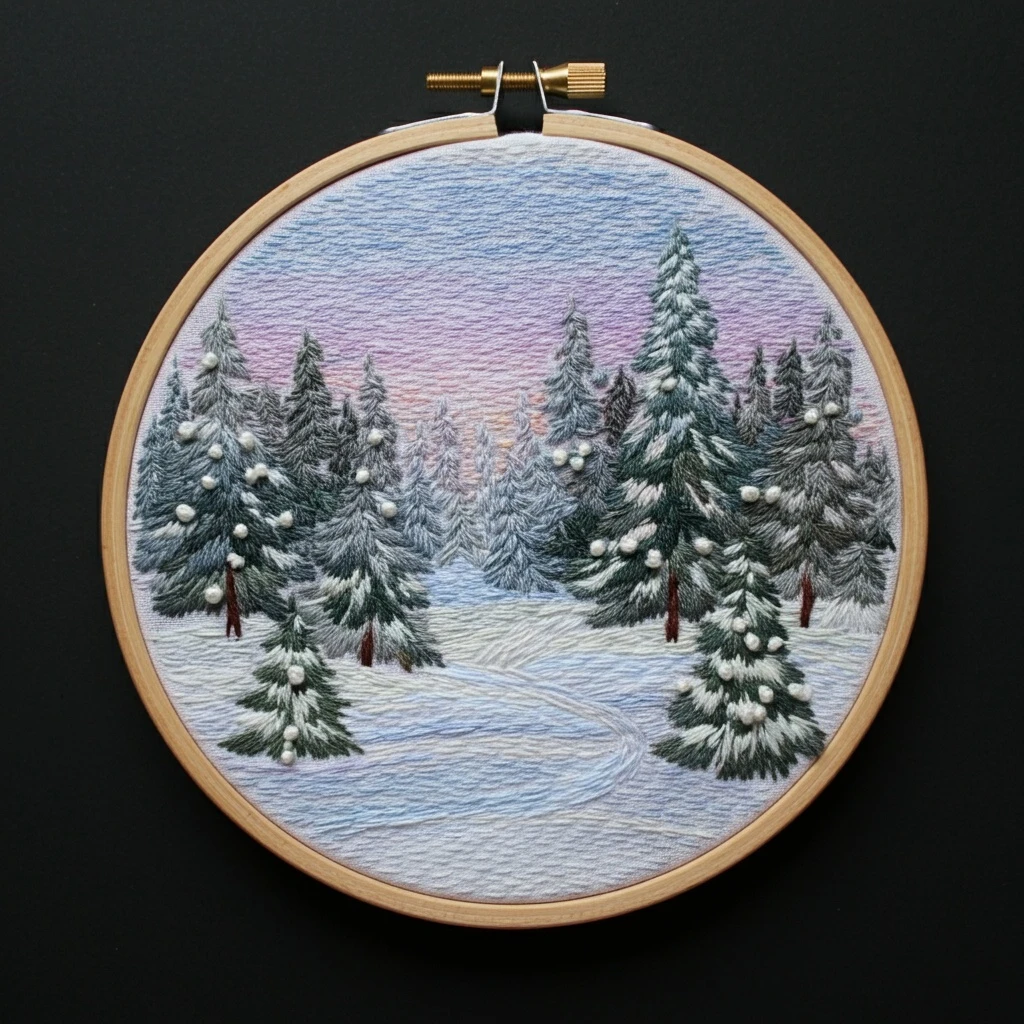

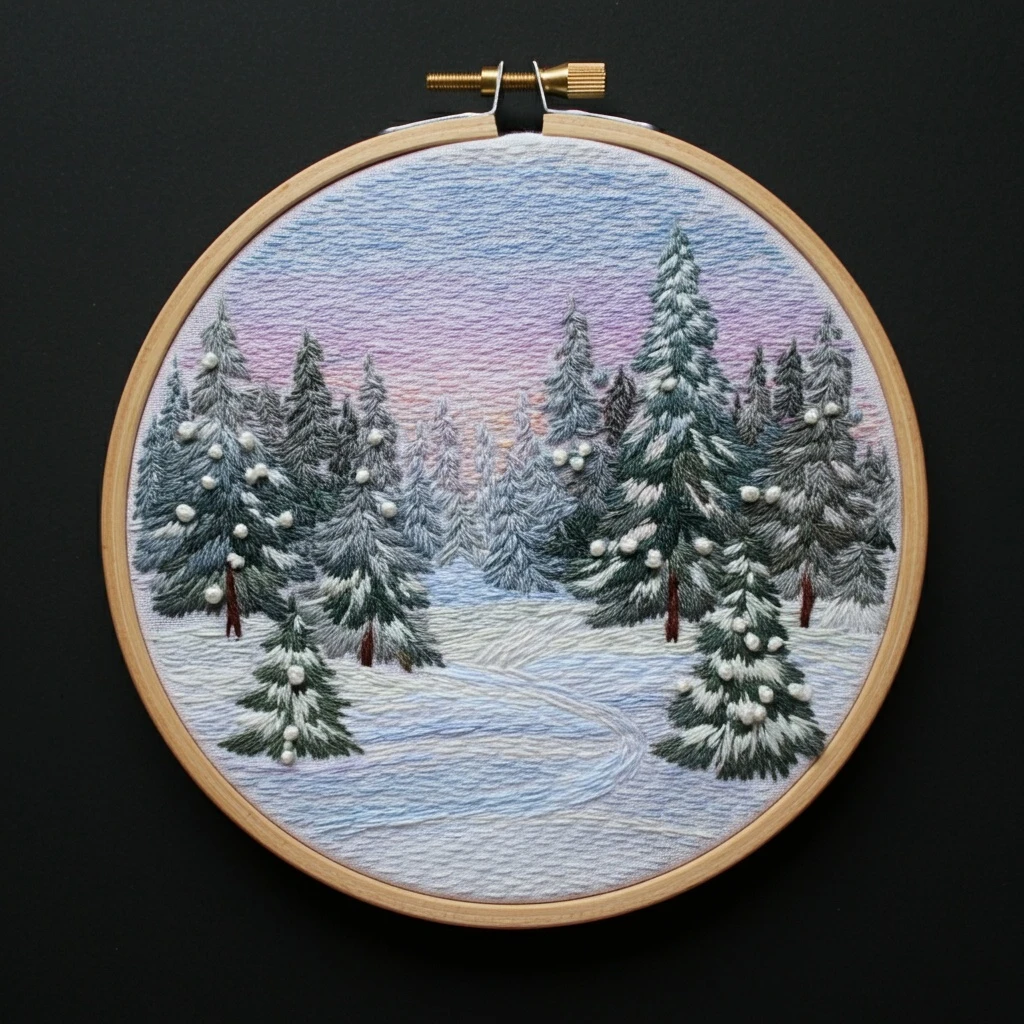
Winter Forest
A calm hoop-art guide for stitching snowy pines, cool blue shadows, slim woodland trunks, and a softly layered winter landscape. The palette leans frosted and natural: bright snow whites, muted blue-gray shade, evergreen depth, bark browns, and a few warm beige highlights to keep the scene from feeling flat.
Design read: what to capture in thread
The image reads as a quiet winter woodland: pale fabric or snowy ground, vertical tree trunks, dark pine shapes, and soft icy atmosphere. The strongest visual rhythm comes from contrast between thin brown-gray trunks and soft masses of evergreen foliage. Keep the background airy, then add darker details last so the forest stays crisp without becoming heavy.
Suggested DMC floss palette
Use these as practical matches rather than strict rules. The winter forest needs a restrained palette with enough value changes to separate snow, pine needles, shadows, trunks, and distant haze.
Stitch plan by design area
| Area | Recommended stitches | Thread count & notes |
|---|---|---|
| Snowy ground and pale background | Long and short stitch, split stitch, seed stitch | Use 1 strand for soft shadow strokes in 3756/762. Add B5200 seed stitches only at the end for snowy sparkle. |
| Evergreen boughs | Fishbone stitch, fern stitch, straight stitch clusters, detached chain | Use 2 strands for the main pine shape. Add 1-strand dark tips in 500 to sharpen the silhouette. |
| Tree trunks | Stem stitch, split backstitch, couching for very straight trunks | Use 1 strand for slim trunks; 2 strands only for foreground trunks. Blend 3862 + 839 in the needle for natural bark variation. |
| Distant forest haze | Tiny straight stitches, seed stitch, broken running stitch | Use 1 strand of 927 or 762 and keep stitches sparse so the background recedes. |
| Snow on branches | Whipped backstitch, small satin dashes, French knots | Use B5200 or 3865 with 1 strand. Place highlights on upper edges only so the snow direction feels consistent. |
| Fine twigs and details | Backstitch, fly stitch, single straight stitches | Use 1 strand in 839 or 3799. Keep lines broken rather than continuous for a hand-drawn woodland look. |
Blending, shading, and outlining
Snow shading
Do not shade snow with gray alone. Blend cool and warm neutrals: 3756 for icy dips, 762 for soft shadow, and 3865 for areas that should remain white but not stark.
Pine depth
Layer 522 first, then 520, then tiny 500 accents. Keep the darkest green mostly under boughs and near trunk centers so the branches look dimensional.
Trunk texture
Alternate 3862 and 839 in short stem-stitch segments. Add occasional single-strand 842 on one side of the trunk for winter light.
Blend idea One strand 520 + one strand 927 makes a muted mid-pine tone for distant trees. Outline idea Use 3799 only in tiny touches around the darkest trunk crossings or deep pine interiors.
Texture suggestions
For frosty sparkle
- Scatter small seed stitches in B5200 over the snow, leaving irregular spaces.
- Use a few French knots in 3865 where snow catches on branches.
- Keep sparkle stitches small; oversized knots can make the scene look floral instead of snowy.
For forest depth
- Make distant trees thinner, cooler, and less detailed.
- Use denser green stitches in the foreground and fewer stitches in the background.
- Let some fabric show through pine branches to suggest snow and air.
Beginner-friendly practical tips
- Stitch order: background haze, snowy ground, distant trees, main pines, trunks, then final highlights and outlines.
- Needle choice: a size 7 or 8 embroidery needle works well for 1-2 strands; switch to a sharper needle for tight bark details.
- Thread length: use 14-18 inch lengths to reduce fuzzing, especially with pale whites and grays.
- Tension: keep satin and long stitches relaxed. Pulling too tightly can pucker the snow areas and warp straight trunks.
- Hoop finish: before trimming, check that pale background stitches are clean; stray dark fibers show easily on winter designs.