
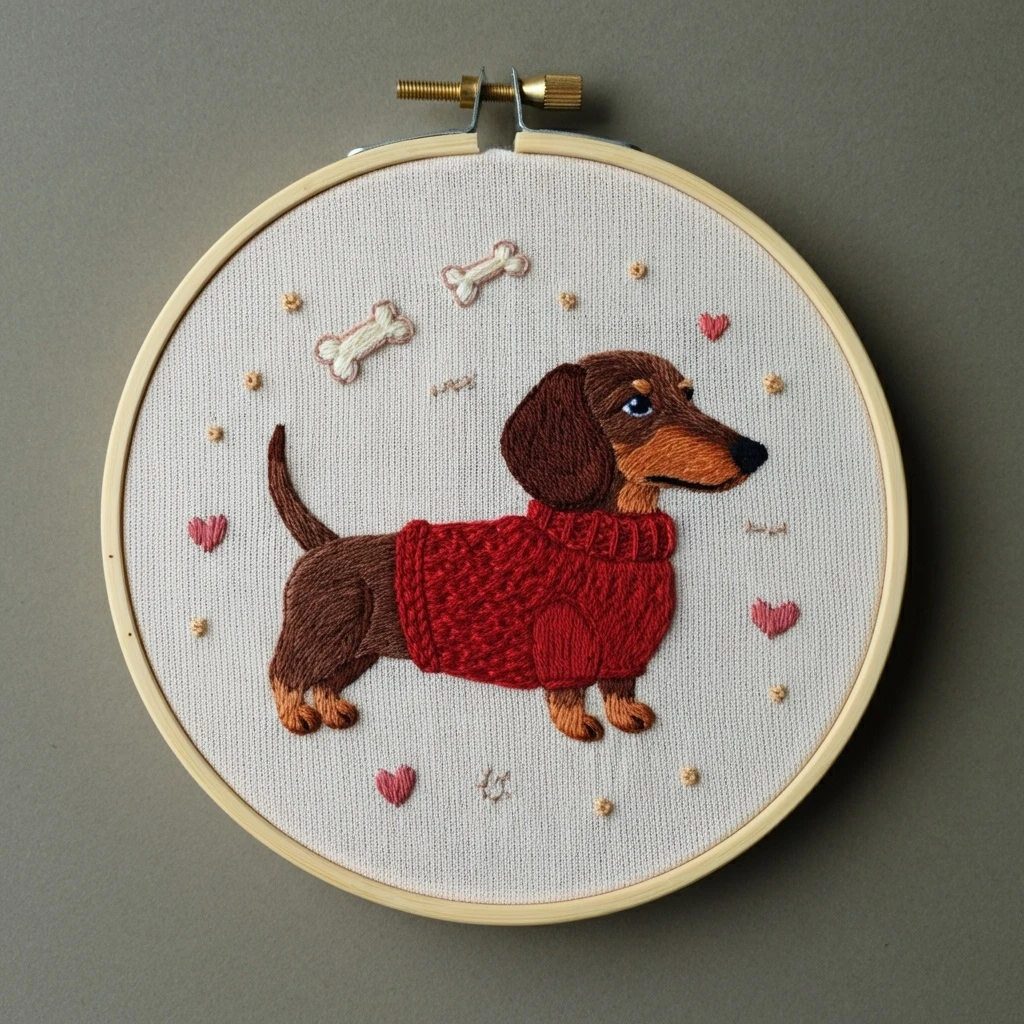
Embroidered Dachshund In A Red Sweater
A charming dachshund portrait with rich brown fur, expressive ears, a bright red knitted sweater, and soft facial highlights. These DMC matches are estimated from the visible hoop preview and chosen to keep the dog warm, lively, and easy to read in embroidery.
Likely DMC Color Palette
Matched to the dachshund’s warm brown coat, facial details, red sweater body, dark knit shadows, and tiny highlight accents.
Stitching Suggestions
Stitch the dog first for shape and expression, then layer the sweater, knit texture, grounding shadow, and final highlight details.
| Element | Stitch Type | Practical Notes |
|---|---|---|
| Main body fur | Long and short stitch | Use 801, 838, 436, and 435 in smooth directional strokes running along the dachshund’s body. Keep stitches lengthwise to emphasize the breed’s long shape. |
| Fur shadows | Split stitch | Use 898, 3031, and 3371 beneath the ear, along the underside, between front and back legs, and near the tail base. |
| Facial features | Satin stitch and tiny backstitch | Use 310 for the nose and pupil, 3865 for eye sparkle, and 739 or 436 to soften the muzzle and brow area. |
| Ears | Long and short stitch | Blend 898, 801, and 436 in downward strokes. Add 3770 or 739 sparingly inside the ear if visible. |
| Legs and paws | Long and short stitch | Use the same fur palette as the body, but keep the stitches a little shorter to define the small paw shapes cleanly. |
| Sweater body | Basketweave stitch or long and short stitch | Use 321 as the main fill, blend 349 through mid areas, then shade with 817 and 814 in the deepest folds. |
| Knit texture | Stem stitch or laid stitch | Add raised ribbing with 666 and 321 on top of the sweater fill. Keep the ridges vertical or slightly curved to mimic knit structure. |
| Sweater cuffs and hem | Whipped backstitch | Use 817 or 814 for darker rib lines, then add 666 on the light-facing edge so the trim looks dimensional. |
| Collar or neckline | Split stitch | Use 321 and 817, with tiny dark accents in 814 where the neck opening tucks under the dog’s fur. |
| Tail | Stem stitch and long and short stitch | Use 801 and 436 with a few darker 898 accents near the base. Taper the stitching toward the tail tip. |
| Grounding shadow | Seed stitch | Use 762 and 415 beneath the paws and belly to anchor the dog without making the design feel heavy. |
| Optional decorative accents | French knots or lazy daisy | If the design includes tiny festive accents, use 3347, 666, or 3865 in small scattered details. |
| Final outlines | Single-strand backstitch | Use 3031 or 3371 selectively around the nose, ear fold, leg joins, and sweater edges. Avoid outlining everything so the piece stays soft. |
Thread Count, Blending & Texture
Use strand changes to separate sleek fur, tiny facial features, and the cozy raised texture of the red sweater.
Smooth fur flow
Use 2 strands for the main body and 1 strand for the face, paws, and ear edges. Following the fur direction is more important than covering every area densely.
Breed shape
Keep the body stitches long and horizontal-leaning to emphasize the dachshund’s stretched form. Short upright stitches can make the body look too compact.
Sweater texture
Use a smooth red base first, then add raised ribbing with a second pass of stem stitch or laid stitch so the knit texture stands out.
Red shading
Blend 321 and 349 through mid areas, then tuck 817 and 814 into the deepest folds near the legs, neckline, and underside of the sweater.
Facial expression
Keep the eye small and neat. One bright white highlight on a dark pupil often gives more life than extra outlining around the face.
Beginner control
Finish the whole dog before adding sweater ribbing. It is easier to judge garment folds once the body shape is already established.
Recommended Stitching Order
This order keeps the dachshund readable and prevents the sweater texture from interfering with the fur shapes.
Helpful Notes for a Polished Finish
Small finishing choices help the dachshund feel expressive, cozy, and neatly stitched.
- Use firm hoop tension so the sweater fill and ribbing sit smoothly without puckering the surrounding fur.
- Keep the fur outline soft; a few selective dark contour stitches are enough around the ear, legs, and tail.
- Vary fur stitch length slightly on the chest and ear to avoid a flat, brushed-on look.
- Use the brightest red only on the upper sweater ridges so the garment keeps its shape and depth.
- Avoid carrying dark red thread behind pale muzzle or eye-highlight areas where it may show through.
- Press the finished hoop face-down on a towel to protect raised sweater texture and small facial detail stitches.