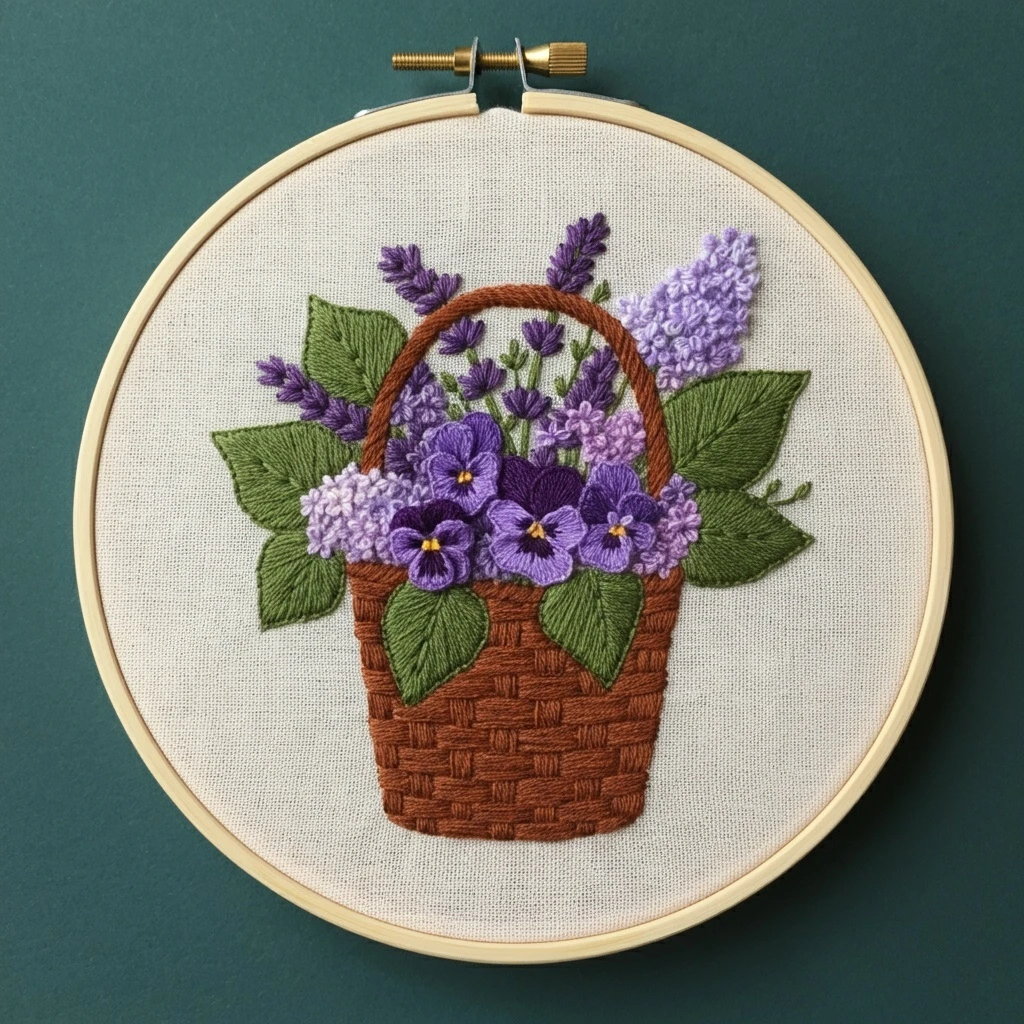

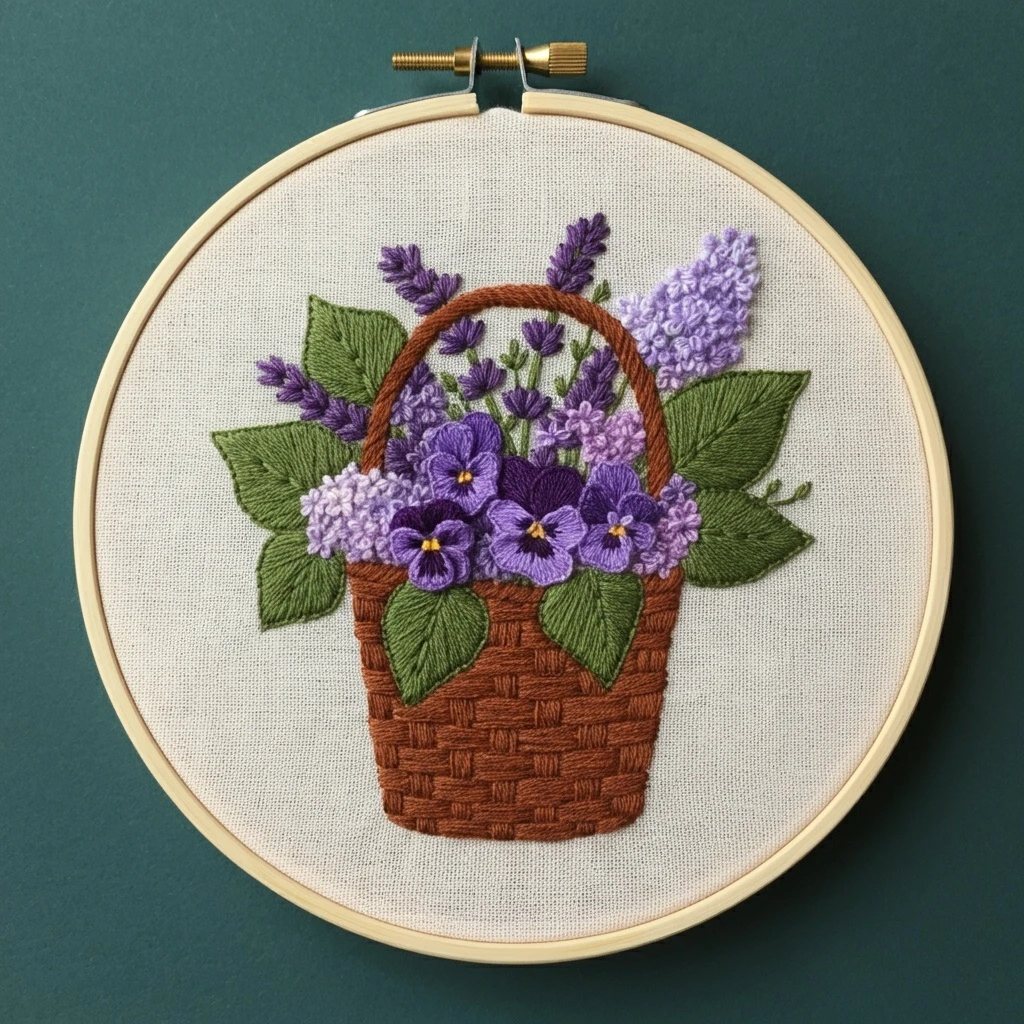
Floral Basket
A dimensional basket arrangement built around rich woven browns, deep violet pansies, soft lilac clusters, lavender sprigs, and broad textured greenery. The best finish comes from treating the basket as a structured base, then layering the flowers forward with knots, padded satin, and crisp vein details.
Observed color story
The image is dominated by a warm terracotta-brown basket and handle, mid-to-dark olive leaves, saturated violet pansy faces, pale lilac clustered blossoms, and small golden flower centers. The contrast between the textured basket and soft floral knots is what gives the design its handmade depth.
Stitch plan by design area
Work from back to front: leafy background first, then tall flower sprigs, the basket body and handle, clustered blossoms, and finally pansy details and gold centers.
| Area | Suggested stitches | Thread count | Practical notes |
|---|---|---|---|
| Large leaves | Fishbone stitch, long-and-short stitch, split stitch veins | 2 strands for fill, 1 strand for veins | Angle stitches toward the center vein. Add 934 at the base and 471 on upper edges so leaves do not look flat. |
| Basket weave | Satin stitch blocks, stem stitch rows, couching, back stitch | 3 strands for raised weave, 2 strands for outlines | Alternate horizontal and vertical satin blocks. Use 938 in the gaps and 301 along selected top edges for a woven, dimensional look. |
| Basket handle | Whipped stem stitch or padded satin stitch | 3 strands base, 2 strands whip | Lay a darker base with 938 or 400, then whip with 301 on the light-facing side to make the handle read as rounded. |
| Pansy petals | Long-and-short stitch, satin stitch, split stitch outline | 1-2 strands | Blend 550 into 552 for the petal throats. Feather 554 toward the edges and keep the outer contour neat with 1-strand split stitch. |
| Lilac clusters | French knots, colonial knots, lazy daisy clusters | 2 strands for knots, 1 strand for tiny highlights | Scatter 210 and 211 knots unevenly. Place darker 554 knots underneath the cluster to suggest depth. |
| Lavender sprigs | Detached chain, fly stitch, small straight stitches | 2 strands for blossoms, 1 strand for stems | Use 550 near the stem and 552 or 554 at the tips. Keep the sprigs slightly irregular and tapered. |
| Flower centers | French knot, seed stitch, tiny straight stitches | 2 strands | Use one firm knot of 729, then add two tiny dark stitches beside it for the pansy face. |
Blending, shading & texture guidance
Make violets luminous
Thread a needle with one strand of DMC 550 and one strand of DMC 552 for the inner pansy folds. Switch to one strand 552 plus one strand 554 as you approach the petal edges. Keep stitches short and slightly curved so the flower faces feel rounded.
Build lilacs with uneven knots
Do not grid the French knots. Place them in small, offset groups, changing between DMC 210, 211, and 554. This creates the bumpy, natural lilac texture seen in the reference image.
Use shadow lines between weave blocks
After filling the basket with DMC 400, add narrow back stitches in DMC 938 wherever one woven strip passes under another. Then touch the raised strips with DMC 301 to make the basket look lifted.
Directional stitching matters
Large leaves should be stitched from the outer edge into the center vein, not straight across. This follows the leaf shape and lets the darker base recede behind the flowers.
Beginner-friendly working order
Transfer lightly
Use a fine water-soluble pen and mark only the main outlines, leaf center veins, basket weave direction, and flower centers. Avoid drawing every knot.
Stabilize the fabric
Hoop the linen drum-tight. If the fabric is loose, the satin basket blocks and long leaves will pucker.
Start with background greens
Complete large leaves and stems first with 2 strands. Keep the tallest lavender sprigs slightly behind the basket handle.
Stitch the basket before front flowers
The basket is the anchor. Finish the handle and weave, then add flowers over the rim so they appear tucked into the basket.
Add dimensional details last
French knots, gold centers, fine outlines, and loose petal highlights should be saved for the end so they stay crisp and raised.
Thread-count quick guide
- 1 strand: fine pansy outlines, leaf veins, delicate stem details, tiny highlight strokes.
- 2 strands: most petals, leaves, lavender sprigs, French knots, and medium outlines.
- 3 strands: raised basket weave, handle padding, and any areas that need strong texture.
- Use a size 7 or 8 embroidery needle for 2-3 strands.
- Use a size 9 or 10 needle for single-strand veins and split outlines.
- Keep strand lengths around 14-16 inches to reduce fuzzing in the purple floss.
Finishing notes
Press from the back on a folded towel so the knots and basket texture are not flattened. For hoop display, trim the fabric with a generous margin, gather it neatly behind the hoop, and avoid pulling so hard that the basket becomes distorted.
Optional sparkle
Add one strand of very pale lavender or a tiny metallic gold accent only in the flower centers. Keep it minimal so the rustic basket remains the focus.
Color substitution tip
If you prefer a softer palette, replace DMC 550 with DMC 3837 and reduce 938 in the basket. If you want stronger contrast, keep 550 and add extra 934 under the flowers.