
Design read: what to preserve
High contrast focal point
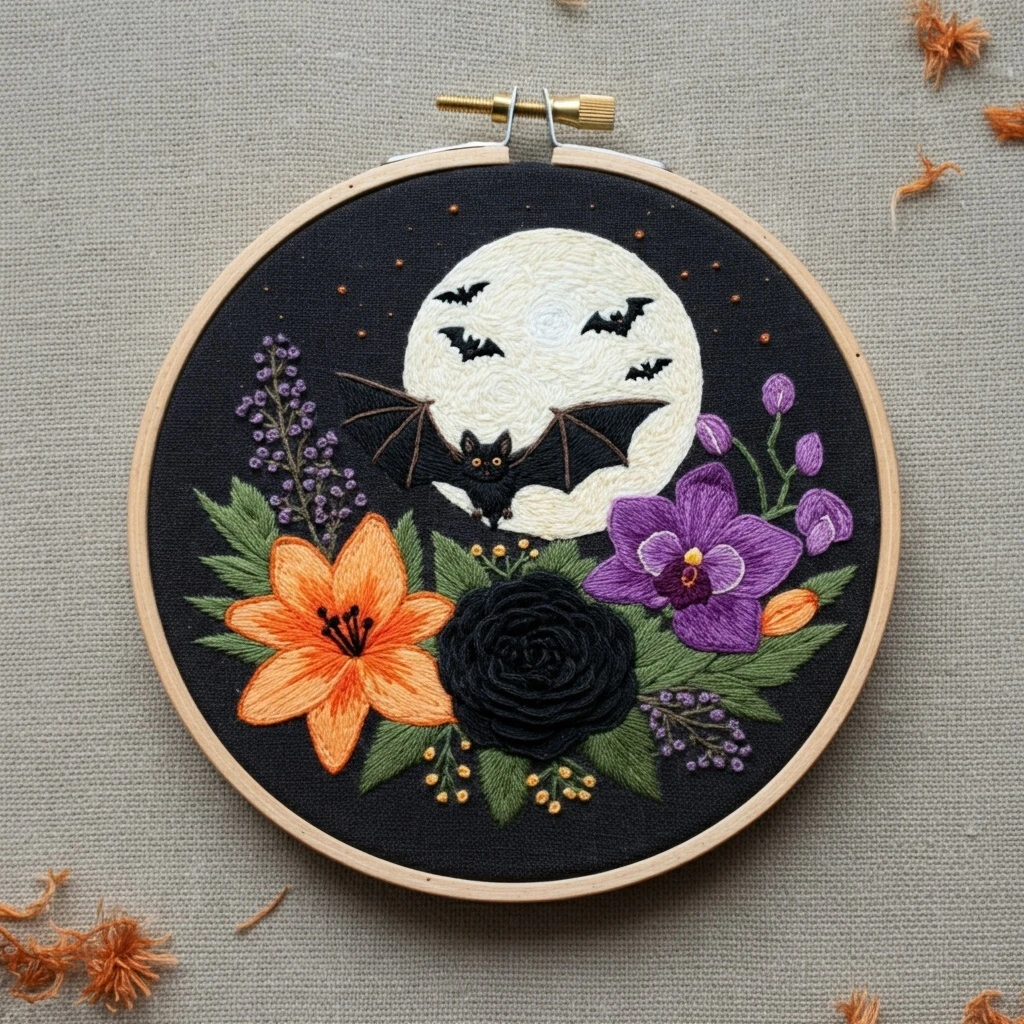
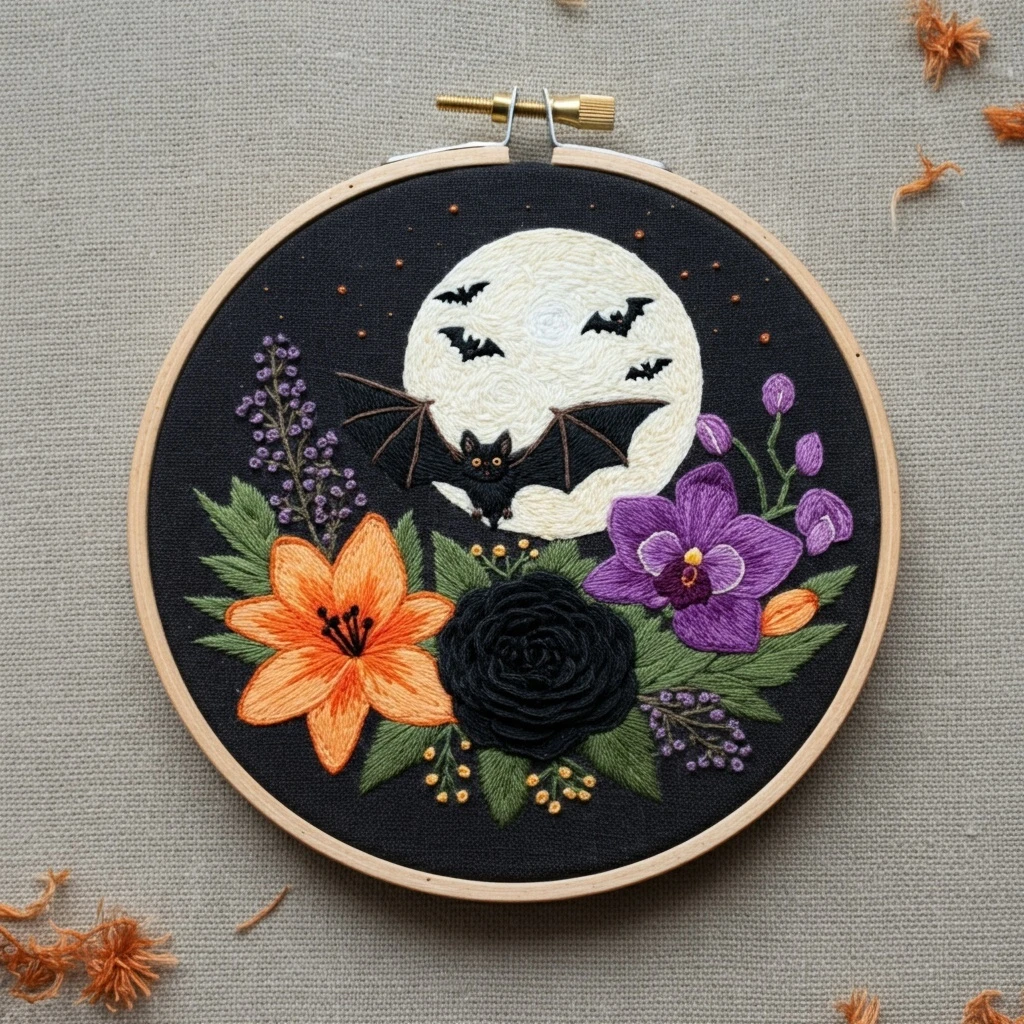
The pale stitched moon sits on black fabric, so keep moon threads warm and luminous rather than stark white. The bat reads best with black-on-black texture plus small brown-gold eye details.
Floral weight at the base
The composition is bottom-heavy: orange lily on the left, purple orchid on the right, black rose in the center, with leaves fanning outward. Keep leaf stitches directional to frame the bat.
Small night accents
Lavender sprigs, copper stars, and yellow berry knots add sparkle. Use them sparingly so the moon and flowers remain the main story.
Polished DMC color palette
Bat bodies, black rose depth, strongest outlines, flower centers.
Subtle highlights on bat wings and black rose petals so details show on black fabric.
Main moon fill and brightest crescent edges.
Moon glow, blended with 712 or 3823 for warmth.
Moon shadow rings and soft swirl variation.
Tiny warm glints around the moon and blended moon texture.
Primary orange lily petals; work from base toward tips.
Lily highlights and petal centers, especially upper surfaces.
Lily veins, petal bases, and outer edge shading.
Deep orchid shadows, lower petal pockets, bud bases.
Main purple orchid fill and rounded buds.
Orchid highlight strokes and lavender sprig tips.
Deep leaf shadows underneath flowers and near the rose.
Main leaf satin/long-and-short stitches.
Cool stems, leaf veins, and darker greenery behind blossoms.
Copper stars, warm bat wing outlines, and small speckles.
Golden berry knots and flower centers.
Bat wing ribs, lily stamens, and natural twig-like outlines.
Stitch plan by element
Full moon
Use 2 strands of 3865/746 for loose circular long-and-short stitches. Change direction in soft spirals, not straight rows. Add 1 strand of 712 in shallow arcs for crater-like shadows, then lightly couch a few 3823 highlights near the brightest rim.
Main bat
Fill the body with 2 strands of 310 in tiny satin or split stitch. Add wing membranes with 1 strand of 939 so the black shape has readable folds. Rib lines can be 1 strand of 898, whipped backstitch, kept thin and angular.
Orange lily
Work long-and-short stitch from petal base to tip: 720 at the inner base, 721 through the body, 722 at the outer glow. Use 1 strand of 720 for fine petal veins and 310 or 898 French knots for the stamens.
Purple orchid and buds
Blend 550 into 552 for shaded lower petals. Use 554 as short highlight strokes following each petal curve. Buds can be padded satin stitch in 552, with a 550 shadow at the base and a 554 cap on the light side.
Black rose
Start with 310 for the deepest central spiral. Outline each petal curl with 939 using stem stitch or split backstitch. For a raised look, add a few padded satin segments or whipped woven wheel arcs, keeping highlights minimal.
Leaves and stems
Use fishbone stitch for individual leaves: 3011 at the base/shadow side, 3012 across the main blade, and 3363 for central veins and cool stems. Angle stitches outward so the leaves fan around the flower cluster.
Lavender sprigs
Stem stitch the stalks in 3363 with 1 or 2 strands. Make tiny detached chain stitches or French knots in 554 and 552, darkening a few knots with 550 where they tuck behind leaves.
Stars and berries
Use 783 for yellow berry knots and 920 for copper stars. Make single-wrap French knots for small speckles and two-wrap knots for the larger dots. Keep the spacing irregular for a natural night-sky effect.
Thread-count and blending guidance
| Area | Recommended strands | Blending idea | Practical note |
|---|---|---|---|
| Moon fill | 2 strands, occasional 1-strand detail | 1 strand 3865 + 1 strand 746 for glow; 1 strand 712 for soft shadows | Use short curved strokes so the moon feels embroidered, not flat. |
| Bat silhouettes | 1–2 strands | 310 for fill, 939 for wing and ear definition | On black fabric, highlights matter more than heavy outlines. |
| Large petals | 2 strands for fill, 1 strand for veins | Blend adjacent colors in the needle for mid-tones, especially 721+722 and 550+552 | Keep stitches following petal growth direction from center outward. |
| Leaves | 2 strands for fishbone, 1 strand for veins | 3011+3012 for shaded leaves, 3012+3363 for cooler leaves | Vary leaf greens slightly so the base does not become one flat mass. |
| Tiny accents | 1 strand for lines, 2 strands for French knots | 783 with a touch of 920 for warmer dots | Add accents last so they sit cleanly above surrounding stitches. |
Suggested stitching order
Stabilize & mark
Hoop black fabric firmly, transfer only essential outlines, and mark petal direction lines lightly.
Build background shapes
Stitch the moon first, then the bat silhouettes and wing ribs before the flowers crowd the center.
Layer foliage and flowers
Work leaves from back to front, then lily, orchid, rose, buds, and lavender sprigs.
Finish with sparkle
Add stars, berries, flower centers, tiny eyes, and final outline corrections with one strand.
Outlining, shading, and texture notes
For crisp outlines on dark cloth
Use split backstitch with 1 strand when an edge needs precision, especially the moon edge, bat ears, wing points, orchid rim, and lily veins. Avoid thick black outlines around the black rose; use 939 instead so the petal curls remain visible.
For beginner-friendly control
Shorten satin stitches on large petals into long-and-short sections. Park thread tails under existing stitches rather than knotting heavily on black fabric. Rotate the hoop often so stitches always travel in the natural direction of petals, leaves, and moon swirls.
Quick practical tips
Fabric choice
Black cotton, black linen, or dark navy linen gives the strongest moonlit effect. If the fabric is loose, add a light stabilizer behind the hoop to stop distortion around dense flowers.
Needles
Use a sharp embroidery needle for dense satin areas and a slightly larger needle for French knots so the wraps sit neatly on top of the fabric.
Finishing
After stitching, gently steam from the back through a towel. Do not press the black rose or French knots flat; they create the dimensional texture that makes the design feel handmade.