
Sunset Mountain Valley
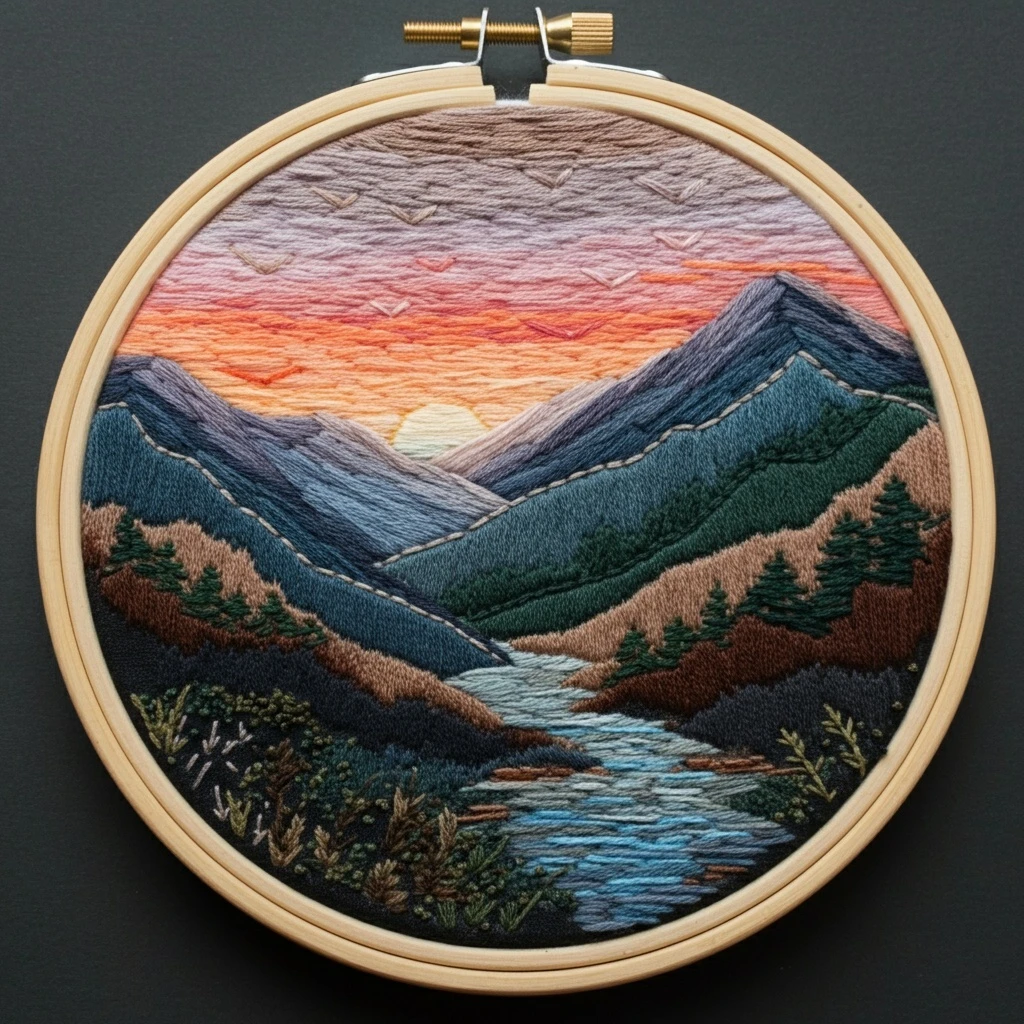
A warm, layered DMC palette and practical hand-embroidery guide for a hoop design with glowing sunset bands, blue-green mountains, pine-covered slopes, a reflective river, and tiny foreground botanicals.
Preview
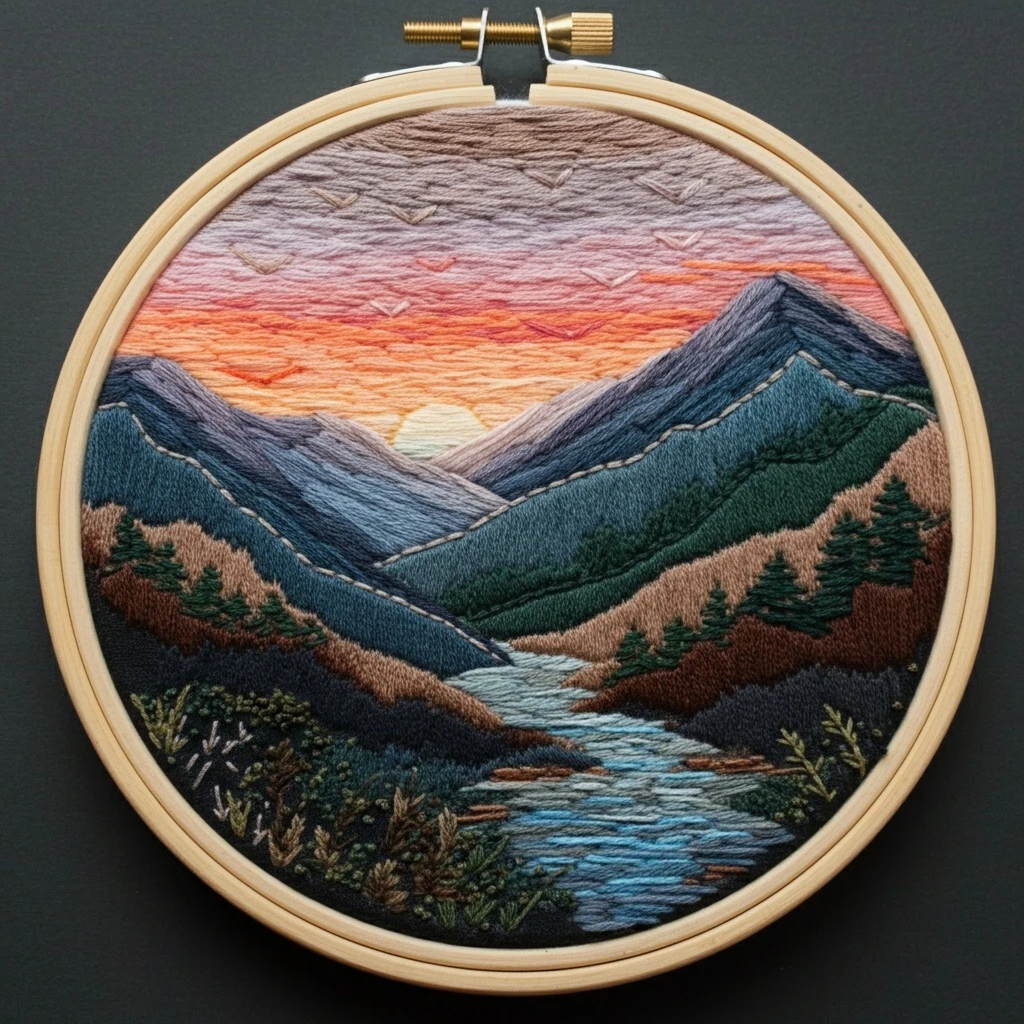
The reference design is built from horizontal sunset threads at the top, angular mountain layers in cool blue-gray tones, dark evergreen slopes, tan valley banks, and a pale blue river that pulls the eye toward the foreground.
The palette below is estimated from the visible stitched preview. Coverage percentages are visual estimates, not exact thread usage.
Likely DMC Color Palette
Use these colors as a flexible palette. For a softer vintage finish, reduce the darkest shades to one strand in the distance and reserve full-strength contrast for the nearest trees and river edges.
| DMC | Thread name | Coverage | Where it appears / practical use |
|---|---|---|---|
| 3778 | Terra Cotta Light | 12% | orange sunset bands, warm cloud streaks, and reflected warmth near the horizon. |
| 3824 | Apricot Light | 10% | sunlit sky glow and soft blending around the setting sun. |
| 754 | Peach Light | 8% | pale peach sky transitions and the lightest warm highlights above the mountains. |
| 760 | Salmon | 8% | pink cloud shadows and the rosy middle band of sunset. |
| 3726 | Antique Mauve Dark | 6% | deeper sunset streaks, distant cloud lines, and small bird accents in the sky. |
| 645 | Beaver Gray Very Dark | 9% | lavender-gray upper sky, shadowed mountain ridges, and distant cool haze. |
| 3768 | Gray Green Dark | 13% | main blue-green mountain faces and the mid-tone valley slopes. |
| 924 | Gray Green Very Dark | 11% | deep mountain sides, shaded riverbanks, and cool outlines between land layers. |
| 930 | Antique Blue Dark | 7% | receding mountain shadows and cool diagonal stitch direction changes. |
| 935 | Avocado Green Dark | 8% | pine tree masses, distant forest bands, and dark foliage texture. |
| 3371 | Black Brown | 6% | foreground shadows, strongest tree bases, and crisp lower edge definition. |
| 839 | Beige Brown Dark | 5% | warm earth banks, rocky ledges, and lower valley shadows. |
| 3863 | Mocha Beige Medium | 5% | tan hillside highlights, dry grass edges, and soft ground transitions. |
| 932 | Antique Blue Light | 7% | river fill, cool water highlights, and distant mist near the valley opening. |
| 3752 | Antique Blue Very Light | 4% | bright water ripples, sunlit river touches, and pale glow on the horizon. |
| 3011 | Khaki Green Dark | 4% | tiny foreground grasses, seed heads, and olive botanical accents. |
Stitching Suggestions
| Element | Stitch type | Notes |
|---|---|---|
| Sunset sky bands | Long and short stitch, horizontal satin stitch | Work side-to-side in broken rows. Blend peach, apricot, salmon, and terra cotta with staggered stitch lengths so the bands look glowing rather than striped. |
| Soft upper sky | Long and short stitch with one-strand feathering | Use gray-mauve and pale peach sparingly. Keep stitches flatter and less dense near the top to suggest distance. |
| Bird silhouettes | Single fly stitch or tiny straight stitches | Use one strand in Antique Mauve Dark or dark gray. Keep each bird very loose; overworking them can make the sky feel crowded. |
| Mountain faces | Directional long and short stitch | Change stitch angle on each plane: diagonal down one slope, diagonal up the other. This gives the mountains their folded, dimensional look. |
| Ridge outlines | Split stitch, stem stitch, or couched line | Use one strand of pale gray-blue or beige on distant ridges, two strands only for the closer ridge lines. |
| Forest bands | Dense seed stitch, fishbone clusters, short straight stitches | Cluster dark greens along the slopes. Let some gaps remain so the forest looks like texture, not a solid stripe. |
| Individual pine trees | Straight stitch branches over a stem-stitch trunk | Start with a dark vertical trunk, then add short angled branches from top to bottom. Vary tree height for a natural valley edge. |
| River | Horizontal satin stitch, split stitch ripples | Use blue-green base stitches across the river, then add light blue broken ripple lines. Narrow the stitches as the river recedes toward the sun. |
| Riverbank rocks | Short satin stitch and backstitch | Add small warm-brown bars along the water edge. A few dark stitches underneath make them read as rocks casting shadows. |
| Foreground plants | Detached chain, straight stitch, French knots | Use one strand for stems and two strands for knots. Mix olive, dark green, and beige-brown for a wild meadow feel. |
Thread Count, Blending & Texture Guide
Blending ideas
For a smoother sunset, thread the needle with two different colors at once: 3824 + 754 near the sun, 3778 + 760 through the orange-pink cloud band, and 760 + 3726 for the darker rose streaks. In the water, try 932 + 3752 for bright ripples and 932 + 924 for shaded sections under the banks.
Shading guidance
Keep the lightest stitches near the sun and the river centerline. Move darker tones outward: mauve in the upper sky, gray-blue on the mountain shadows, pine green on the forest bands, and black-brown only at the closest foreground edges. This keeps the valley glowing instead of becoming heavy.
Beginner-Friendly Stitching Order
Helpful Notes
- Use a sharp needle for dense landscape fills so the thread can pass cleanly between earlier stitches.
- Keep long stitches under 1/2 inch where possible; very long satin stitches can snag or loosen in a hoop landscape.
- Do not fully outline every mountain. A few broken ridge lines look more natural and preserve the painted-thread effect.
- For the river, leave tiny slivers of the base fabric or pale thread between ripple rows to create sparkle.
- Press the finished embroidery face down on a towel so raised knots and tree textures are not flattened.