Intricate Ecclesiastical

Intricate Ecclesiastical - DMC Palette & Stitch Guide
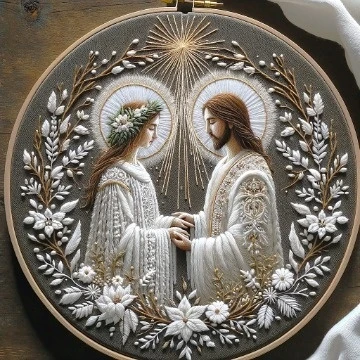
Intricate Ecclesiastical Embroidery  Union in White and Gold

DMC palette & hand embroidery guide

Intricate Ecclesiastical

A refined white-and-gold ecclesiastical embroidery concept with a formal, symmetrical sacred ornament feel: luminous ivory ground, raised whitework details, antique-gold outlines, small gleaming accents, and scroll-like flourishes that frame the central union motif. The overall impression should be ceremonial, polished, and heirloom-like rather than bright or busy.

Whitework eleganceAntique gold accentsSacred ornamentRaised texture

Design color read

The design is built around a restrained white-and-gold palette: clean white highlights, warmer ivory satin areas, antique-gold tracery, and deeper old-gold shadows that define the ornate curves. The strongest design elements are the formal symmetry, sacred central shape, fine scrollwork, and small jewel-like gold points. Because the color family is narrow, value contrast and stitch texture are more important than adding extra colors.

Use white for lifted surfaces, cream for soft fabric warmth, pale gold for illumination, and old gold for outlines, recesses, and the lowest points of the ornamental relief.

Thread-count snapshot

  • Fine gold outlines: 1 strand cotton floss, or one strand metallic couched on the surface.
  • Whitework fills: 2 strands for satin and long-and-short areas; 1 strand for small veins and inner lines.
  • Raised padding: 3 to 6 strands of white or cream laid underneath, then covered with 2-strand satin.
  • Tiny dots and beads of light: 1 strand French knots or colonial knots so the details stay refined.
  • Metallic accents: do not force metallic thread through dense stitching; couch it with matching gold cotton.

Suggested DMC palette

DMC B5200 - Snow White
Crisp highest highlights on raised whitework, tiny sparkle stitches, and the cleanest edge of the central motif.
DMC Blanc - White
Main bright white for petals, sacred forms, and padded satin that needs brightness without the sharpness of B5200.
DMC 3865 - Winter White
Soft shadowed white. Use next to gold lines so white areas look dimensional instead of flat.
DMC 746 - Off White
Warm ivory fill for background ornament, satin leaves, and broader pale sections.
DMC 712 - Cream
Subtle aged-linen tone for recessed whitework and lower side shading on raised shapes.
DMC 739 - Tan Ultra Very Light
Very gentle warm shadow under ivory scrolls, around padded borders, and beneath gold couching.
DMC 677 - Old Gold Very Light
Softest gold glow, halo stitches, and light-facing edges of ornamental bands.
DMC 676 - Old Gold Light
Pale gold fill for delicate motifs, small dots, and transition areas between ivory and deeper gold.
DMC 3822 - Straw Light
Main warm gold for scrollwork, rays, bands, and small satin-filled accents.
DMC 3821 - Straw
Richer gold body tone. Blend with 3822 for smooth, illuminated curves.
DMC 729 - Old Gold Medium
Antique gold outlines and the lower side of raised borders. Strong enough to define without looking brown.
DMC 680 - Old Gold Dark
Deepest gold creases, scroll overlaps, and narrow shadow stitches beside couched metallic lines.
DMC 3047 - Yellow Beige Light
Mellow aged-gold bridge color for areas that should look softer than metallic but warmer than cream.
DMC 762 - Pearl Gray Very Light
Barely visible cool shadow in whitework folds. Excellent for keeping white-on-white details readable.
DMC 318 - Steel Gray Light
Use very sparingly for the deepest shadow under white raised areas or where two ivory shapes overlap.
DMC Diamant D3821 - Light Gold
Optional metallic highlight for couched borders, rays, and ceremonial sparkle. Couch it; do not pull it through crowded satin.
DMC Diamant D3852 - Dark Gold
Optional antique metallic accent for outer outlines and the most formal goldwork details.

Stitch suggestions

Padded satin for raised whiteworkLay several padding stitches inside the larger white shapes, then cover with smooth 2-strand satin. Keep the top satin stitches parallel and polished.
Couched gold lines for formal outlinesPlace DMC Diamant or a doubled strand of 3821 along the design line, then couch with 676 or 729 every few millimeters. This gives a goldwork effect without wrestling metallic through the fabric.
Split stitch foundationsBefore satin filling, outline important shapes with 1-strand split stitch in Blanc, 746, or 729. This creates a crisp raised edge and keeps curves clean.
Stem stitch for scrolls and tendrilsUse 3822 for graceful gold scrolls. Switch to 680 only on the underside of curls so the line looks rounded.
Laid work for larger gold bandsLay parallel gold stitches across the shape, then couch them with tiny perpendicular stitches in 729. It looks ceremonial and uses less floss than dense satin.
French knots and colonial knots for gold pearlsUse 676, 3822, or D3821 for dotted borders and jewel-like points. Keep them consistent in size for a church-vestment look.
Buttonhole stitch for scalloped lace edgesIf the ornament includes lace-like tips or small arches, work tight buttonhole scallops in Blanc or 3865 and add a 677 highlight at the crest.
Seed stitch for soft ivory textureUse 3865, 746, and 712 in sparse seed stitch to break up plain white areas without distracting from the gold ornament.

Best order of work

Transfer the central shape and scroll outlines accurately; symmetry is more important than dense detail.
Stitch white padding and satin areas first, beginning with the central motif and moving outward.
Add gold outlines and scrolls after the white sections so the metallic-looking lines sit cleanly on top.
Finish with knots, tiny rays, and selective cool shadows only where the design needs definition.

Blending & shading guidance

White-on-white dimension

Use Blanc or B5200 only on the topmost highlights. Move into 3865 and 746 for the main ivory body, then add 712 or a tiny touch of 762 along lower edges. The goal is a carved-ivory effect: visible relief, but still calm and ceremonial.

Gold transitions

For a smooth antique gold, blend one strand of 3822 with one strand of 3821 in the needle. Use 677 on upper edges and 729 or 680 on the underside of scrolls. This simple three-value formula creates the look of illuminated metal without needing many shades.

Metallic moderation

If using Diamant, reserve it for the highest-status accents: the central outline, ray tips, dot borders, and a few bright scroll crests. Too much metallic can overpower the whitework. Cotton golds should do most of the shading, with metallic used as the final glint.

Texture notes

  • Keep satin stitches short on tight curves; long stitches can snag and distort ornate outlines.
  • Pad only the most important white shapes so the design has hierarchy, not uniform puffiness.
  • Use consistent spacing on couched gold lines for a disciplined ecclesiastical finish.
  • Alternate smooth satin with small knots and laid work so the palette feels rich even with few colors.
  • Leave tiny fabric breathing spaces between scrolls; dense gold on white can become visually crowded.

Outlining details

Outline the central sacred form with 729 or couched D3821, then add a fine inner highlight in 677 or 3822. For ivory shapes, use split stitch in 3865 before satin filling; this produces a clean, raised border without a harsh dark line. Reserve 680 for the deepest gold recesses and 318 only for tiny whitework shadows where two pale forms overlap.

Clean finish tip: Metallic and pale floss show tension mistakes quickly. Work with short thread lengths, smooth each strand before threading, and let the needle dangle occasionally so the floss untwists.

Beginner-friendly practical tips

  • Choose a fabric with enough contrast for white thread, such as warm linen, pale taupe, or soft cream cotton.
  • Mark only the main scroll lines and key points; too many transfer marks can stain a light design.
  • Start with cotton golds before adding metallic thread. Cotton is easier to control while learning the curves.
  • Use a hoop or frame with firm tension so padded satin and couching stay even.
  • Step back often to check symmetry. Small unevenness is more visible in formal white-and-gold designs.
  • When a section looks flat, add one value darker at the base instead of adding a new color family.

Compact stitch plan

Central motif: split stitch outline, padded satin in Blanc, 3865, and 746, then a 729 or couched D3821 border. Gold scrollwork: stem stitch, laid work, and couching in 677, 676, 3822, 3821, 729, and 680. Whitework details: satin, buttonhole scallops, seed stitch, and tiny 762 shadows. Finishing: add gold French knots, small ray stitches, and a few metallic highlights only after all cotton stitching is complete.
Leave a Reply

Your email address will not be published. Required fields are marked *