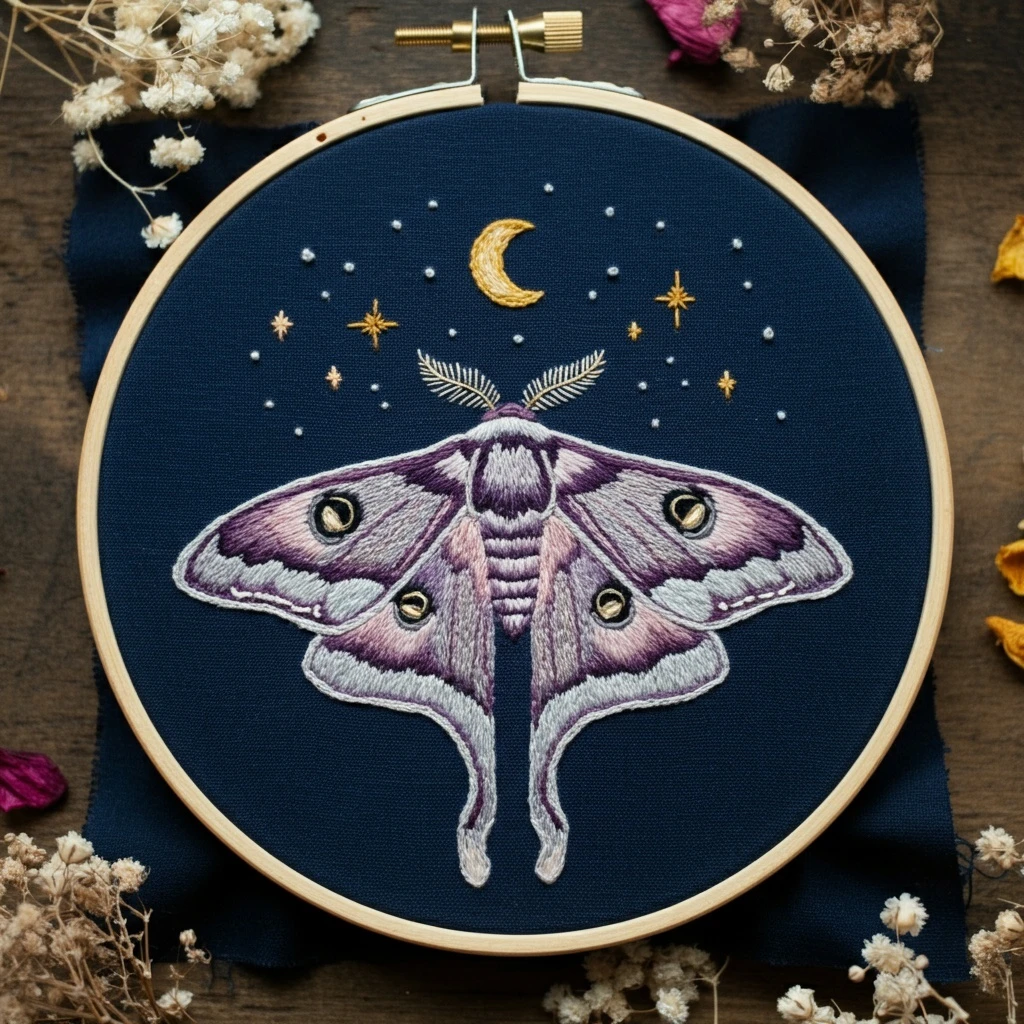

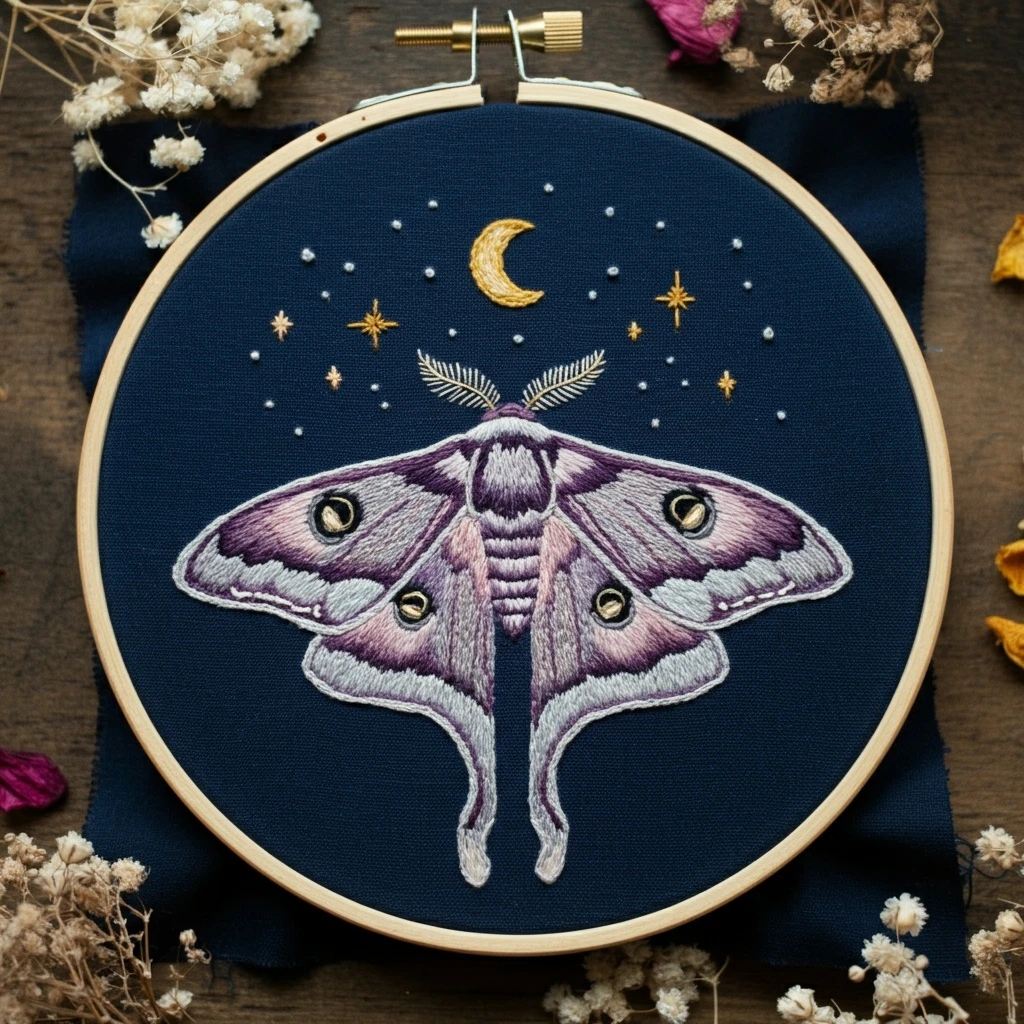
Celestial Moth
This celestial moth design calls for soft, symmetrical wing shading, a gently fuzzy body, delicate antennae, and moon-and-star details that feel mystical without overpowering the insect form. The palette below combines muted taupes and creams for the moth, lavender-plum shadows for night-sky depth, and warm gold for celestial sparkle.
Polished DMC Color Palette
This palette is designed for a luminous moth with natural wing tones and magical celestial accents. Keep the darkest shades close to the wing body, lower markings, and eye-like details; use the pale creams and golds for glow and fine decorative highlights.
Stitch Map by Design Element
Thread Count & Blending Guide
Fine details
Use 1 strand for antennae, wing veins, small dots, celestial rays, mirrored markings, and final outline corrections. One strand keeps the moth elegant and precise.
Main fills
Use 2 strands for wing panels, body texture, moons, larger markings, and main decorative fills. Two strands give coverage without overpowering the fine wing pattern.
Raised sparkle
Use 2–3 strands for French-knot stars and prominent wing dots. Reserve three strands for only a few focal celestial accents near the moth body or wing tips.
Shading, Outlining & Texture Suggestions
Wing symmetry
- Stitch matching left and right wing sections before changing colors.
- Keep the darkest shadows close to the body and along lower wing folds.
- Use the same highlight placement on both wing tips for a polished finish.
- Mark key celestial motifs lightly so mirrored details stay aligned.
Soft moth texture
- Use short, directional stitches for the body rather than one solid satin fill.
- Add fuzzy edges with a few single-strand taupe strokes extending outward.
- Keep antennae and legs very thin so the wings remain the focus.
- Use 3371 sparingly to avoid making the body too dark.
Celestial glow
- Place gold details near the wing center and pale white points at the outer highlights.
- Use lavender and blue accents to cool the taupe wing palette.
- Vary star sizes with knots, seed stitches, and tiny crosses.
- Leave open fabric between celestial dots so the design feels airy.
Outlining approach
- Outline after filling so wing edges sit cleanly on top of the shaded panels.
- Use taupe or grape shades instead of harsh black for most outlines.
- Use split stitch for curves and back stitch for straight wing markings.
- Reserve 3799 for the tiniest high-contrast points only.
Beginner-Friendly Stitching Order
- Transfer carefully: mark the moth outline, body center, wing divisions, main celestial markings, antennae, and only the largest star details.
- Stitch the body first: establish the centerline and fuzzy texture so wing symmetry is easier to judge.
- Fill wing panels: work paired left and right sections together, moving from darker body-side tones to lighter outer highlights.
- Add wing markings: stitch natural markings first, then celestial motifs so they sit cleanly on top.
- Add antennae and legs: use one-strand lines after the wings are complete to avoid snagging them.
- Finish with sparkle: add stars, moons, French knots, tiny highlights, and final outline corrections last.
Practical Tips for a Clean Finish
Fabric & hoop
Warm cream cotton, linen, or cotton-linen gives the moth a natural glow and lets gold and lavender details stand out. Keep the fabric drum-tight so wing symmetry and long stitches stay smooth.
Needle choice
Use a sharp embroidery needle size 7–9 for one- and two-strand work. For three-strand French knots, use a slightly larger needle so the knots pull through without puckering.
Managing mirrored details
Complete one color on both wings before moving to the next. This keeps the moth balanced and prevents one wing from becoming darker or more detailed than the other.
Preventing bulk
Do not overfill every wing marking. A celestial moth looks best when some details are fine linework and some are tiny knots or sparkles, leaving room for the wing shading to breathe.