
Succulent Garden
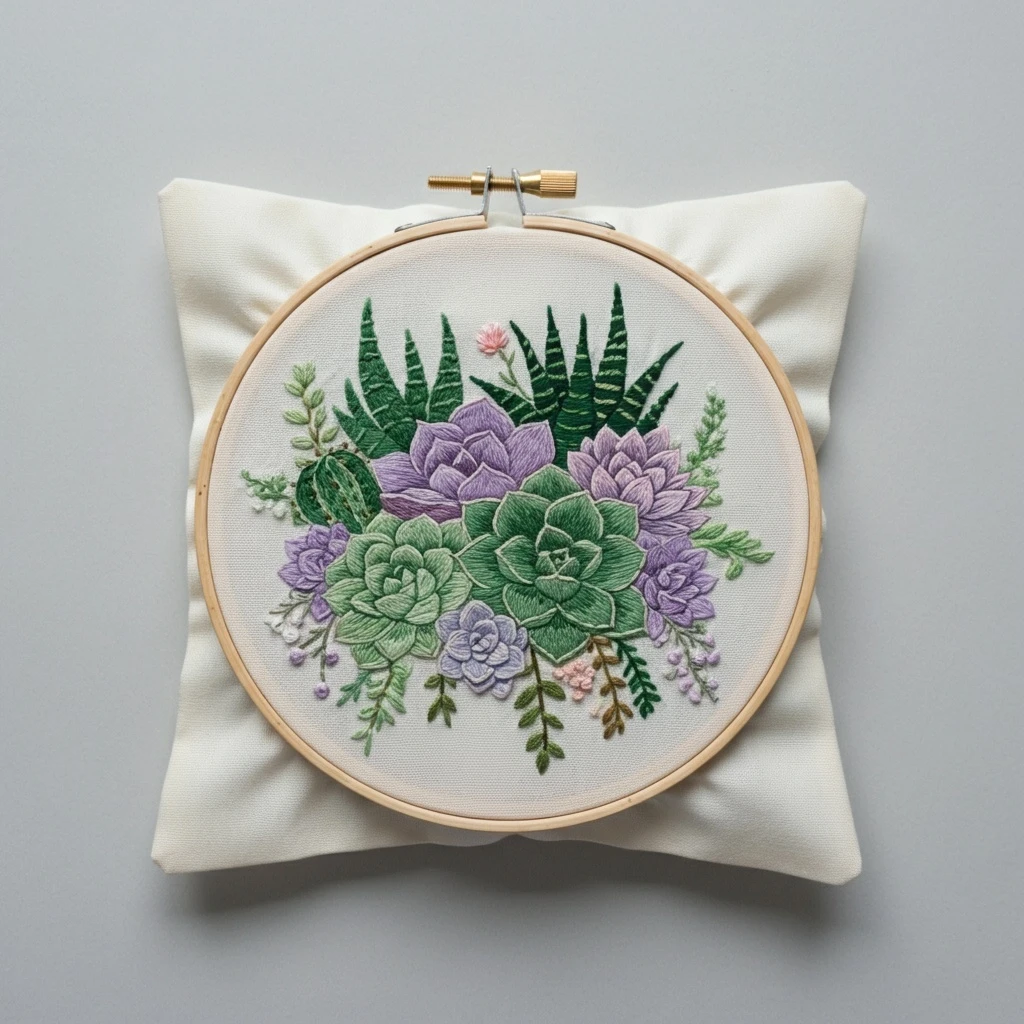
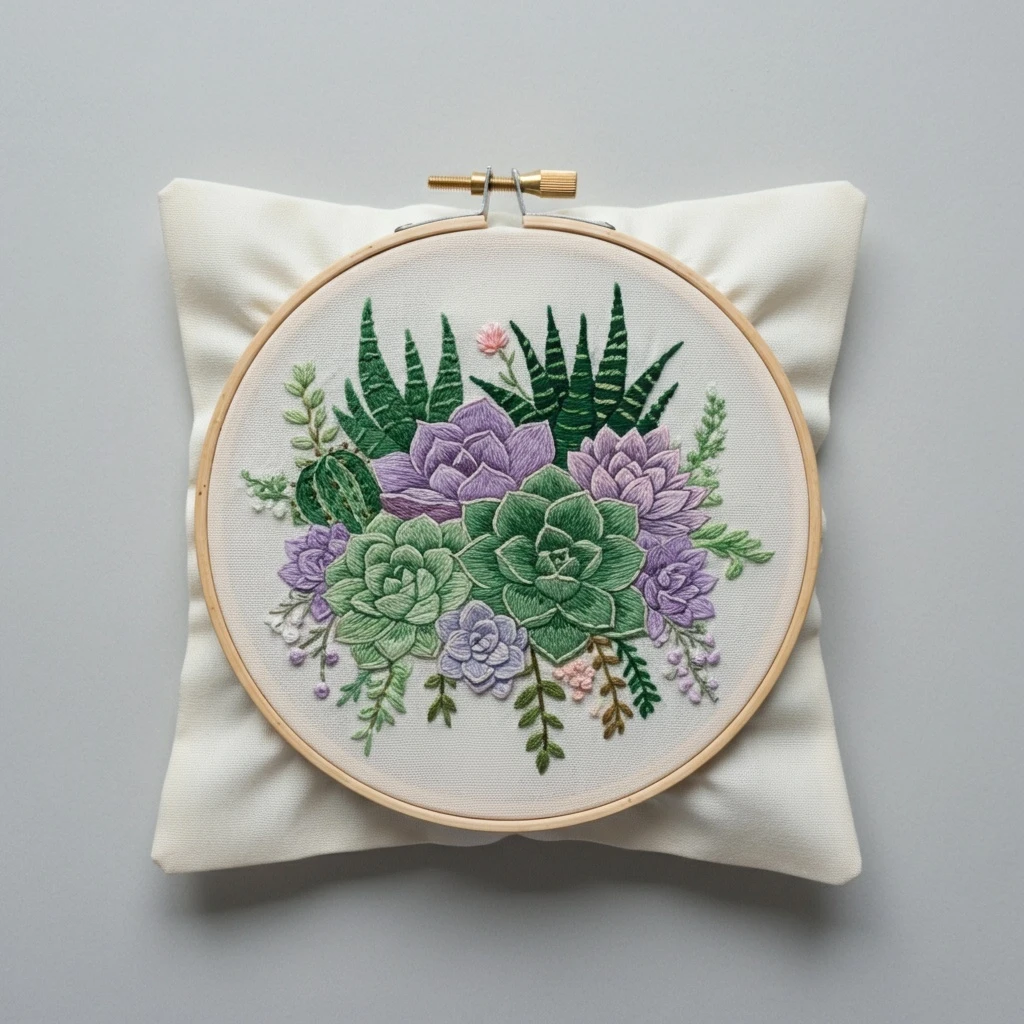
A dense botanical hoop filled with layered rosette succulents, upright striped leaves, lavender blooms, trailing sprigs, and tiny pink flower accents. The palette leans cool and calming: blue-greens and sage for the fleshy leaves, deep forest greens for height and contrast, soft violets for the rosettes, and a few warm pink and brown notes for delicate finishing details.
Likely DMC Color Palette
These matches are practical close DMC choices based on the visible stitched colors: medium succulent greens, dark aloe leaves, lavender-purple rosettes, muted sage sprigs, pale highlights, pink flower buds, and earthy trailing stems. Coverage is a visual estimate, not exact thread usage.
Stitching Suggestions
Work from the larger succulent masses outward, keeping stitch direction curved and radial so each rosette looks plump rather than flat.
Large green rosettes
Long and short stitch with split-stitch outlines. Start each leaf at the base and stitch toward the rounded tip, changing from DMC 895 or 699 at the base to 367 and 3053 at the edges.
Purple succulents
Satin stitch or long and short stitch. Use 3837 in the deepest folds, 340 as the body color, and 341 along the top edges for a soft powdery bloom.
Upright spiky leaves
Fishbone stitch gives a strong center vein. Add short straight stitches in lighter green across the leaves to mimic the striped aloe-like texture visible in the preview.
Fine fern sprigs
Stem stitch for the branch line, then small angled straight stitches for each leaflet. Use one strand so background sprigs remain airy.
Tiny buds and blossoms
French knots and detached chain stitches. Cluster 1-wrap knots for lavender buds and 2-wrap knots for pink flower centers where you want more texture.
Final definition
Backstitch or split stitch in one strand of dark green, lavender, or brown. Outline only the underside and overlaps of petals to avoid a cartoon-heavy edge.
Thread Count & Texture
- 2 strands for most succulent leaf fills, purple rosettes, and medium stems.
- 1 strand for fine veins, outlines, small fern leaves, and delicate trailing stems.
- 3 strands only for raised accents such as the pink top flower or a few plump foreground petals.
- Keep satin stitches short on tight curves; long satin stitches can snag and lose their petal shape.
- For a softer gradient, blend one strand DMC 699 with one strand DMC 367 through the middle of larger green leaves.
Blending & Shading Ideas
- Shade from inside-out: darkest color near the center of each rosette, lighter color at the outside rim.
- Alternate 895 and 699 in the upright leaves so the background foliage does not become one flat dark shape.
- Use 340 + 341 together for a pale lavender blend on the front rosette; use 3837 + 340 for shaded petals.
- Add a few 3865 single-strand stitches on petal tips only after the main fill is finished.
- Let the browns stay sparse; they are grounding details, not a major color family in this design.
Suggested Stitch Order
Beginner-Friendly Practical Tips
Use a firm hoop
Succulent fills require many directional stitches. Keep the fabric drum-tight so the rosettes stay smooth and do not pucker.
Shorten the floss
Use 14–18 inch lengths, especially with greens. Frequent thread changes are better than fuzzy, worn floss on detailed leaves.
Test the knots
Practice French knots on scrap fabric first. For tiny lavender buds, a single wrap usually looks cleaner than a large knot.
Outline last
Wait until fill stitches are complete before adding dark outlines. This lets you correct uneven petal edges gracefully.
Vary leaf direction
Each succulent petal should point toward or away from the center. Direction is what creates the dimensional spiral effect.
Pause between layers
After finishing a rosette, step back and check contrast. Add only a few highlight stitches; over-highlighting can flatten the design.