
DMC palette & stitching suggestions
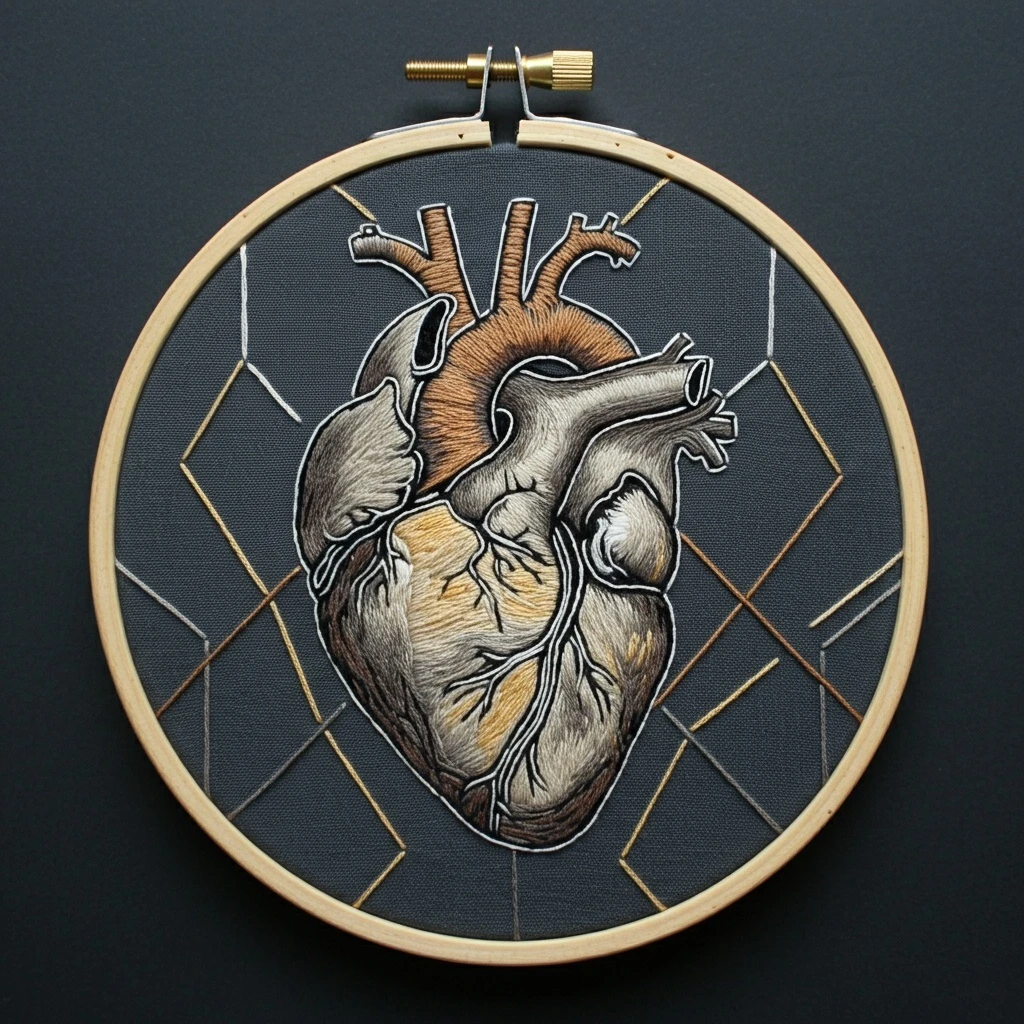
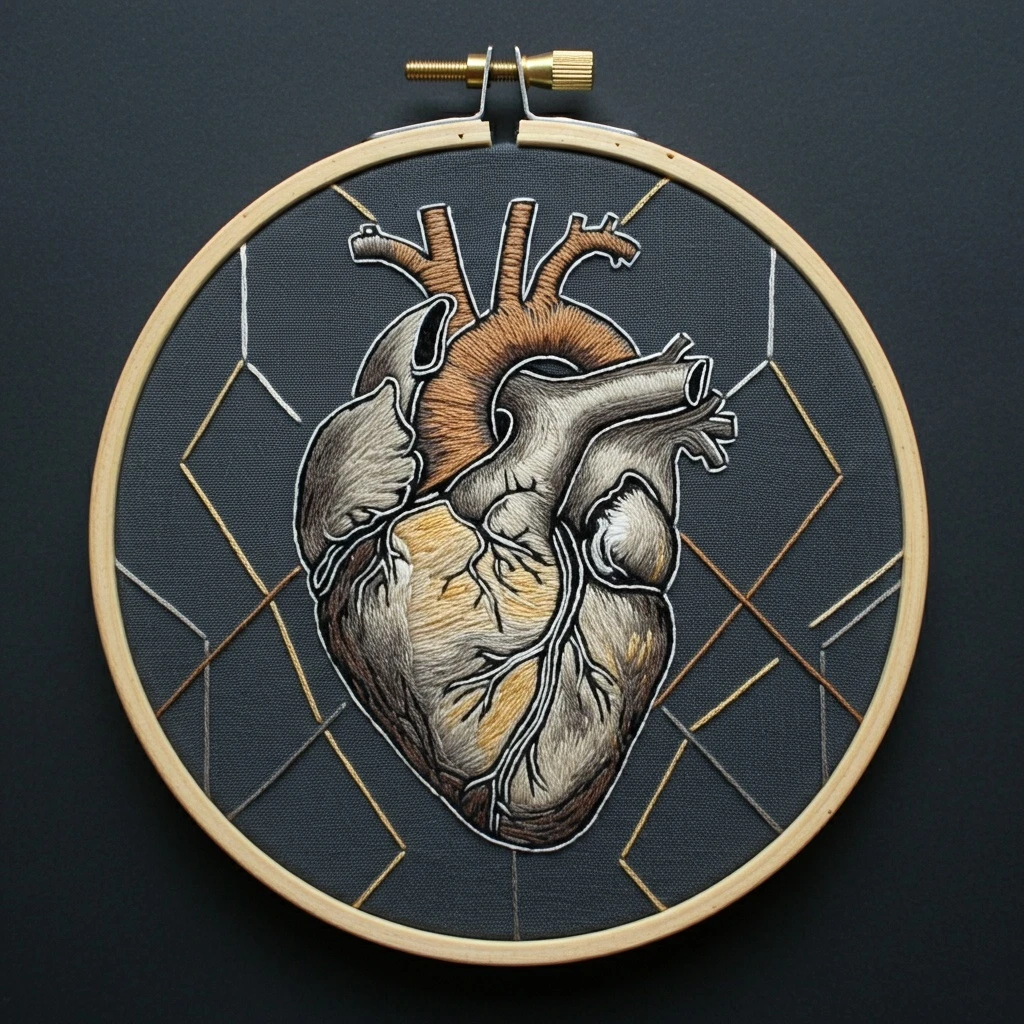
Anatomical Heart on Geometric Background
A polished thread guide for stitching a dimensional anatomical heart with layered reds, pink highlights, blue-purple veins, strong contouring, and a clean geometric background that frames the organic form with modern linework.
Design Color Story
This design contrasts an organic anatomical heart with a crisp geometric backdrop. The heart should feel sculptural and alive: deep burgundy shadows, strong crimson body color, coral-red transitions, and pale rose highlights on raised chambers and vessels. Veins and arteries can be separated with blue, teal, plum, and dark red accents so the structure stays readable. The geometric background should be much quieter than the heart, using soft gray, taupe, metallic gold, or muted blue-gray linework to support the central motif without competing.
Suggested DMC Floss Palette
Stitch Plan by Design Area
| Area | Recommended stitches | Thread count | Technique notes |
|---|---|---|---|
| Main heart muscle | Long and short stitch, split stitch guide lines, satin stitch for compact planes | 1 strand for shading; 2 strands for larger smooth fills | Block the large red forms first with 347 and 321, then deepen the underside with 817, 815, and 902. Use the stitch direction to follow the curve of each chamber rather than filling in straight rows. |
| Highlights and raised ridges | Short satin stitch, feather stitch, tiny straight stitches | 1 strand | Layer 352, 151, and small touches of 225 along raised ridges and upper surfaces. Keep highlights broken and narrow so they look like shine, not stripes. |
| Arteries and red vessels | Stem stitch, whipped back stitch, split stitch, padded satin stitch | 1-2 strands depending on vessel size | Use 321 or 817 for vessel bodies, shade one side with 815, and add 352 or 151 along the top edge to round the tube. |
| Blue veins | Stem stitch, split stitch, couching, whipped back stitch | 1 strand for fine veins; 2 strands for major vessels | Use 930 for the shadow edge, 932 as the main blue, and 3753 as a tiny highlight. A single couched strand makes very clean vein lines. |
| Dark anatomical separations | Back stitch, split stitch, couching, seed stitch | 1 strand | Use 902, 815, or 3371 only in the deepest cracks and small separation points. Avoid outlining the whole heart in black because it can flatten the dimensional shading. |
| Geometric background | Back stitch, couching, running stitch, straight stitch | 1 strand; metallic thread optional | Keep the background thin and tidy. Use 3023 or 842 for understated lines, and reserve 3821 for a few accent intersections or constellation-like points. |
Blending, Outlining & Shading Guidance
Blending ideas
- Primary red blend: build from 347 into 321, then feather 817 and 815 into the lower or tucked-under side of each form.
- Highlight blend: use 352 as the bridge between red and pink, then add narrow top stitches in 151 and 225.
- Deep vascular blend: combine 815, 902, and 3834 where red vessels transition into cooler shadows.
- Blue vessel blend: use 930 on the dark edge, 932 as the center tone, and 3753 in tiny highlight ticks.
- Background balance: stitch geometric lines in 3023 or 842 first; add 3821 only after the heart is complete so the accents do not overpower it.
Outlining details
- Outline main heart edges with one strand of 815 or 902 instead of black for a softer anatomical look.
- Use 3371 only for the deepest tiny cuts, vessel openings, and select shadow points.
- Back stitch vein branches with 930, then whip with 932 if a raised vessel effect is desired.
- Use couching for perfectly straight geometric lines; it is cleaner than trying to back stitch long diagonals.
- Break outlines at highlight edges so the heart appears dimensional and organic.
Practical Embroidery Tips
For the anatomical heart
- Transfer all major vessel paths carefully before stitching; the design depends on readable structure.
- Stitch from back elements to front elements: deeper vessels first, then main chambers, then highlights and fine surface lines.
- Keep thread lengths short with reds and burgundies to prevent fuzzing and maintain clean color changes.
- Use a single strand for final anatomical lines; thick outlines can make the heart look cartoonish.
- Step back often. The shading should read as sculptural from a distance, even if individual stitches are painterly up close.
For the geometric background
- Use a ruler and removable marking tool for straight lines before stitching.
- Couch long geometric lines with 1 strand for the neatest finish and fewer wobbles.
- Keep knots and thread carries minimal because pale fabric can show shadows from the back.
- Do not stitch every background line at the same thickness; make secondary lines lighter to create depth.
- Press from the back on a towel after finishing to preserve raised veins and couched background lines.
Recommended Stitching Formula
For the most polished result, use 1 strand long-and-short stitch for the anatomical shading, stem or whipped back stitch for vessels, and couched one-strand lines for the geometric background. Let the heart be richly layered while the background remains elegant and architectural.
- Best heart red set: 225, 151, 352, 347, 321, 817, 815, 902
- Best vessel set: 3721, 3834, 930, 932, 3753
- Best outline set: 815, 902, 3371
- Best geometric set: 842, 3023, 3821, 3865