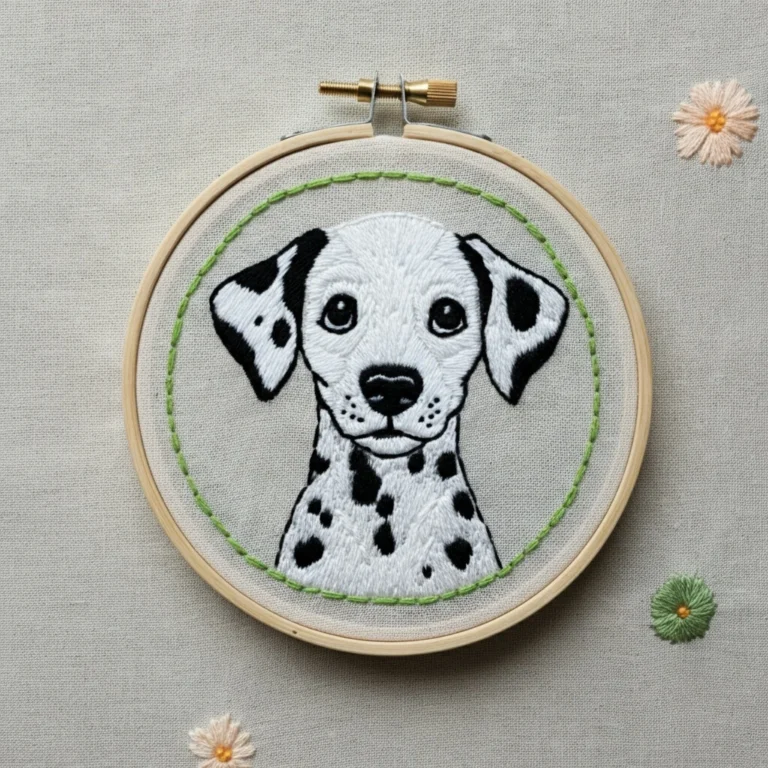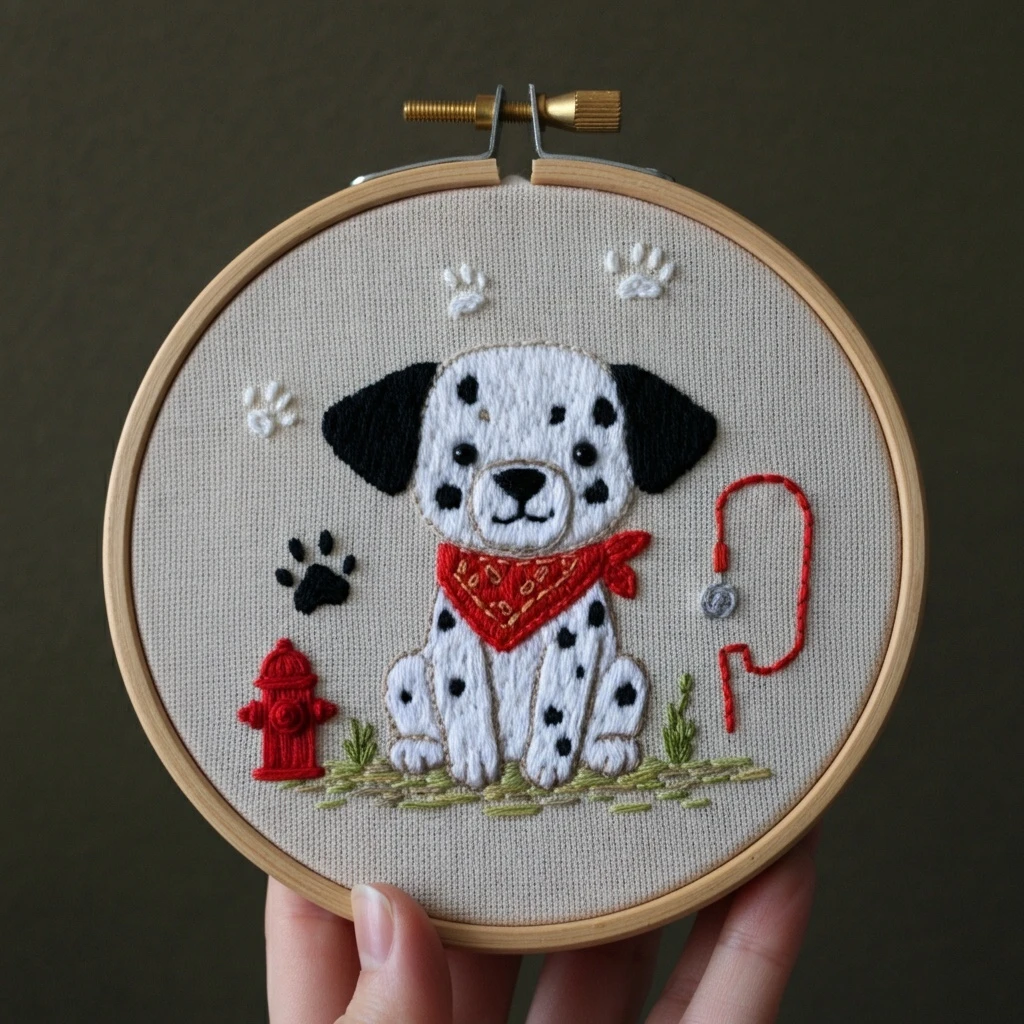

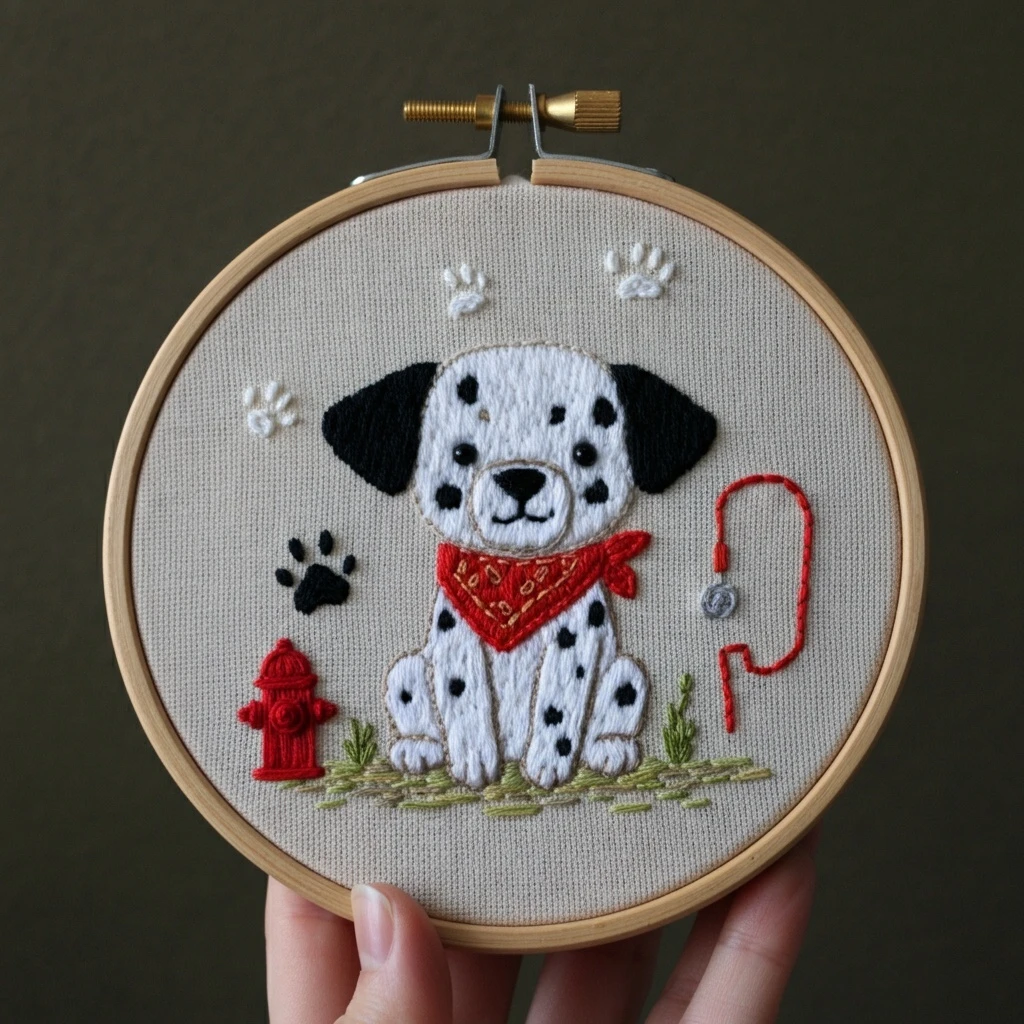
Dalmatian Puppy
A cheerful hoop-art puppy with velvety black ears, crisp white fur, playful spots, a bright red bandana, tiny paw prints, a hydrant, leash detail, and soft grassy ground. This guide favors clean outlines, simple texture, and beginner-friendly fill choices that keep the design cute and readable.
Visual cues used: creamy white fur, black ears and spots, beige muzzle shadows, glossy eyes, red scarf and hydrant, olive grass, pale paw prints, and a warm wooden hoop on natural linen.
Suggested DMC floss palette
Choose a compact palette with strong contrast: warm whites for the puppy, true blacks for spots and ears, two reds for the bandana and hydrant, mossy greens for the ground, and gentle beige-grey tones for shadows and outlines.
Stitch map for the design
| Area | Best stitches | Practical notes |
|---|---|---|
| Puppy body & face | Long and short stitch, split stitch, satin stitch | Work 2 strands in short vertical strokes following the fur direction. Add a few B5200 single-strand highlights on the forehead and paws. |
| Ears and spots | Satin stitch, padded satin, tiny seed stitch | Use DMC 310 with occasional 3799 stitches near the ear edges to keep the black areas dimensional, not blocky. |
| Nose, eyes & mouth | Satin stitch, French knots, back stitch | Keep the nose rounded with padded satin. Add one white catchlight stitch to each eye after all surrounding stitches are complete. |
| Red bandana | Satin stitch, split stitch outline, fly stitch accents | Fill with 321, shade folds with 815, then add small 3778 dashes or lazy-daisy marks for the printed scarf detail. |
| Hydrant & leash | Stem stitch, whipped back stitch, satin stitch | Stem stitch curved red lines for the leash. Use padded satin for hydrant caps and 815 along the left/lower edges. |
| Paw prints | Satin stitch, French knots, detached chain | Use 1–2 strands. White prints stay soft in the background; black paw print can be slightly bolder for contrast. |
| Grass & plants | Straight stitch, fly stitch, lazy daisy | Mix 3013 and 3012 randomly. Vary stitch length so the puppy looks seated on grass rather than a single flat line. |
Thread-count, blending & shading guidance
Thread counts
- Outlines: 1–2 strands for face, paws, spots, and leash curves.
- Fur fills: 2 strands for body and ears; switch to 1 strand for final highlight hairs.
- Bandana/hydrant: 2–3 strands where you want the red details to pop.
- Paw prints: 1 strand for background prints; 2 strands for the bold black print.
Blending ideas
- Blend 3865 + B5200 in the needle for soft white fur highlights.
- Blend 310 + 3799 for ear edges or spots that need softer transitions.
- Blend 321 + 815 sparingly at scarf folds and the hydrant base.
- Blend 3013 + 3012 for grass clumps under the paws.
Texture and outlining details
Fur direction
Use short vertical stitches down the forehead and chest. On cheeks, angle stitches outward so the puppy face looks rounded and plush.
Crisp spots
Outline larger spots with one strand of 310 before filling. Keep spot shapes uneven and organic; perfect circles look less natural.
Soft background
For the white paw prints floating above the puppy, use raised satin or small French knots with B5200 so they read as cute decorative motifs.
For the main puppy contour, use split stitch in 644 or 642 rather than black. This keeps the portrait sweet and soft while still separating white fur from the neutral fabric. Reserve black outlining for eyes, mouth, nose, ears, and selected spots.
Beginner-friendly workflow
- Transfer the full outline lightly, marking spot positions and the main bandana fold lines.
- Stitch the face outline and body separations first with 644 using one strand.
- Fill white fur areas with 3865, then add B5200 highlights on top only where light catches.
- Complete black ears, eyes, nose, and spots next so the character appears early and placement can be checked.
- Stitch the red bandana, hydrant, and leash after the puppy so the accent color stays clean and vivid.
- Finish with grass, paw prints, and tiny highlights. Steam from the back and avoid pressing directly over padded areas.