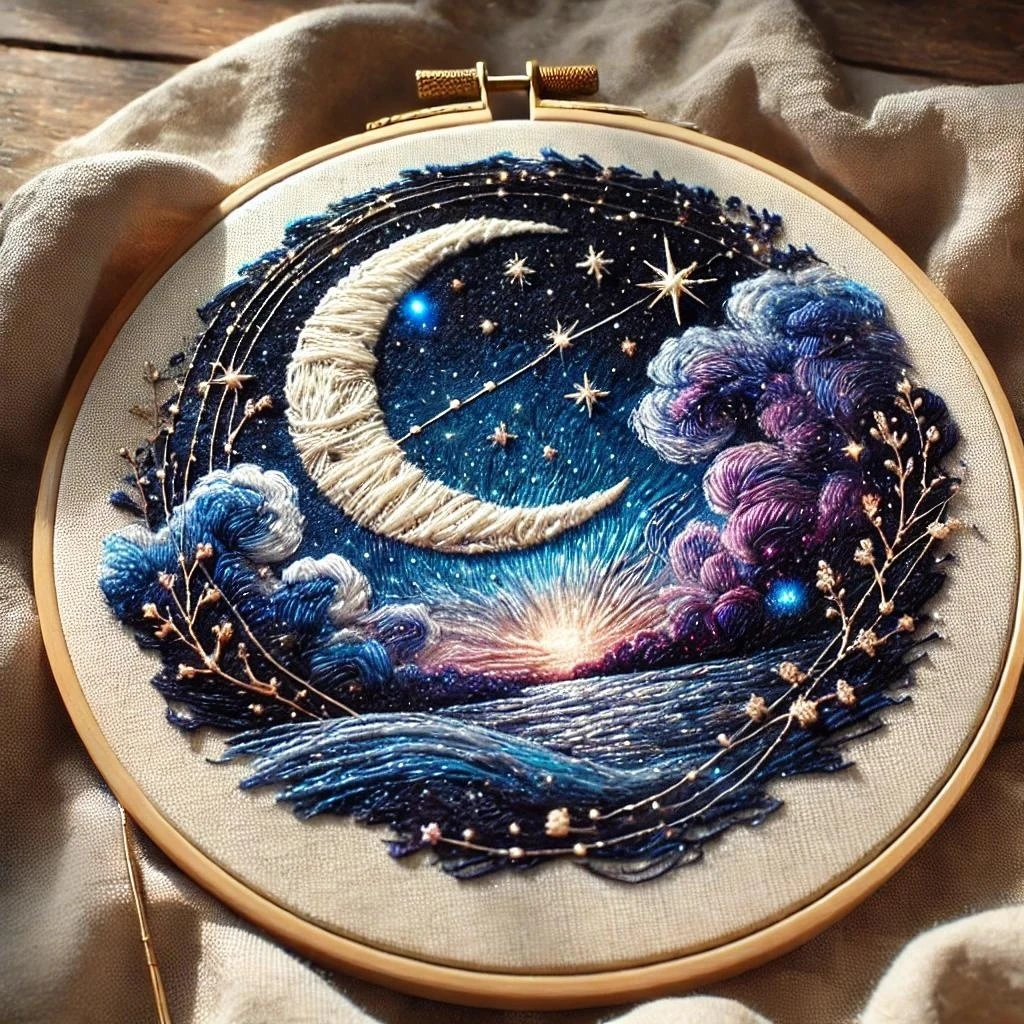

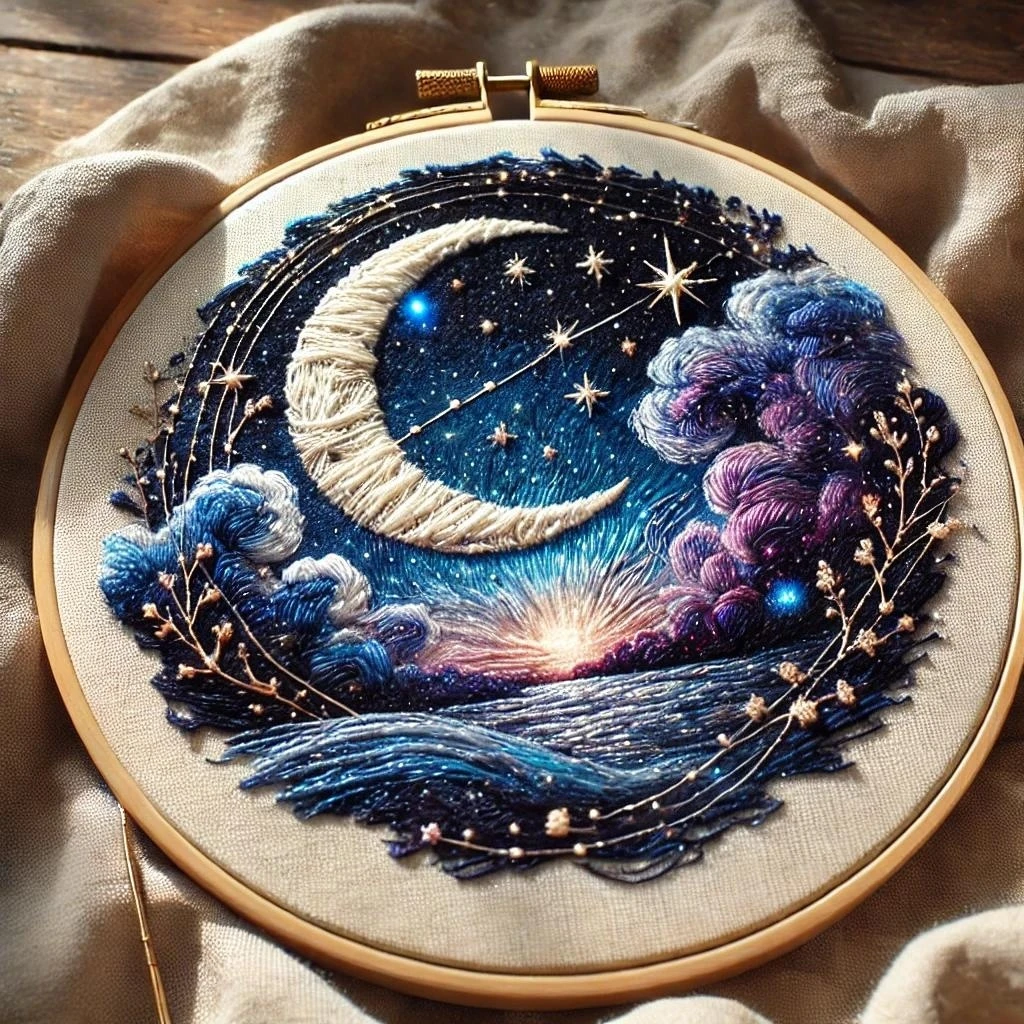
Embroidered Celestial Nightscape
A dreamy celestial landscape with deep navy sky, moonlit lavender clouds, bright stars, golden glints, and cool teal nightscape accents. These DMC matches are estimated from the visible embroidery preview and tuned for a polished hand-stitched finish on dark or blue-toned fabric.
Likely DMC Color Palette
Matched to the midnight sky, moon glow, lavender clouds, scattered constellations, golden stars, teal horizon, and darker landscape texture.
Stitching Suggestions
Layer the nightscape from dark grounding shapes to glowing celestial details, saving the brightest stars and moon highlights for the final pass.
| Element | Stitch Type | Practical Notes |
|---|---|---|
| Night-sky background | Long and short stitch or seed stitch | Use 823, 336, 3838, and 3042 in loose blended areas. Keep the stitching open if the fabric already provides a dark sky ground. |
| Moon or large celestial disc | Padded satin stitch | Pad with 762 first, then satin stitch with 3756 and 3865. Add 415 in tiny curved strokes for crater-like softness. |
| Moon halo | Straight stitch and feathered long stitch | Use 3823, 744, 156, and 3841 in sparse rays around the moon. Keep the halo delicate so it looks luminous rather than outlined. |
| Large starbursts | Star stitch | Anchor the center with 744 or 3852, then radiate one-strand stitches in 3865 and 3756. Vary ray length for a natural nightscape sparkle. |
| Tiny stars | French knots and seed stitch | Use one-wrap knots for distant stars and two-wrap knots for brighter points. Mix 3865, 3756, 744, and 3841. |
| Constellation lines | Backstitch or couching | Place star knots first, then connect selected stars with one strand of 762 or 3841 using very light tension. |
| Comet or falling light | Long straight stitch with tiny couching | Pull 3865 or 3756 in a clean diagonal line, then add 744 near the head for a warm glow. |
| Cloud bands | Split stitch and long-and-short stitch | Shade the underside with 3838 and 415, then add 3042, 156, and 3841 along the upper ridges for moonlit softness. |
| Cloud texture | Detached chain, seed stitch, or loose couching | Add small broken marks rather than solid fill. This keeps the clouds airy and lets the background show through. |
| Mountain silhouettes | Satin stitch or split-stitch rows | Use 939 and 3799 at the deepest base, then add 336 or 415 along ridge edges for subtle moonlight. |
| Distant hills | Stem stitch and straight stitch | Use 926 and 3808 in short horizontal marks. Keep the stitches low-contrast so the sky remains the focal point. |
| Water or horizon glow | Horizontal straight stitch | Blend 3808, 598, 3841, and 156 in short broken lines. Leave gaps to imitate reflected light. |
| Fine outlines | Single-strand backstitch | Use 939 sparingly around mountains or celestial shapes. Thin outlines preserve the dreamy, hand-embroidered look. |
| Final sparkle layer | French knots, seed beads, or metallic accent thread | Optional: add a few beads or metallic stitches only after all floss work is complete, focusing near the moon and brightest stars. |
Thread Count, Blending & Texture
Use strand changes to create a soft sky, dimensional moon, airy clouds, and crisp points of light.
Sky depth
On dark fabric, use sparse 1-strand seed stitches rather than filling the whole sky. On pale fabric, use 2 strands for blended blue-violet coverage.
Moon glow
Blend 3756 and 3865 at the brightest edge, then feather 762 and 415 into shaded areas. Add yellow only where you want a warm halo.
Cloud softness
Use curved long-and-short stitches following each cloud puff. Layer lavender shadows underneath and pale blue-white on the raised ridges.
Star hierarchy
Make only a few stars large. Use mostly tiny French knots, then add several star stitches near the moon to guide the eye.
Horizon blending
Short horizontal stitches in teal and pale aqua create distant glow. Keep them broken so the horizon looks misty rather than striped.
Beginner control
Mark the moon, horizon, and major clouds before stitching. Finish the sky before adding delicate constellation lines so they stay clean.
Recommended Stitching Order
This sequence keeps the smooth gradients underneath and the sparkle details crisp on top.
Helpful Notes for a Polished Finish
Small finishing decisions help the nightscape feel luminous, balanced, and beginner-friendly.
- Use shorter floss lengths for pale threads on dark fabric; white and light blue floss can pick up dark lint quickly.
- Keep constellation backstitches very loose and fine so they do not pucker the sky fabric.
- Do not outline every cloud. Selective shadow lines make the clouds softer and more atmospheric.
- For extra sparkle, add a few metallic stitches or seed beads only near the brightest stars, not across the whole sky.
- Carry threads carefully behind the work so dark threads do not shadow through moon or pale cloud areas.
- Press face-down on a towel after finishing to protect knots, starbursts, and any raised moon padding.