
DMC palette & hand embroidery notes
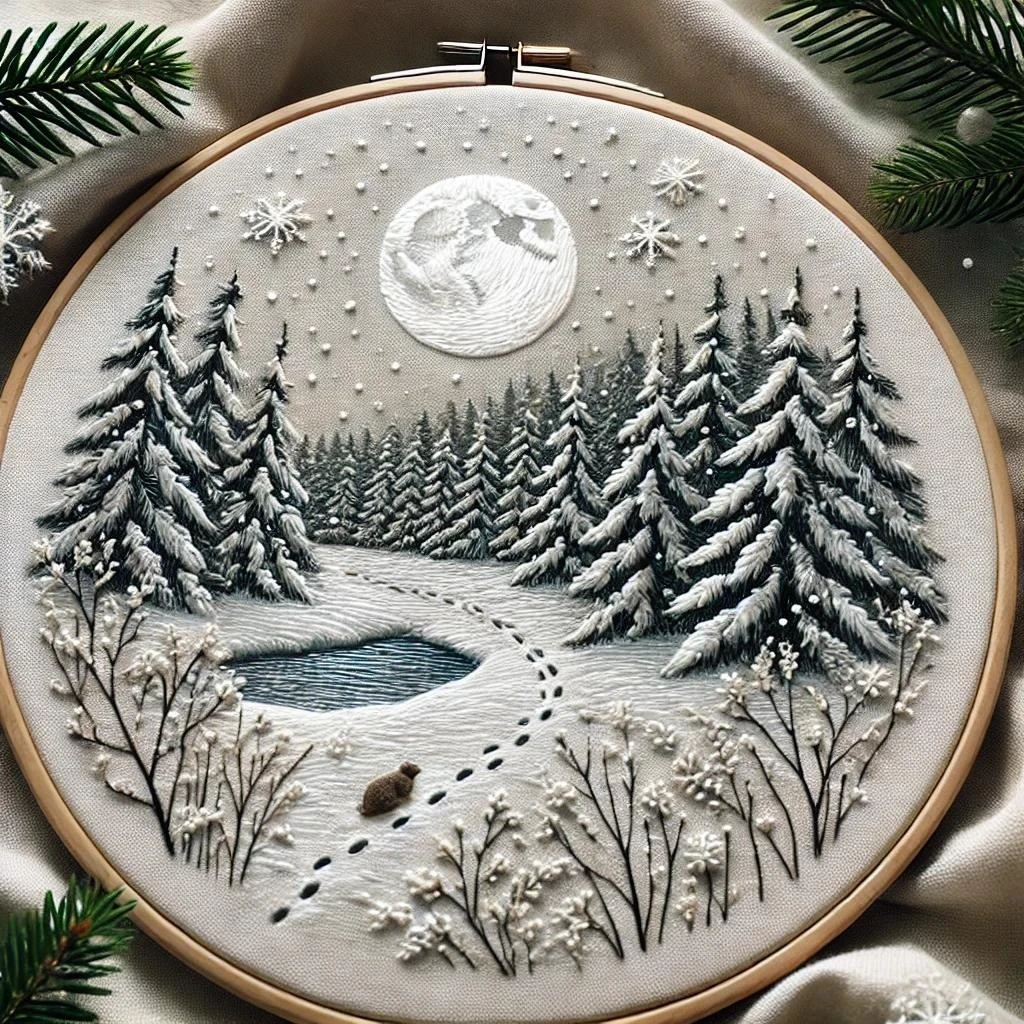
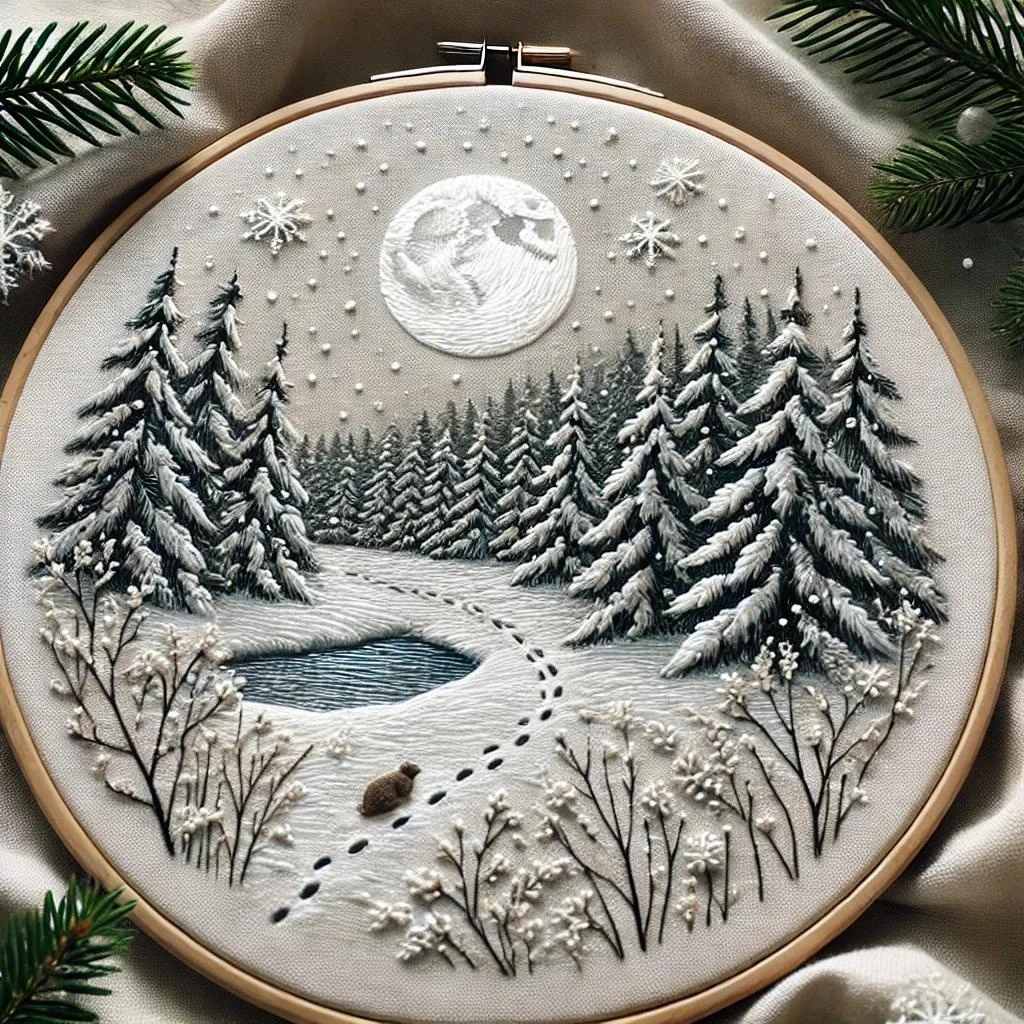
Winter Night Forest
A quiet woodland scene built from deep blue night tones, dark evergreen silhouettes, cool snow shadows, and small moonlit highlights. The best result comes from keeping the background soft while making the nearest trees crisp and velvety.
Design read
A still winter forest at night, with layered trees, snowy ground, and a soft glow that makes the dark shapes feel peaceful rather than heavy.
Midnight navy, slate blue, blue-gray snow, black-green pine, bark brown, and a small warm cream highlight for moon or star accents.
Protect the lightest snow and sky areas, build tree layers from distant to foreground, and save the sharpest branches and star details for the final pass.
Suggested DMC floss palette
This palette gives a complete working range for snowy ground, blue night shadows, evergreen silhouettes, bark, and tiny celestial highlights. Use fewer colors in the smallest areas so the finished hoop remains clean and calm.
Stitch plan by area
| Area | Recommended stitches | Thread count & handling |
|---|---|---|
| Night sky | Long and short stitch, soft seed stitch, and very light horizontal satin shading. | Use 1 strand for smooth gradients. Blend 932 into 931, then add 930 only where the sky needs depth. |
| Snowy ground | Split stitch contour lines, long and short stitch, and tiny straight stitches for sparkle. | Use 1 strand for blue-gray shadows and 2 strands for foreground white highlights. Leave fabric showing for brightest snow. |
| Evergreen trees | Fishbone stitch, stacked fly stitch, straight stitch, and detached chain for bough clusters. | Use 2 strands for main pines, 1 strand for distant trees. Alternate 520, 890, and 924 for natural depth. |
| Bare trunks and branches | Stem stitch, back stitch, split stitch, and tiny couching for long straight trunks. | Use 2 strands for the nearest trunks, 1 strand for fine branch tips. Add 3371 only after the tree shape is complete. |
| Moon, stars, or snowflakes | French knots, colonial knots, single straight stitches, and small cross stitches. | Use 1 strand B5200 or 746. Keep knots small and spaced irregularly so the sky looks natural. |
| Distant forest layers | Seed stitch, tiny vertical straight stitches, and broken running stitch. | Use 1 strand of 932, 931, or 924. Lighter thread and smaller stitches create distance. |
Blending, shading & texture notes
Night-sky blending
- Blend one strand 932 with one strand 931 for a soft blue transition around the glow.
- Use one strand 930 alone in the deepest corners or behind the darkest trees.
- Keep the brightest moonlit area open or stitch it lightly with 3865 and 746.
- Work sky stitches in slightly varied directions so the fill does not look striped.
Evergreen texture
- Start each pine with a central stem stitch spine, then add short angled boughs from top to bottom.
- Use 520 for the main body, 924 for cold shadow, and 890 only under heavy lower branches.
- Add small B5200 or 3865 straight stitches on upper boughs for snow resting on needles.
- Vary branch length: even spacing can make pine trees look like ladders.
Outlining and composition guidance
Outline only the forms that need clarity: foreground trunks, the most important pine silhouettes, and the snowbank edges closest to the viewer. Let distant trees dissolve into broken stitches and soft color changes.
Use 2 strands for dark trunks and evergreen masses. Add a few 3371 accents to anchor the scene.
Use 1 strand for blue-green tree layers and snow shadows. Keep edges broken so the forest feels misty.
Use pale blue-gray thread and open spacing. The farther the trees are, the shorter and lighter the stitches should become.
Beginner-friendly practical tips
- Stitch pale snow and sky glow first, then add mid blues, then evergreens, and finally the darkest branch details.
- Use a sharp needle for single-strand branches; dull needles make tiny tree tips look fuzzy.
- Keep dark floss tails short on the back so they do not show through pale snow areas.
- For stars, make fewer knots than you think you need, then add more only after stepping back.
- When filling sky or snow, use short thread lengths so pale floss stays clean and does not fray.
- If the trees feel too heavy, add a few tiny 3865 snow marks on top of boughs to restore winter light.
Finishing suggestion
Press the finished embroidery face down on a thick towel after it is fully dry. Mount with the tree line centered and the snow smoothed outward from the glow area. A dark wood hoop, charcoal frame, or deep blue mat will emphasize the night mood while keeping the pale snow and stars luminous.