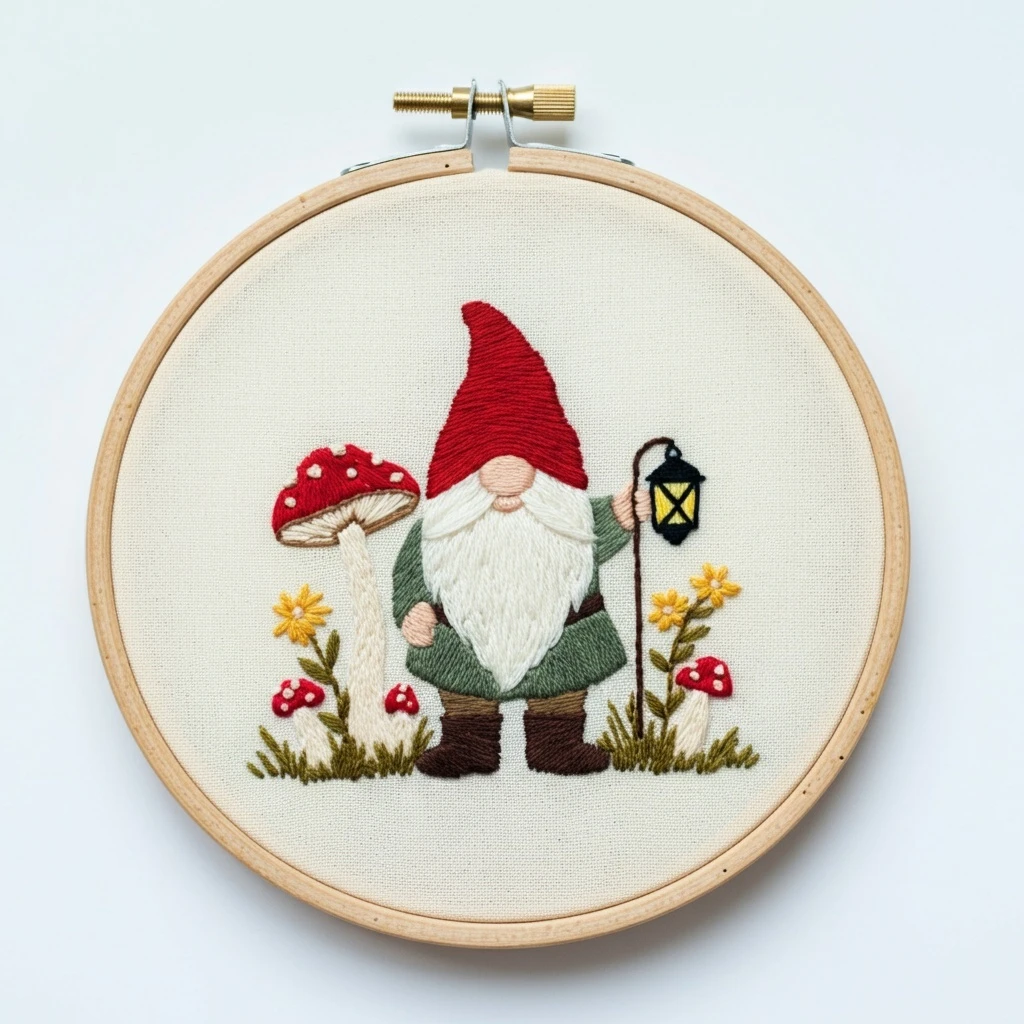

Forest Gnome with Lantern and Mushrooms
A warm woodland embroidery guide built from the visible hoop preview: a red-hatted gnome with a creamy beard, mossy coat, glowing lantern, red spotted mushrooms, golden meadow flowers, and tufted grasses.
Likely DMC Color Palette
Colors are estimated from the visible embroidery preview and matched to close DMC six-strand cotton shades. Coverage is approximate, intended for planning rather than exact thread quantities.
Stitching Suggestions
| Element | Stitch Type | Practical Notes |
|---|---|---|
| Pointed red hat | Long and short stitch | Follow the curve of the hat from brim to tip. Blend 321 with 815 in lower folds and keep the top edge smooth. |
| Gnome beard | Split stitch base + long straight stitches | Lay the beard in downward strokes using 822 first, then add 3865 highlights on top for fluffy texture. |
| Nose and hands | Satin stitch | Use 1-2 strands and keep stitches rounded. A tiny 3778 or 758 shadow beneath the nose gives dimension. |
| Green coat | Long and short stitch or satin stitch | Angle stitches toward the center opening. Use darker pine at side seams and sleeves. |
| Boots and belt | Satin stitch with backstitch | Fill with brown, then outline with 3371 so the feet and belt remain crisp against the grass. |
| Lantern | Backstitch, satin stitch, straight stitch | Work the black frame last. Fill the glass with 725 and a touch of 3865 near the center for glow. |
| Mushroom caps | Satin stitch + French knots | Stitch red caps smoothly, then add white dots as French knots or tiny satin circles. |
| Wildflowers | Lazy daisy and French knots | Use six to eight lazy-daisy petals around a topaz knot. Vary petal length for a natural meadow look. |
| Grass tufts | Straight stitch and stem stitch | Mix 3052, 3362, and coffee brown. Make stitches uneven and angled so the ground feels organic. |
Thread Count & Blending
Outlining Details
Backstitch the hat brim, sleeves, belt, boots, staff, and mushroom undersides after the fills are finished. Use DMC 3371 for warm dark outlines and reserve DMC 310 for the lantern frame only, so the design stays soft rather than cartoon-heavy.
Texture Ideas
Let the beard be the most textured area: stagger long stitches and slightly overlap them. Keep the hat smoother, the coat softly directional, and the meadow lively with scattered straight stitches and raised knots.
Shading Guidance
Place shadows where objects overlap: under the hat brim, beneath the beard, at the coat sides, under mushroom caps, and below the boots. Add highlights to the lantern center, beard tip, nose top, and red cap spots.
Where to Start
Start with the gnome body because it anchors the scene: coat, boots, hands, then the large red hat. Work the beard after the face so the white strands can overlap naturally. Add the mushrooms and flowers next, stitch the grass tufts around the feet, and save the lantern frame, white mushroom spots, French knots, and crisp outlines for the final pass.
Beginner-Friendly Practical Tips
- Keep the fabric drum-tight so satin stitches on the hat and coat do not wrinkle.
- Use shorter satin stitches on curved edges; long satin stitches can snag on small hoop art.
- Stitch mushroom spots after the red cap has settled, not before.
- For French knots, hold the working thread taut until the needle is almost through the fabric.
- Step back often: the lantern and hat need strong contrast, while the beard should stay soft.
Finishing Notes
The charm of this design comes from contrast: a velvety red hat, a fluffy pale beard, warm lamp light, crisp dark lantern lines, and loose meadow texture. Use neat fills for the character and more relaxed, varied stitches in the grass so the woodland setting feels hand-grown and magical.
Encouraging Finish
Build the design from large shapes to tiny accents, and do not rush the last details. A few carefully placed highlights on the beard, lantern, mushroom spots, and flowers will make this little forest gnome feel bright, cozy, and dimensional inside the hoop.