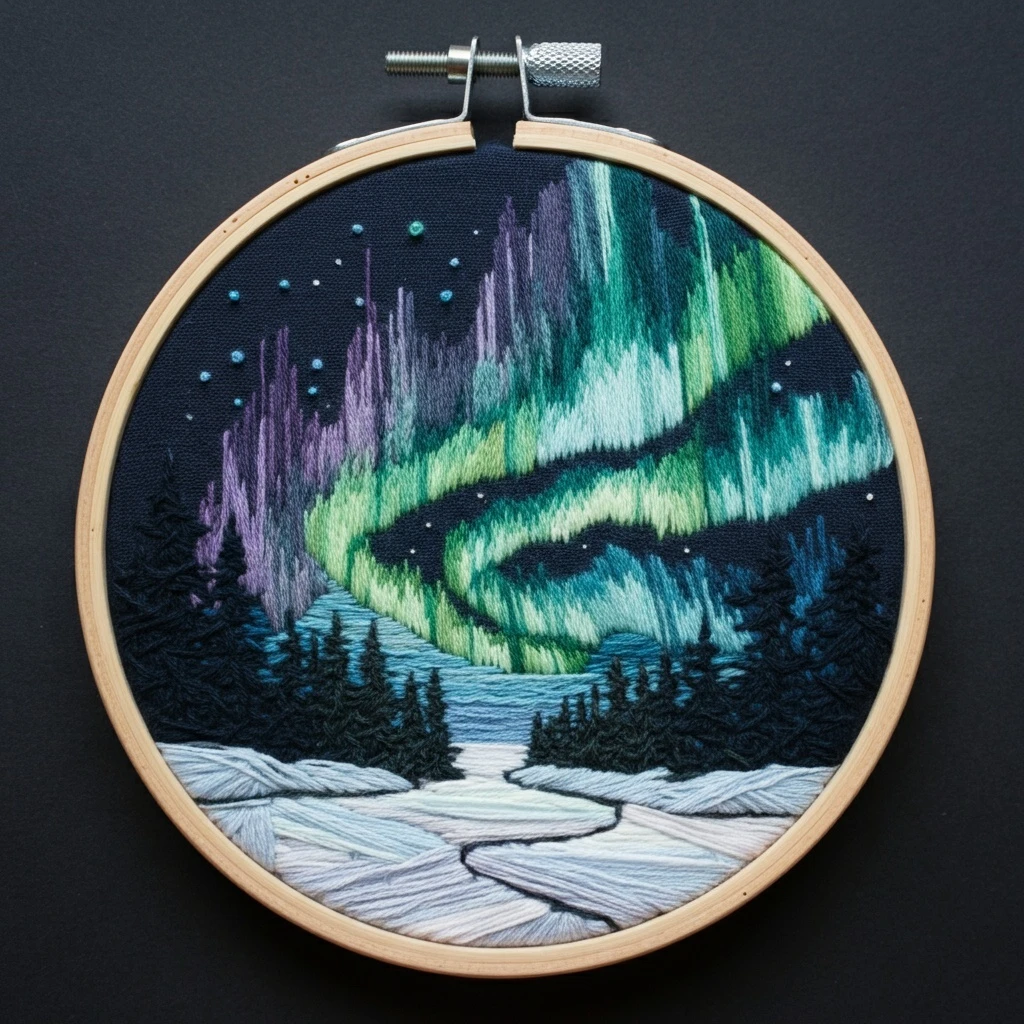

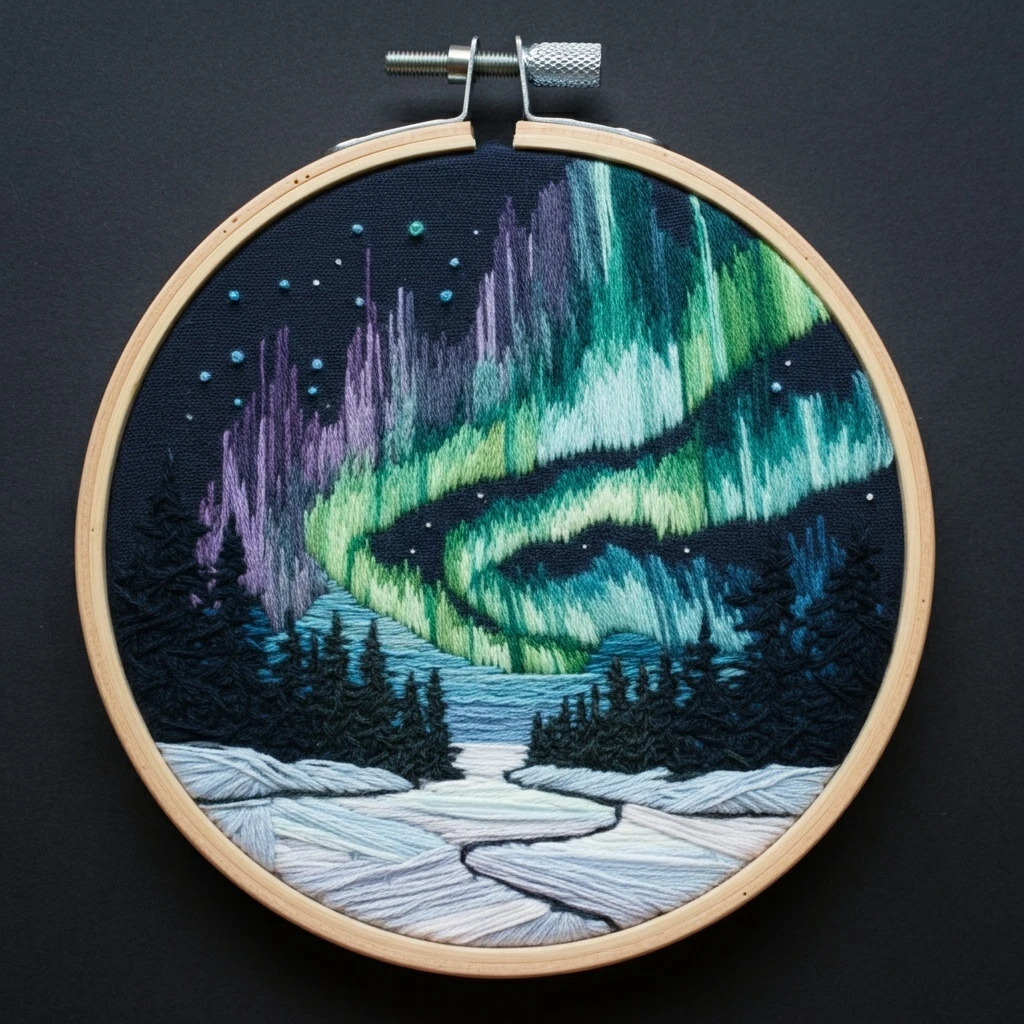
Aurora Borealis Winter Landscape
A luminous embroidery plan for a night-sky hoop with sweeping green and aqua aurora ribbons, violet light pillars, dark evergreen silhouettes, icy snowdrifts, and a winding frozen stream. The goal is soft movement in the sky, crisp contrast in the treeline, and satin-cool texture across the snow.
Design Read
The image is built from strong value contrast: a nearly black winter sky and pine forest set against luminous aurora strokes and pale snow. Keep the background restrained so the light bands feel radiant.
Aurora movement
Long vertical and diagonal strokes form feathery curtains. Let stitches vary in length and direction so the green, mint, aqua, and teal blend like soft light rather than flat stripes.
Forest silhouettes
The evergreen line is almost black with blue-green highlights. Use dense branch strokes and occasional brighter tips, keeping tree shapes irregular and natural.
Snow & frozen stream
The foreground uses pale blue-gray shading with dark cracks and curved banks. Directional satin and long-and-short stitches create drift contours and icy reflection.
Core DMC Color Palette
Use these DMC cotton floss colors as the main palette. The selections prioritize luminous aurora colors, cool snow shadows, and deep winter contrast.
Stitch Map by Design Area
| Area | Recommended stitches | Thread count | How to work it |
|---|---|---|---|
| Aurora curtains | Long-and-short stitch, vertical satin flicks, split stitch under-guides | 1–2 strands | Start with darker teal/violet columns, then layer mint and pale aqua over the top. Keep many strokes uneven and tapered. |
| Bright aurora ribbons | Long satin stitch, couching for sweeping curves | 2 strands; 1 strand for top glow | Follow the arc of the light band. Blend 913 + 955, then add 3849 or 747 in broken highlight strokes near the center. |
| Night sky | Open background fabric, tiny seed stitches, French knots | 1 strand | Let dark fabric do most of the work. Add scattered 747/B5200 stars and a few 3846 turquoise knots around the upper sky. |
| Pine trees | Fishbone-style branch strokes, straight stitch, detached fly stitch | 2 strands for large trees; 1 strand for distant trees | Use 939 and 500 as the base. Add tiny 3808 or 3846 strokes on aurora-facing branches only. |
| Frozen stream | Directional satin stitch, stem stitch ripples, split stitch bank lines | 1–2 strands | Stitch horizontally and diagonally following the water path. Use 775, 747, and small 3846 reflections for cold shimmer. |
| Snowdrifts | Long-and-short stitch, laid stitches, split stitch contour lines | 1 strand for shading; 2 strands for foreground | Use pale blue-grays sparingly. Leave some fabric or B5200 space open to avoid overworking the snow. |
| Cracks and outlines | Backstitch, whipped backstitch, split stitch | 1 strand | Use 939 for sharp ice cracks and deepest bank separations. Whip with 775 where a softer snowy edge is needed. |
Blending & Shading Plan
The magic of this design comes from controlled color transitions. Work the sky before the foreground, and keep the brightest colors as the final layer.
Aurora blends
- Deep teal base: 500 + 3808 for shadowed folds.
- Blue-green light: 3808 + 3846 for saturated turquoise.
- Mint glow: 913 + 955 for soft green ribbons.
- Ice flare: 3849 + 747 for the brightest vertical streaks.
- Violet haze: 333 + 340, softened with a few 3747 or 211 stitches if desired.
Snow & water blends
- Use 775 and 747 for cool snow shadows, then add B5200 only to the crispest ridges.
- For the stream, mix 747 + 3846 in single-strand broken stitches to echo aurora reflection.
- Shade beneath trees with 939 lightly feathered into 775 so the forest feels grounded.
- Keep foreground stitches longer and more directional than distant snow to create depth.
Outlining, Texture & Finishing Details
Outlines
Use a single strand of 939 for the strongest tree trunks, ice cracks, and foreground separations. Avoid outlining the full aurora; it should dissolve softly into the sky.
Stars
Use tiny straight stitches, colonial knots, or French knots in B5200 and 747. Vary the size so the sky feels natural. A few 3846 knots can suggest colored light.
Tree texture
Build branches from trunk outward with staggered diagonal strokes. Let some dark fabric show between branches for a lace-like silhouette.
Aurora texture
For vertical light columns, stitch upward and downward from the ribbon edge using uneven lengths. Overlap colors but do not completely fill every gap.
Snow texture
Angle stitches along the slopes of the drifts. Use split stitch lines to guide the drift shapes before filling with satin or long-and-short stitches.
Hoop presentation
A natural wood hoop complements the cold palette. Steam gently from the back and lace the fabric tight so satin snow areas stay smooth.
Practical Embroidery Tips
Order of stitching
- Transfer the horizon, stream, main aurora bands, and treeline only.
- Stitch distant aurora shadows first, then the brightest ribbons.
- Add the forest silhouette over the lower sky edge.
- Work the frozen stream and snowdrifts from back to front.
- Finish with stars, ice cracks, and final highlight stitches.
Needle & tension notes
- Use a sharp embroidery needle, size 7–9, for clean directional stitches.
- Keep tension relaxed in long satin areas to prevent puckering.
- Shorten stitches near the hoop edge and where the aurora changes direction.
- Use fewer strands in the distance and more strands in foreground snow for scale.
- Test Light Effects or metallic filament on scrap fabric before adding it to the hoop.